 MPI für Radioastronomie
Three weeks ago, the scientific journal Nature @nature reported the discovery of the most energetic #neutrino ever observed. Its energy is 16,000 times greater than the strongest particle collisions created by the Large Hadron Collider and corresponds to 30 times the energy needed to press a computer key.
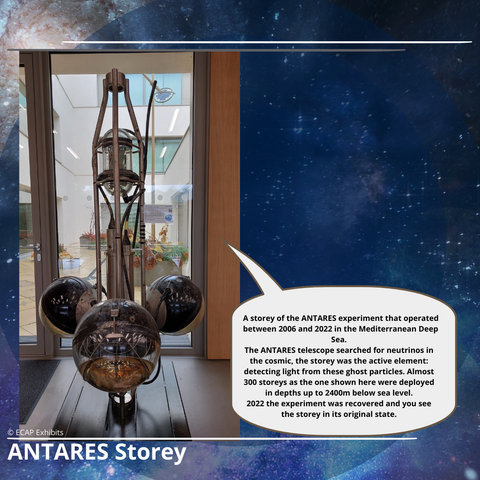
The neutrino was discovered in an underwater observatory in the Mediterranean, one of three neutrino detectors in water - two in the Mediterranean and one at Lake Baikal. At the geographic South Pole, there is the #IceCube neutrino detector under the ice. Other detectors exist underground in China, Italy, and Japan.
All these #detectors are not located on the Earth's surface because the Earth itself acts like a #telescope for neutrinos. Neutrinos are extremely light, electrically neutral particles that interact very weakly with matter and pass through the Earth. When they collide with atomic nuclei, charged particles are produced that move faster than light in water or ice, emitting blue light that is captured.
Water and ice are ideal media for detecting neutrinos because they provide large volumes to detect these particles while shielding against cosmic radiation and other disturbances. IceCube even utilizes 1 cubic kilometer of ice.
Neutrinos are the second most abundant particles in the universe, after photons, but are difficult to study because they interact so little with matter. Interestingly, dark matter and dark energy, which make up 95% of the universe, also interact very weakly with normal matter, while the remaining 5% consists of elements like #hydrogen and #helium, of which only 0.5% is visible matter (such as #stars).
 Tip
Tip