 Sjmarf
fuck_around/find_out
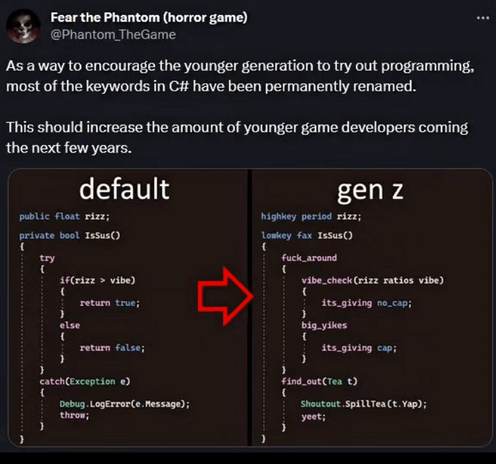
fuck_around/find_out
A perfectly reasonable language. None of this Gen Z rubbish.
Something something better times. Shakes stick at sky.
My 21 year old is pretty into rust and html. Does that count?
I’m pretty ignorant on most of it. In my youth, I just dabbled trying to lean basic on a c64 and AMOS on the Amiga though, so maybe not lol
For some reason, this just sparked an ancient memory of the Geek Code, which was a sort of signature block you could append to your emails and online bios to show off how much of a geek you were in the geekiest fashion possible.
Goddamn I’m old.
Remember it spawning a bunch of copycats? For a while every community had their own code block. I wrote one for a usenet group i was in at the time.
alt.sysadmin and alt.sysadmin.recovery both had em iirc…
yeet instead of return…
For programmers who need action (cross-generational):
It’s a method definition. C#'s standard formatting puts the left bracket brace of the method body on a new line. It’s equivalent to:
private bool IsSus(){ ... }No, this is what they win:
yeet keyword, I’m really friggin’ diggin’ this. [modernisation required]
The whole thing was pretty damn good all the way through. The only thing that had me wondering was
TeaUntil it got to
SpillTeaWell played.
Yeah, I love that one.
“Try” is too hopeful. “fuck_around” makes it clear that you know what you’re doing is dangerous but you’re going to do it anyhow. I know that in some languages wrapping a lot of code in exception blocks is the norm, but I don’t like that. I think it should be something you only use rarely, and when you do it’s because you know you’re doing something that’s not safe in some way.
“Catch” has never satisfied me. I mean, I know what it does, but it doesn’t seem to relate to “try”. Really, if “try” doesn’t succeed, the corresponding block should be “fail”. But, then you’d have the confusion of a block named “fail”, which isn’t ideal. But “find_out” pairs perfectly with “fuck_around” and makes it clear that if you got there it’s because something went wrong.
I also like “yeet”. Partly it’s fun for comedic value. But, it’s also good because “throw” feels like a casual game of catch in the park. “Yeet” feels more like it’s out of control, if you hit a “throw” your code isn’t carefully handing off its state, it’s hitting the eject button and hoping for the best. You hope there’s an exception handler higher up the stack that will do the right thing, but it also might just bubble all the way up to the top and spit out a nasty exception for the user.
I visualized “try” as watching a young child climb something that might be out of their comfort zone, so you’re letting them, but stay ready to “catch” them if something goes wrong. I suppose “throw” would be if they soiled themselves in their fall, you can throw them back into the arms of their loving parent for cleaning.
But fuck_around, find_out and yeet would be fantastic.
ratios I need this and I’m an elder millenial
Haven’t published it yet.
Here are comparisons:
⚖️
🐲
🐲⚖️
⚖️🐲
🚫🐲⚖️
Post the GitHub repo.
I will help you make this happen.
Sure! It doesn’t do anything yet, I just have a text file with how I’m intending to architect it.
It quite literally started two days ago.
I’ll configure a repo, stick this in a file, and push it. I’ll reply with another comment so you (and others) can look it up.
I’ve come up with some crazy stuff. Instead of something like “class” to indicate a class, it’s
🏫 Followed by the emoji name of the class like 🖼️📁. So it will need to be able to handle operators in the name it’s amazingly gross! Properties and methods will also be emoji names, like to get the 🖼️📁 “File Name” it would be 📁💳.
C# is basically Java and from what I can tell, this looks approximately valid.
Variables can always* be named freely to your liking.
*You used to have to stick to the Latin alphabet, but that’s increasingly not the case anymore. Emoji-named variables FTW!
No it’s not “basically Java”
Aside from how Microsoft stole it, fucked the standard library, fucked the naming conventions, etc. You would never just “throw” without specifying what you were throwing.
To be honest I’m just playing into the meme of Java.
My understanding is it’s academically great, but a pain in practice.
For reference we use C# .Net, Entity Framework with GraphQL and React TypeScript for our enterprise applications and I really like C# now, but when I first started I’d only really used Node.js and some Java.
I started my career in Java and transitioned to c# a few years in and c# is much better imo, especially now that .Net can be run in Linux.
I run a team for a large project (13 deployable components apis/ Windows services/ desktop applications/ websites/mobile) that has mix of vb.net/c# .net framework 4.8 and .net 6 soon to be 8 with angular for Web and wpf for desktop. Slowly but surely working to kill off our legacy code and consolidate.
Some of the older vb code (that existed long before I joined the project let alone became the lead dev) is so bad that a bug fix for nhibernate that stopped silently failing and began throwing exceptions breaks everything if we try to update to a later version. it’s such a tangled mess and I’m probably the only one on my team that could unfuck it(but I didn’t have the time to do it) it’s not even worth fixing even though our version of nhibernate has a CVE with rating of 9/10 (we don’t actually use anything that is affected from the finding thankfully) and are just biding our time till we kill off the offending apps.

 brokenlcd
 The Ramen Dutchman
 RVGamer06
 SubArcticTundra
 Demigodrick
 EntirelyUnlovable
 agentshags
 cobysev
 rbos
rbos AnUnusualRelic
 𝒎𝒂𝒏𝒊𝒆𝒍
 Bizzle
 darkdemize
 Dyskolos
 noughtnaut
 jballs
 Match!!
 merc
merc Psaldorn
 peoplebeproblems