LGBTQIA+ As we resist those who claim diversity distorts scholarship, let’s run through the acronym & show how easy it is to find the rainbow in every era. We don’t even need to look beyond the Renaissance celebrities that are household names today!

(Countdown to Inventing the Renaissance) 1/?
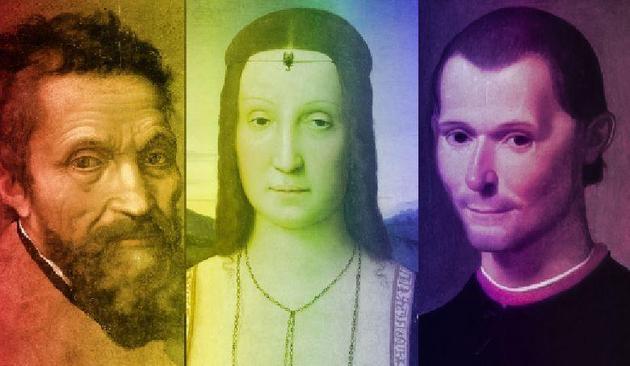
LESBIAN
Lucrezia Borgia’s last husband Alfonso d’Este appears in a lot of big budget historical dramas about the period; I introduced him last week parading around Ferrara buck naked with his dick in his hand, & his sister Beatrice was part of Milan’s ruling polycule with Ludovico Visconti Sforza & Galeazzo Sanseverino. 2/? https://www.exurbe.com/galahad-sanseverino-milans-sovereign-polycule-threesome/
Galeazzo Sanseverino & Milan’s Sovereign Polycule-Threesome – Ex Urbe

What such dramas usually leave out is mentioning Alfonso’s first wife Anna Visconti Sforza (sister of Duke Ludovico) who, documents tell us, preferentially wore men’s clothes, preferred exclusively female company, and slept with a female lover in her bed every night. 3/?
GAY
2 out of 4Ninja Turtles here: Michelangelo whose passionate relationships w/ men and lack of interest in women are much discussed in letters & poems, & Donatello whose relationship w/ Brunelleschi was so public all Florence erupted in gossip the time it looked like they might break up 4/?
And while one must be very cautious about looking at an artist’s work (so many bad histories have done it badly) Donatello made the first nude sculpture produced since Antiquity, and it wasn’t a sexy Venus, it was a *way sexier* David. 5/?
Pausing a sec: modern identity labels (gay, trans) didn’t exist in the 1400s so we don’t know what labels these people would’ve chosen if offered our feast of terms & concepts; likely they would’ve tried out many. We must take great care not to project modern ideas on history too much, but… 6/?

…as long as I keep getting undergrads in my classroom whose educations-so-far left them with the impression homosexuality didn’t exist between Socrates and Oscar Wilde (sigh) we need to do better to show all these identities have histories.

So back to the Renaissance LGBTQIA+ countdown! 7/?

BISEXUAL
A feast of options here since men having lovers of both sexes was super common, but Machiavelli is as big as a name gets. He wrote erotic poetry to male beloveds in his teens, his letters talk freely of male & female lovers, and he give hetero- and homosexual sex advice to friends. 8/?
TRANSGENDER
Enjoy this portrait of the incomparable Lucrezia Borgia in male dress! Complete with sword! A very striking and deliberate choice for someone who wielded such complexly gendered power, but during her family's wars she took on male kinds of power too, like governing Spoleto. 9/?
TANGENT: there are SO MANY GREAT NEW BOOKS treating transgender and radical gender in the Renaissance! See:
Gordon “Glorious Bodies"
Manion “Female Husbands”
Goldberg “Queering the Renaissance"
Murray & Terpstra “Sex Gender & Sexuality in the Renaissance”
so many! 9.5/?
QUEER
It's neat thinking about who in the Renaissance would’ve liked the project to embrace & subvert the pejorative sense of “Queer” & turn it into an identity celebrating the breadth of sexualities & being outside a narrow mainstream? My pick isn’t a household name now but was in the period 10/?
Floriano Dolfo (c. 1445-1506) One of the top law professors & theologians of his day, faculty star at U Bologna, also disabled so for most of his life he worked, taught, & lived in a single room. In leisure time he wrote over-the-top fantastical porn, describing wonderlands of huge dicks etc… 11/?
…sending much of it to his friend & patron Francesco Gonazaga Marquess of Mantua (Isabella d’Este’s husband). Dolfo wrote to Gonzaga he took great pride in what he himself called his perversion, especially in liking *only* men w/o interest in women, so I think he would’ve loved the label queer. 12/?
INTERSEX
There’s great scholarship on period ideas of the hermaphrodite & its entanglement w/ medical concepts of monstrosity, but I like to also recognize figures whose bodies didn’t conform to rigid period ideas of sex in ways that shaped their (inescapably gendered) careers. Two examples 13/?
Jeanne de Valois was a daughter of Louis XI of France. Something about her body meant one could tell in childhood *by inspecting her genitalia* that she couldn’t bear children. Her father used this, marrying her to his cousin the Duke d’Orleans to prevent the Orleans branch from having an heir 14/?
When Jeanne’s brother Charles VIII died w/o an heir & her husband became king, he demanded an annulment so he could marry Charles's widow Anne of Brittany. The pope sent Cesare Borgia all the way from Rome to inspect Jeanne's body to confirm; an atypical a body that literally shaped a kingdom 15/?
2nd example: after a string of daughters, Battista Sforza, wife of the mercenary Federico da Montefeltro, died bearing their son Guidobaldo, who became their heir. When dad died on campaign, Guidobaldo took over commanding his military league at age *11*. He married Elizabetta Gonzaga, but 16/?
…no kids. When people to pressured Guidobaldo to divorce Elizabetta & remarry, he shocked Europe w/ an announcement no one thought a prince would dare make: It’s not her, it’s me, I’m impotent, shut up, & if anyone wants to question my manhood over it, my armies are right here, so bring it. 17/?
Most men of the period went to HUGE lengths to hide emasculating characteristics, & perceived unmanliness could shatter power & careers. The pope even pressured Guidobaldo to renounce his duchy & military career to become a churchman, a fitter path for one seen as not-quite-fully-male. No Way! 18/?
ASEXUAL
After Guidobaldo’s announcement, Elizabetta was pressured to leave *him*, of course, but insisted she was very happy in her sexless marriage thank-you-very-much, & the pair remained one of the most celebrated of all Renaissance couples, immortalized in Castiglione’s Book of the Courtier 19/?
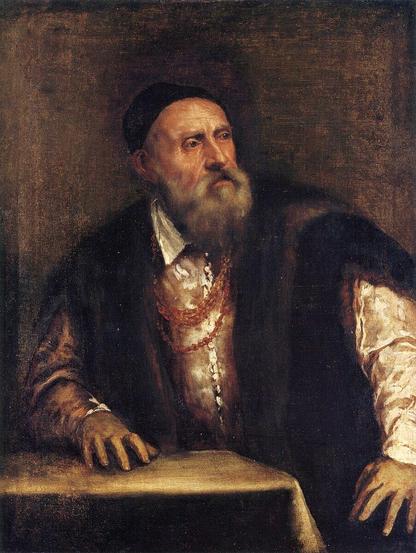
As for PLUS it’s useful to remind ourselves that sexual ideas of “normal” change w/ history too, so let’s finish w/ Titian, whose friends remarked on what they saw as his (for the time) weird & unexpected *heterosexual monogamy* in an age that expected famous men to move through serial lovers 20/?
@adapalmer Not Leonardo? We just watched the Ken Burns documentary and it seemed reasonably clear that he was gay too.
@overholt Just had exactly this conversation on Bluesky. Leonardo definitely had a homosexual relationship, but letters written by friends & contacts over many years (a much longer period than that relationship) comment repeatedly on Leonardo's conspicuous and strange-to-them lack of interest in sex & romance in general, and in both men and women, making L seem to me more like an asexual/aromantic who, like many Ace/Aro people, tried a relationship but mostly was more A than the G in LGBTQIA+
@overholt Leonardo's sexuality is a good example of how asexuality is often one of the most consistently erased identities, especially when we're looking at a society which had such an obsession with celibacy, making it hard to tell what's political/religious/morals/career-enabling celibacy and what's an asexual person. That erasure is why I try to take it extra seriously when a historical figure's friends say "Dude, why aren't you having sex much?" the way Leonardo's friends did.

@overholt So in general while Leonardo is definitely in the LGBTQIA+ community, I think it's valuable to differentiate Michelangelo & Donatello who were passionate gay men with long & plural relationships, from Leonardo who 100% did have a gay relationship but mostly preferred life w/o romance.

We can then complete our turtles with Raphael who, like Titian, was devoted to one female lover to the degree that friends found his voluntary monogamy with Margherita Luti bizarre.

@adapalmer I was a diversity student and was at the top of my class. Many kids are lazy and don't study hard, so that's bullshit.