#BabelOfCode 2024
Week 4
Language: FORTRAN

Confidence level: High

PREV WEEK: https://mastodon.social/@mcc/113867584791780280
NEXT WEEK: https://mastodon.social/@mcc/113975448813565537
RULES: https://mastodon.social/@mcc/113676228091546556

I was very excited about doing TCL this week, but I told myself the first time I get a two-dimensional array problem I'd go FORTRAN, so I guess this week is FORTRAN.

A friend of mine who did AOC2024 in December noted the early challenges this year were *very* easy. Today's definitely is. I wonder if part 2 will have any depth.

I went into this thinking: C is basically cleaned up FORTRAN, right? I know C? This should be easy, right? Right off the bat I find there will be a lot of difficulties entirely not of the kind I'm used to in programming. After a brief adventure with accidentally naming my file .f and not .f90 causing horrific and baffling errors, I run a hello world off the Internet. There's a space before the printout. Hm, how do I turn that off?

https://stackoverflow.com/a/31236043

Oh my fuck, *what*?

How to get rid of unwanted spacing in Fortran's print output?

It may look like a trivial issue, but I couldn't find any answer through googling. I have this little program : Program Test_spacing_print Integer:: N Real:: A,B N=4; A=1.0; B=100.0 prin...

Stack Overflow

I get frustrated with C all the time for being fundamentally a 70s language. It may be I'm about to learn the pain of using a *50s language*.

(Alternately, I hear modern FORTRAN has all kinds of fancy niceties like operator overloading and might not resemble traditional FORTRAN all that much. But then I have the problem if I pick up a random tutorial it's hard to guess which *decade's* standard it's teaching me from, or if it's the GNU extension, if the GNU extension is that different, etc.)

Just learned FORTRAN has an aint() function

Don't that just beat all

I am getting a weird floaty feeling from FORTRAN. I do not at any point really understand what I'm doing, but I am having little to no problems having any one particular thing. I keep doing google searches and getting which I do not understand the syntax of ( `write(error_unit, *) "String to write"`— wait, what? but which work. I do not know if I'd be able to get anywhere with this language if I didn't have either a more experienced programmer or Google+Stack Overfow.

Here is my current program. At the moment, all it does is take a command line argument (a path) and attempt to open the specified file. I build it with `gfortran src/puzzle.f90 -std=f2023 -o program`

https://github.com/mcclure/aoc2024/blob/822e460f81b944c21ca675303b868c45b22a4c2b/04-01-wordsearch/src/puzzle.f90

I'm having two problems, one serious, one unserious.

The unserious problem: I want to abort if the # of arguments is bad. If I do "error stop", it prints a backtrace, which I didn't ask for. If I do "call abort", gfortran fails to link ("undefined reference to 'abort_').

aoc2024/04-01-wordsearch/src/puzzle.f90 at 822e460f81b944c21ca675303b868c45b22a4c2b · mcclure/aoc2024

Advent of Code 2024 challenge (laid-back/"babel" version) - mcclure/aoc2024

GitHub

Here's my serious FORTRAN problem (code link in previous post):

The recommended GET_COMMAND_ARGUMENT function seems to assume you know the length of the argument ahead of time. Obviously, I don't.

https://gcc.gnu.org/onlinedocs/gfortran/GET_005fCOMMAND_005fARGUMENT.html

It allows me to pass in an `allocatable` string, but I believe it is leaving that string of length 0 if I do not ALLOCATE() it, and the fetched string is ''. Is there a way to get the length of a command-line argument before GET-ing it?

I see GET_COMMAND, but that's… awkward

GET_COMMAND_ARGUMENT (The GNU Fortran Compiler)

GET_COMMAND_ARGUMENT (The GNU Fortran Compiler)

…hm. I am concerned.

According to the FORTRAN working group

https://wg5-fortran.org/N2201-N2250/N2212.pdf

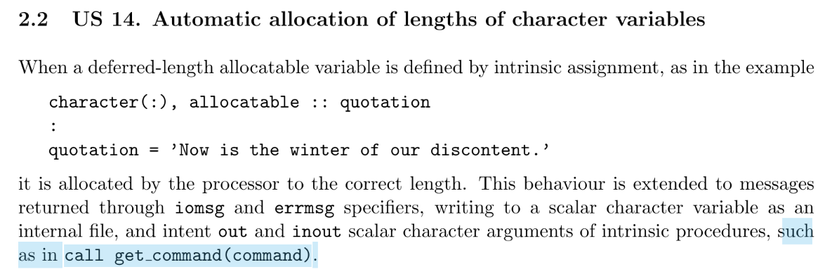
As of the 2023 standard, an un-allocated deferred-length variable may have its length set by calling intrinsic procedures; they give GET_COMMAND as an example specifically, and StackOverflow users assert GET_COMMAND_ARGUMENT is also included.

I don't get this behavior. My argument is being input as ''.

Do you think this means my code (linked above) is wrong, or that gfortran -std=f2023 is nonconformant?

@mcc how do you mean ". ? the shell won't let you enter it.
You'd have to quote it as '".' Using the example proggy from the manual for GET_COMMAND_ARGUMENT gives you then

$ ./a.out 333 '".'
./a.out
333
".

@dimpase The argument is a nonempty sequence of characters, but is being read in as the empty string. I say '' in my post because I don't know how else to represent a string of zero length in text.
@mcc Fortranically speaking, every NULL and empty string (wat? without a terminating character, or with?) are sins, committed by C-minded ppl...
@dimpase I am aware of nothing to suggest a zero-length string is something FORTRAN considers invalid.

@mcc in old fortrans an empty string still had length 1.
Something like

CHARACTER FOO[1]

can hold a zero-length string.

Fortran 77;
----
There are no null (zero-length) character-string variables. A one-byte character string assigned a null constant has the length zero.
---

I'd be surprised if this has changed.