 James Allison
Viejo period structures were found by Charles DiPeso under the large Medio period site of Paquimé, but not well described in reports. Archives contain much more information.
Places gain historical gravity from the accumulation of events and memories. Ancestral worship was important to Vasas Grandes culture: dna evidence shows genetic continuity across the Viejo to Medio periid transition, and Medio period people maintained ties to earlier places that had historical gravity.
Now a prerecorded talk by Meradeth Snow on dna evidence and integrating bioarchaeology with other archaeological data.
One big archaeological question is whether the dramatic changes that marked the Medio period were caused by large scale migrants who came in and built the city of Paquimé.
Comparing mirochondrial dna from the Viejo period Convento Site and Paquimé shows there is no real change in dna profiles. Nuclear dna shows the same thing.
The next talk is Christopher Schwartz on Scarlet Macaws and Paquimé, and how they relate to hroader historical trajectories in souwesrern North America. Large number of macaws were bred at Paquimé, although their natural range is far to the south. Isotope data shows most of the birds were raised locally and hand-fed maize.
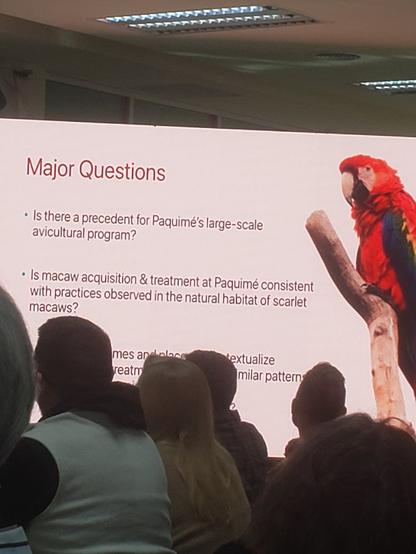
Birds and feathers have been found in many locations in northern Mexico and thensouthwestern US. Color symbolism is important, birds also valued because of their ability to imitate human speech.
In the US, strontium isotopes show birds were raised in Chaco Canyon, the Flagstaff area, and the Mimbres area. But narrow range of genetic variation shows the birds in the north came from a restricted population, probably descended from birds raised at Paquimé.
(missed one talk) Now Jaron Davidson is talking about what came after Paquimé's demise at about AD 1450. Little archaeological evidence for what happened between then and the time Spanish established a permanent presence in the 1600s.
Now Nora Rodriguez Zariñán is speaking about turkeys, and the cosmological duality involving turkeys and macaws.
Turkey raised for feathers and food throughout the region. Their bones are also used for musicalninstruments. But sometimes articulated burials of turkeys are found, probably sacrificial burials.
The last talk of the morning is Julian Alejandro Hernandez Chavez on the Influence of archaeology in northwestern Chihuahua. He is describing changes in local communities resulting from the presence of archaeologists in the region.
The afternoon session is starting. Ben Bellarado from the University of Arizona is talking about ancestral Pueblo sandals and fashion theory.
Twined sandals were made for 1500 years, from 200 BC to 1300 AD. He has a dataset of 57 dated samples, which allows him to talk about change in sandal technology and style.
There is evidence for specialized production, and for the development of stylistic traits distinguishing communities and individuals. The most interesting change is the development of raised tread designs. The most elaborate of these designs were individualized and would have left distinct footprints that would allow the individual who left the footprint to be identified.
In the 1000s and 1100s, "toe jogs" are added to some sandals, creating the impression that the wearer had six toes. This probably stmbolized a real or fictive link to a high status lineage of individuals with six toes. High-status burials have been found in Chaco Canyon and sites from the broader Chaco tradition that have six toes.
The next speaker is R.J. Sinensky, talking about cultural diversity in the northern Southwest between AD 200 and 550. This spans the time when intensive farming spreads across the region, with ceramics not widely adopted until late in this period.
There has been a lot of discussion about the possibilities of migration and diffusion. He wants to move beyond this debate and look at in situ development in the area over the centuries before the dramatic changes.
Comparing different subregions, in some areas ceramics were adopted piecemeal- some households used ceramics while others didn't, and in some cases ceramic users and non-users lived side-by-side for up to four generation. In other areas there is a gap between the last non-ceramic farmers and the introduction of ceramics.
Communal architecture is diverse before AD 550, after 550 great kivas become common across the region.
Now it's Kellam Throgmorton from Northern Arizona University. He is going to talk about cycles of convergence and divergence between the Chaco and Mesa Verde region fron the 600s to 1200s.
Global cooling trend in the 500s due to volcanic activity would have made agriculture almost impossible for about a decade. Coming out of that event, distinctive style of vernacular architecture is widespread, pitstructures with antechamber entries.
In the 700s there were dramatic divergences, development of aggregated villages with long, linear surface habitation structures in the north, not so much in the Chaco region.
Convergence of ceramic designs across the entire Southwest in the 900s, accompanied by dramatic increase in the amount of decorated pottery. Thick white slips on ceramics begin at the same time that cotton, and cotton textiles, spread. The shared design style has similarities tontextule designs.
Divergence of architecture and comminity styles in the 900s into the 1000s. Chaco Canyon grwleat houses begin to develop, while Mesa Verde region population declines.
After AD 1050 great houses began to be built in the Chaco style in the Mesa Verde region. "McElmo style" great houses have a similar form across the entire area.
Now a prerecorded presentation by Sarah Oas. She is talking about human-domestic relations, specifically looking at maize, turkeys, and cotton.
Now it's Katelyn Bishop talking about human-relaptor relationships at Chaco Canyon. human-raptor relationships articulate with social and ceremonial life.
She analyzed 11,000 bird bones from Chaco Canyon sites. Included were 16 different species of raptor; golden eagles and red-tailed hawks were the most common. No evidence that raptors were eaten. Raptors were kept for feathers and for use in ceremonies.
There were special deposits of raptor bones at Pueblo Bonito and Pueblo Alto. Each of these deposits contained pieces from many different birds. Differences in the degree to which residents of great houses and small houses interacted with raptors. Hawks, falcons, and eagles disproportionately common at great houses than small sites, owls about evenly distributed.
Also, differences among the great houses in the distributions of tutkeys, macaws, and eagles. In some cases, there are macaws and no raptors, other cases with raptors and no macaws.
Conclusion: Raptors are important across the Southwest. Eagles become particularly important at Chaco Canyon, but not elsewhere.
Now Katie Richards of New Mexico State University. She is giving a talk called "the tyranny of dead ideas in Fremont archeology." She is focusing on the way archaeologists latch onto ideas and pass them down even if they have no proof, or after they have been dispeoven.
First introducing the Fremont at the far northern frontier of the Southwest. Focus will be on the introduction of pottery and how false (or probably false) ideas about the introduction of pottery have been mobilized to support claims about the in situ development of Fremont.
Radiocarbon dates, now known to be strongly biased by dating old wood, are the basis for the idea that there was gradual introduction if maize and pottery. But newer AMS dates on maize show that many of the dates are wrong. No one can point to sites with early Fremont gray ware and reliable dates prior to AD 900 or 1000.
Instead of gradual in situ development.with later minor influence from ancestral Pueblo, the Fremont region transitions rapidly from scattered small settlements of farmers with little or no pottery to aggregated villages with people making pottery in an established tradition with clear ties to the ancestral Pueblo.
Today's last talk is by Wade Campbell, who breaks with the Spanglish theme of the conference by opening with a greeting in Navajo. He is now speaking (in English) about the development of tree-ring dating and it's relationship to Navajo (Diné) archaeology.
Archaeological work supported Navajo legal claims under the Indian Claims Commission. Over 4000 pieces of wood collected, not all dated at the time. Issues with species preference, particularly avoiding juniper because of belief that it wasn't was possible to cross-date.
Black Mesa Archaeological Project identified over 1,000 Navajo sites, collected thousands of tree-ring samples. Fruitland project in northern New Mexixo also dealt with many Navajo sites, in the traditional homeland on the Navajo.
Concluding by asking what this history means. What does it mean that for decades juniper wasn't collected? What does it mean that much of the work was undertaken in a legal context? What does it mean that much of this research was never published? He suggests we need new approaches to dendrochronology, wiggle matching, more measurement of the tree rings.
Now it's time for the poster session. I have two reaearch posters to try to explain to everyone.
We're back for one more Saturday morning session of the Southwest Symposium #archaeology conference. This last session is on interactions between north and west Mexico and the US Southwest.
The first speaker is Peter Jimenez, talking about interaction networks between AD 200 and 1200. He begins by talking about Wallerstein's world systems theory.
He distinguishes (in order of increasing spatial scale) bulk-goods networks, political/military networks, prestige goods networks, and information networks.
Core-periphery networks centered on Teotihuacan fall apart at about 600, smaller regional networks form. Then at 900 Tula becomes core of new networks extending south into the Maya area and across west Mexico to the Pacific Coast.
By 1000 AD Mesoamerican themes show up far to the north, e.g. hero twin themes in Mimbres icoconography. Networks link Tula to west Mexico then Mimbres and up to Chaco Canyon.
Now it's Luis Allfonso Grave Tirado talking about Sinaloa and it's place between Mesoamerica and Southwestern North America.
It was an interesting talk, but in Spanish and I couldn't keep up with posting while following the translation.
Next up is Cinthya Isabel Vidal Aldana on obsidian sources and social interactions in Durango. (She is alternating English and Spanish).
Interpretation of Durango archaeology has often favored Mesoamerican influences over local development. She is describing ibsidian sourcing work to determine the extent of interaction networks.
Most artifacts are from a local source or sources from the north, including as far north as the Mule Creek source in New Mexico. There is variation in sources between different Durango area sites, but northern sources are are always important.
Green obsidian used to be assumed to all come from central Mexico (the Pachuca source), but there are sources of green obsidian in Sonora.
The next talk is Susana Ramirez speaking about exchange networks between the Sayila Basin in Jalisco and the Southwestern US.
They have identified salt production workshops, and production of shell and obsidian artifacts.
She is describing burials from with many turquoise ornaments, shell beads, lots of other artifacts. (The turquoise, at least, is peobably from the US Southwest). Sandals made from 2600 shell and turquoise beads! (The reconstruction of the sandals is very stylish but I'm too far from the screen to get a good photo).
There are ritual deposits and iconography showing Mesoamerican influence and economic connections. Lack of turquoise in some periods, shifting long-distance connections. Turquoise in high-status burials in the epiclassic period, decline in turquoise in the early postclassic. (She had lots of really interesting things to say, but again I'm struggling to post and listen to Spanish at the same time).
Now José Luis Punzo Diaz is speaking on metalurgy in western Mexico and the US Southwest.
Metalurgy begins in AD 600s, but really expands in west Mexico after 900.
He is describing network analysis combing data on similarity of metal objects and geographical distance to examine the linkages between sites in the US and western Mexico. (I want to see the details of this analysis; it's hard to interpret what he is showing)
Metal objects in the US Southwest are almost all copper bells. At Paquime, there are lots of other kinds of metal objects, mostly beads. Possibly production of some metal objects at Paquimé, but for local use more than export.
Edourda Gamboa is now speaking about Mesoamerican influence in the construction of ceremonial centers in northern Mexico. He is describing in detail the multi-year excavations of Room 48 in the House of the Pillars at Paquimé.