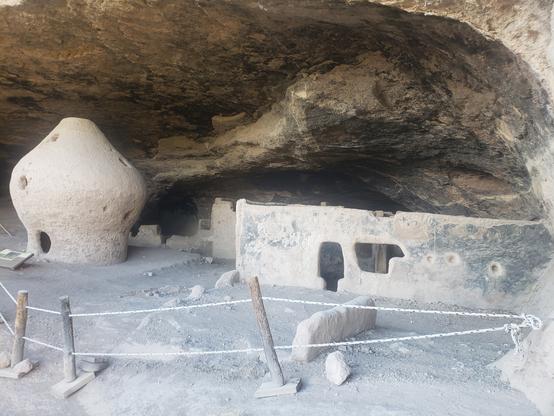
I'm in Casas Grandes, Mexico, for the Southwest Symposium, a biannual conference on the #archaeology of southwestern North America. The conference really starts tomorrow, but here's a photo from a side trip this afternoon to a site called La Cueva de la Olla.
The Southwest Symposium is just getting started at the Universidad Tecnológica de Paquimé, in Casas Grandes, Mexico. The official language of the conference is apparently Spanglish, with lots of switching between Spanish and English.
First up is Sam Jensen, giving an introduction to a session on historical trajectories of the Casas Grandes culture in Chihuahua, Mexico. He is providing an overview of the history of archaeology in Chihuahua.
Next us Matt Pailes of the University of Oklahoma. He is talking about the Archaic and early agricultural periods in northern Mexico. He highlights difference between Sonora, west of the Sierra Madre, where there is evidence for a long occupation but no population growth trend, and Chihuahua, east of the mountains, where there are no early dates, but a rapid increase in population after 1500 BC.
Now Mike Seary is talking about historical gravity during the Viejo Period to Medio Period transition in Casas Grandes culture. Connections to people, places, and historical knowledge drew people back to places and influenced historical trajectories.
The Viejo to Medio period transition around AD 1200 involved major changes in architecture, social organization, and other aspects of culture. But many Medio perio sites are built directly on top of Viejo period sites. Often later buildings were built directly on top of Viejo period buildings.
Viejo period structures were found by Charles DiPeso under the large Medio period site of Paquimé, but not well described in reports. Archives contain much more information.
Places gain historical gravity from the accumulation of events and memories. Ancestral worship was important to Vasas Grandes culture: dna evidence shows genetic continuity across the Viejo to Medio periid transition, and Medio period people maintained ties to earlier places that had historical gravity.
Now a prerecorded talk by Meradeth Snow on dna evidence and integrating bioarchaeology with other archaeological data.
One big archaeological question is whether the dramatic changes that marked the Medio period were caused by large scale migrants who came in and built the city of Paquimé.
Comparing mirochondrial dna from the Viejo period Convento Site and Paquimé shows there is no real change in dna profiles. Nuclear dna shows the same thing.
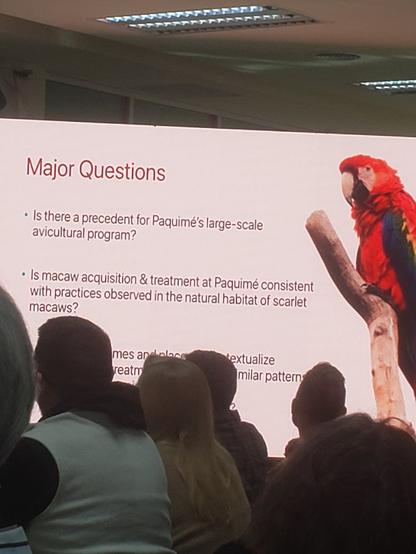
The next talk is Christopher Schwartz on Scarlet Macaws and Paquimé, and how they relate to hroader historical trajectories in souwesrern North America. Large number of macaws were bred at Paquimé, although their natural range is far to the south. Isotope data shows most of the birds were raised locally and hand-fed maize.
Birds and feathers have been found in many locations in northern Mexico and thensouthwestern US. Color symbolism is important, birds also valued because of their ability to imitate human speech.
In the US, strontium isotopes show birds were raised in Chaco Canyon, the Flagstaff area, and the Mimbres area. But narrow range of genetic variation shows the birds in the north came from a restricted population, probably descended from birds raised at Paquimé.
(missed one talk) Now Jaron Davidson is talking about what came after Paquimé's demise at about AD 1450. Little archaeological evidence for what happened between then and the time Spanish established a permanent presence in the 1600s.
Now Nora Rodriguez Zariñán is speaking about turkeys, and the cosmological duality involving turkeys and macaws.
Turkey raised for feathers and food throughout the region. Their bones are also used for musicalninstruments. But sometimes articulated burials of turkeys are found, probably sacrificial burials.
The last talk of the morning is Julian Alejandro Hernandez Chavez on the Influence of archaeology in northwestern Chihuahua. He is describing changes in local communities resulting from the presence of archaeologists in the region.
The afternoon session is starting. Ben Bellarado from the University of Arizona is talking about ancestral Pueblo sandals and fashion theory.
Twined sandals were made for 1500 years, from 200 BC to 1300 AD. He has a dataset of 57 dated samples, which allows him to talk about change in sandal technology and style.
There is evidence for specialized production, and for the development of stylistic traits distinguishing communities and individuals. The most interesting change is the development of raised tread designs. The most elaborate of these designs were individualized and would have left distinct footprints that would allow the individual who left the footprint to be identified.
In the 1000s and 1100s, "toe jogs" are added to some sandals, creating the impression that the wearer had six toes. This probably stmbolized a real or fictive link to a high status lineage of individuals with six toes. High-status burials have been found in Chaco Canyon and sites from the broader Chaco tradition that have six toes.
The next speaker is R.J. Sinensky, talking about cultural diversity in the northern Southwest between AD 200 and 550. This spans the time when intensive farming spreads across the region, with ceramics not widely adopted until late in this period.
There has been a lot of discussion about the possibilities of migration and diffusion. He wants to move beyond this debate and look at in situ development in the area over the centuries before the dramatic changes.