 varx/social
Found a neat site that walks you through disassembling your electric toothbrush and replacing the battery. Usually requires some soldering, but... very cool. (They're funded by selling replacement batteries!)

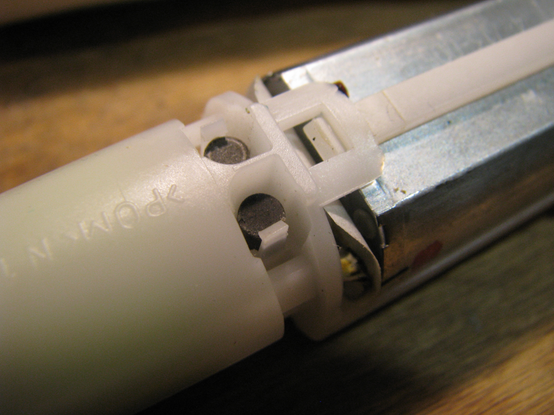
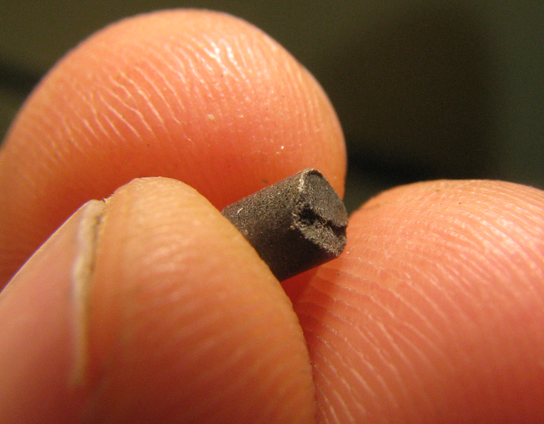
While disassembling my toothbrush, I came across an oddity. What are these little gray cylinders?
They're held loosely captive in a pocket of the plastic, not touching any other component. They're lightweight, rigid, non-magnetic, and maybe composed of something granular.
What the heck?
[EDIT: See rest of thread for possible answer!]
 Deborah Pickett
@varx Perhaps they are ballast? To alter the {mass, (second?) moment of inertia} of something that needs to vibrate with particular characteristics?
@varx Also take a look at 7m30 on this EEV Blog video: https://www.eevblog.com/2012/05/30/eevblog-284-braun-toothbrush-teardown/

@futzle Nice find—and they're in a completely different placement and orientation there! But still a pair of them, and still the same size, clipped in in a similar way... WTF.
@varx Lots of conjecture in the comments to that video on YouTube.
@futzle Ohoho, I didn't think to go to the video's page on YouTube! This comment by Kayr Herkert sounds dead on:
« The 2 little black thingies are pellets that neutralize chemical gasses that can be produced when a nimh cell is overcharged. » and then has a dead link to a PDF about potassium hydroxide pellets.
My gut has been saying that these are used for their chemical nature, based on how they looked like a compressed powder. But I couldn't figure out what that would be!
Excellent find!
@futzle I don't *think* it's KOH, as NiMH batteries apparently release hydrogen has, and I can't find anything about KOH absorbing that. (It does react with CO2, but... that doesn't seem relevant. And I think that might only be in solution?)
But a catalyst or something to absorb H2 seems very plausible.
Maybe I can generate some H2 and expose one of the cylinders to an H2 atmosphere? :-)
@varx I am not responsible for the inevitable gas explosion. Godspeed!