Is fundamental physics really experiencing a Great Stagnation? In this thread, let's look at the history of fundamental physics from the dawn of the 20th century to now.

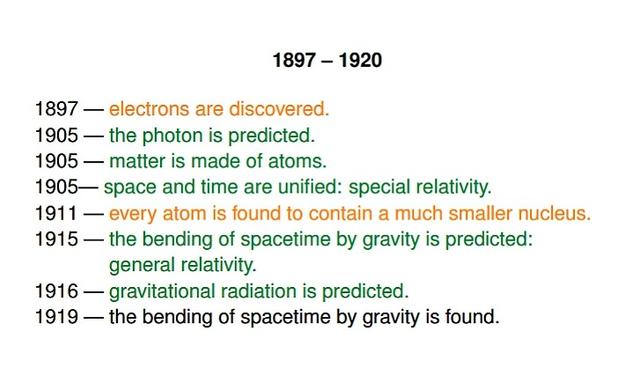
Experimental discoveries that were later accounted for by theories will be shown in yellow. (Mustard?)

Theoretical predictions that that were later confirmed by experiment are in green.

Experiments that confirmed theoretical predictions are in black.

Experiments that are still not accounted for by theories are shown in red.

(Yes, I'm a theorist. So to me, green means "success!" while red means "hey, we gotta do something here!)

One could argue endlessly about what to put on this list, and also what counts as "fundamental" physics. To me, the "fundamental" laws of physics are those that *in principle* we could use to compute all the physical quantities that we can compute at all.

The words "in principle' are carrying a lot of weight here. There are many laws, like formulas for turbulent fluid flow or masses of short-lived particles made of quarks, that we can't yet derive from the so-called "fundamental" laws. Yet most physicists think these are just signs of limitations in our ability to work with the fundamental laws, not new fundamental laws.

There is a long conversation to be had here about computability, chaos, etc. But that's not what these posts are about! Let's go back to the turn of the 20th century, and see how fundamental physics has grown since then.

Actually we should start in 1897.

(1/n)

The really shocking thing is how much the first two decades of fundamental physics in 20th century were dominated by one man: Einstein.

In the same year he predicted that light was made of particles, showed how to prove that matter was made of atoms, and unified space and time.

After thinking for a decade more, he gave a precise formula explaining gravity as the *curvature* of space and time, and predicted that gravity could form waves.

The two really big experimental surprises in this era are shown in yellow. In 1897, J. J. Thomson discovered electrons, and in 1911 Rutherford's team discovered that every atom has a small heavy central core.

(2/n)

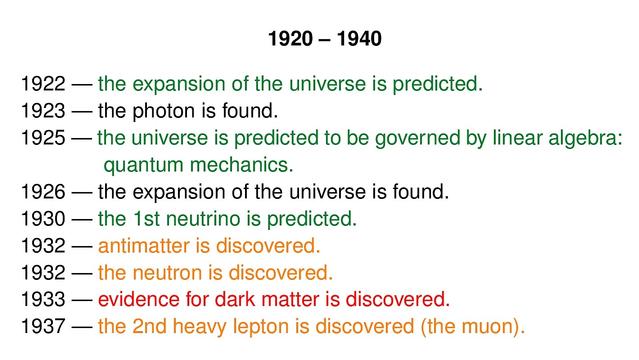
The period from 1920 to 1940 was just as explosive in fundamental physics.

In 1922, Friedmann used Einstein's theory of gravity to predict that the universe is expanding: galaxies are moving away from each other. In just 4 years this was confirmed by Hubble!

Einstein's predicted particles of light were found in 1923 and eventually called 'photons'.

But the biggest revolution occurred around 1925, when Schrödinger, Heisenberg, Born, Jordan, Dirac and others discovered that most of the universe was governed by linear algebra. This new way of understanding physics is called 'quantum mechanics'. One of its first big successes was computing the spectrum of light emitted by hydrogen, but thousands more came soon.

Then in orange we see a bunch of shocking experimental discoveries that eventually fit into the Standard Model... and one in red that we *still* don't understand!

(3/n)

In fundamental physics, the period from 1940 to 1960 looks a bit slower than the previous two decades. Perhaps World War II slowed things down.

But the development of quantum electrodynamics was huge. People had been trying for decades to unify quantum mechanics with special relativity - that is, understand a world where space and time are unified and all particles and forces are described using linear algebra. Initial attempts gave infinite answers to physics questions.

Only when Tomonaga, Schwinger and Feynman developed "renormalization" did this project begin to succeed. At first it only applied to charged particles interacting by exchanging photons. This is called quantum electrodynamics. But this opened the floodgates for future work on quantum field theory.

Pauli had predicted there must be a hard-to-detect and almost massless particle which he called the "neutrino". This was found in 1956. It turned out to be just the first of three.

And also in 1956, a huge experimental shocker: Wu discovered that left and right are fundamentally different!

(4/n)

The period from 1960 to 1980 was the heyday of particle physics! This is when I was a kid, so you can see I wanted to work on fundamental physics.

There was a thrilling interplay of theory and experiment. There were plenty of experimental surprises that were later fit into the Standard Model (in yellow), but also brand-new theories, now parts of the Standard Model, that were later confirmed by experiment (in green).

The 2nd neutrino came as a surprise, but the first 3 quarks were predicted to exist, by Gell-Mann, Zweig and others, based on data about the zoo of particles (made of quarks) that were being discovered. Electromagnetism was unified with the weak nuclear force in a theory that predicted the W, Z and Higgs bosons. Then 3 more quarks were predicte - and people came up with a theory of the strong nuclear force that holds together quarks, saying that it's carried by bosons of its own, jokingly called gluons.

The biggest experimental surprise in this era is the discovery that not only is left different from right, the world also change if you could switch left and right while switching matter and antimatter. This is called the violation of CP symmetry. This too is now a key part of the Standard Model.

You'll notice that, despite all this excitement, physicists were starting to probe realms very far from everyday human experience. Unlike work down in the first half of the century, it's hard to use these theories to build new technologies. The low-hanging fruit had already been picked when it comes to finding new fundamental laws. By this time, most physics was about *applying* the laws we already knew.

(5/n)

@johncarlosbaez I got into the field right after this and I was excited by all the ideas popping up as possible next steps: GUTs, supersymmetry, technicolor, quark components, inflationary cosmology, string theory. In hindsight it all seems like a kind of extinction burst.

@mattmcirvin - is there such a thing as an "extinction burst" in biology: a false flowering right before the crash?

But yes, we grew up in the same era. As an undergrad I saw Witten giving lectures on GUTs and Hawking giving a talk on virtual black holes. The mood was cocky. Among mathematical physicists, the use of algebraic topology to understand anomalies was tremendously exciting.

@johncarlosbaez It's from psychology: when you take away the reward for some behavior, at first you get an increase in the behavior apparently because the subject assumes they need to do it harder. Then they start to give up and the frequency drops off.

@mattmcirvin
Well, how is basic, fundamental research monetised?

Let's be honest a chance that you might a phone call inviting to gala diner in a Nordic country, is in today's hyper-commercialised HE environments a little bit underwhelming.

@johncarlosbaez

@yacc143 @mattmcirvin @johncarlosbaez Typically through government grants (NSF, HHS, DoD, etc.) for universities, or in national laboratories.
@nonlinear - you didn't link your post to the one you're commenting on, so it's an orphan.
@johncarlosbaez Strange. It looks linked in my UI. I'm not sure how to fix that.
@nonlinear - the only way to fix it is to repost it. Anyway, at least the 3 people you mentioned will have already had a chance to read it.