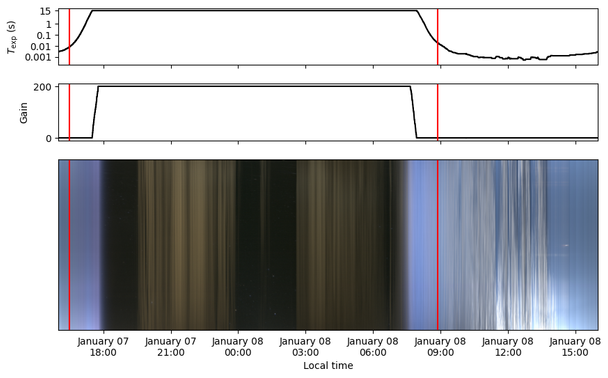
@xxx This is due to the approach I've chosen for the exposure settings. The camera has controls for exposure and gain, and I've implemented the exposure logic such that from daytime to night time, the gain stays at the daytime value until the exposure time increases to 15 seconds. After that, the gain gets to increase to a maximum value. At Sun rise, the opposite happens (gain deceases first, then exposure time). This plot shows the evolution of exposure time and gain during 24h and can be compared to the keogram and the times of Sun set and Sun rise (red vertical lines). It's clear that the transition from in color coincides with the gain change, which occurs in deep twilight.
 Cees Bassa
 xxx
xxx