 Jakylla
Hard time to be non-binary Spanish person
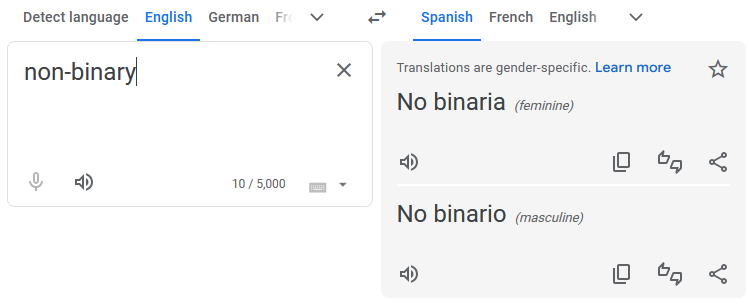
Hard time to be non-binary Spanish person
Stuff that I’ve seen from people addressing this:
The -@ and -x things don’t work well when spoken.
I wonder whether, after this, linguists and others will adopt calling them noun classes instead of genders.
I have a harder time believing we’d adopt a new term to supplant “gender” for human social roles, but stranger things have happened.
I wonder whether linguists and others will gradually adopt calling them noun classes instead of genders.
I hope so. It would also help when explaining the grammar of a few languages to laypeople. Such as the Bantu ones - people treat their noun classes as if they were something completely alien, even when they speak a language with M/F noun classes.
Don’t they call it “conjugations” in Spanish too?
Note however that they work in a really different way, more like noun declensions than like noun classes=gender. For example, you don’t trigger agreement; even if you were to replace an -ar verb with an -er or -ir verb, the rest of the sentence stays the same.

 Lvxferre [he/him]
 jbrains
 PumaStoleMyBluff