 Stylus
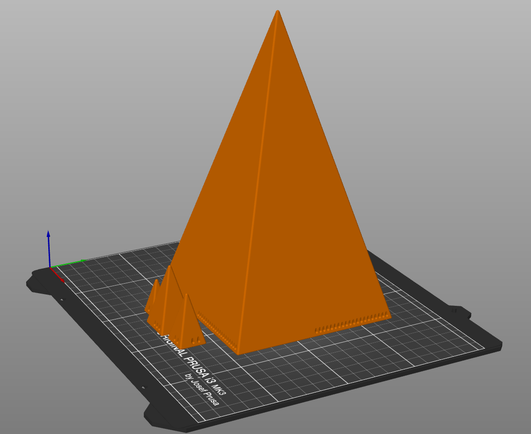
the math doesn't lie: a 20-pip looney pyramid exists
From my #openscad 3d model of looney pyramids, which adjusts the base by 7/32in (about 5.6mm) by every step, and scales the height proportionally. This keeps the angle of every piece identical, which I think is more pleasing in a hypothetical sort of way. (though an angle of exactly 30 degrees would be even more satisfying)
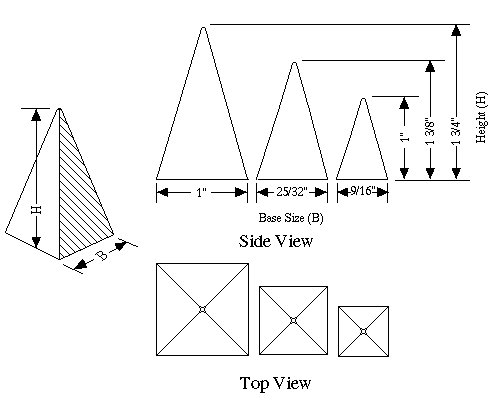
This is different than the official(?) dimensions, which change the base by 7/32in by every step, and the height by 3/8in (about 9.5mm) every step. This makes the angle dependent on the triangle size, ranging from 31.4° to 31.9° on the official pieces. The hypothetical official 20-pip triangle would end up nearly an inch shorter (22.8mm) with an angle of 35.2°
Next time I go to my local board game cafe I'll check how well my pieces stack & tree with the official ones and decide whether I have to follow their dimensions or not. The difference in absolute height of the 1-pip piece is just 0.4mm (about two layer heights). If I used the middle-sized piece as the reference piece, it would split the difference, making the big piece just 0.2mm too short and the small piece just 0.2mm too tall. That's around the size of 1 3d printed layer...
Prevously: https://social.afront.org/@stylus/113557312812359498

Stylus (@[email protected])
Attached: 2 images why yes, I am designing my own [Looney Pyramids](https://www.looneylabs.com/pyramids-home) in OpenSCAD. These game pieces are used in a variety of (mostly abstract strategy) games, and can be placed on top of each other in "trees" or "nests" There are multiple designs on thingiverse & printables, including an OpenSCAD design. I've printed several other designs and, unavoidably, thought "can I do this better?" My WIP has two features I didn't spot in any of the 3 designs I looked most closely at, to improve taking apart the pieces after they've been nested (a kind of stack where the 1-pip is under/inside the 2-pip, the 2-pip is under/inside the 3-pip, or both). First, the bottom part of the pyramidal shape is replaced with a vertical surface right at the build plate, to try to ensure that elephant foot doesn't make the parts as-printed interfere when shoved together. Second, there's an interior feature to dig a fingernail into when trying to separate a pair of pyramids. I don't have any official pyramids but my pieces don't *quite* match the geometry of any of the other sets I've printed. If I end up satisfied with the design I'll post it up on printables. #3dprinting #looneylabs #looneypyramids #icehouse #openscad
 nycki
nycki