
The discourse on high-risk/high gain research is prevalent. But we have little insight in what researchers consider "risky", and we don't know how these notions vary across disciplines. Daniel Stein and I have compared grant proposals from the SSH and the natural sciences.

Paper in the journal: https://doi.org/10.1093/scipol/scae062

Paper on SocArXiv: https://doi.org/10.31235/osf.io/2tc7a
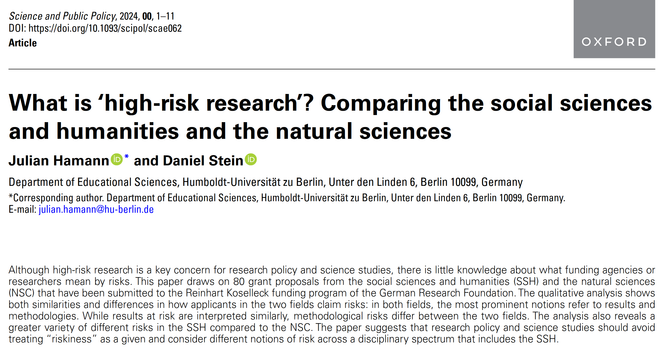
What is ‘high-risk research’? Comparing the social sciences and humanities and the natural sciences

Abstract. Although high-risk research is a key concern for research policy and science studies, there is little knowledge about what funding agencies or re

OUP Academic

The proposals have been submitted to the Reinhart Koselleck funding program of the @dfg_public

We find striking similarities in notions of risk between the two fields. They could be explained either by constraints of the genre grant proposal that invites applicants to claim specific risks or by applicants in the SSH adapting their notions of high-risk research to the prevalent discourse on high-risk/high-gain research, which is mostly concerned with STEM disciplines.

We also find notable differences between notions of risk in SSH and in natural sciences. Methodological risks in the NSC refer to methods or technical challenges, i.e., practical issues from a craftmanship perspective. In the SSH, methodological risks pertain to the amount and availability of data, i.e., risks that are more difficult to manage and control.