 Information Is Beautiful
Most of the world’s solar panels are fixed in one position. But what if they tracked the movement of the sun?
http://beautifulne.ws/1343 #bnews
http://beautifulne.ws/1343 #bnews
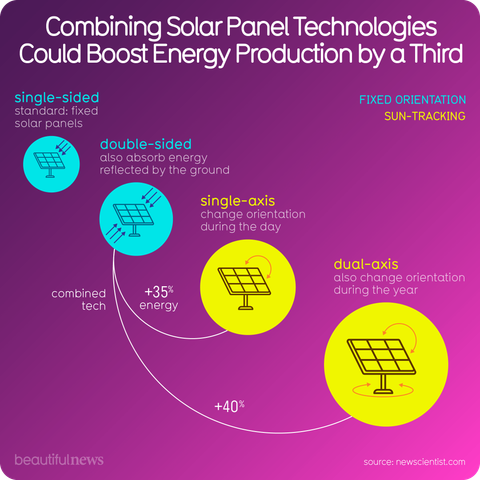
@infobeautiful in theory great, but then each panel has to have its own motor etc, which will require more maintenance etc.
It would be nice to see a proper study with costs of the extra infrastructure, how much parasitic power is needed, and how much extra maintenance is required.
@infobeautiful I've worked in PV manufacturing. The reason you don't see these kinds of complexities is not because nobody has tried. It's that they don't make financial sense.
When you say "efficiency", you're probably thinking W/m². But the real number that matters is kWhr/$. Panels are supposed to last about 20 years outdoors. Putting them on a moving mount means installing a lot of mechanical hardware that greatly increases BOM costs, installation costs, and maintenance costs. With panels as cheap as they are, better to install a few more panels at a suboptimal angle to get the same power output.
@infobeautiful
Basic comprehension questions about the image:
What is the benefit of single-sided versus double-sided fixed solar panels? I am missing a specification.
Are the rotation axes reversed? I would want to rotate around the horizontal axis for the summer-winter change and around the vertical axis for the course of the day?
 josh g.
 Chewie
 Joana de Castro Arnaud
 Pope Bob the Unsane
 Dr. Max
 simmer
 Kampfteppich