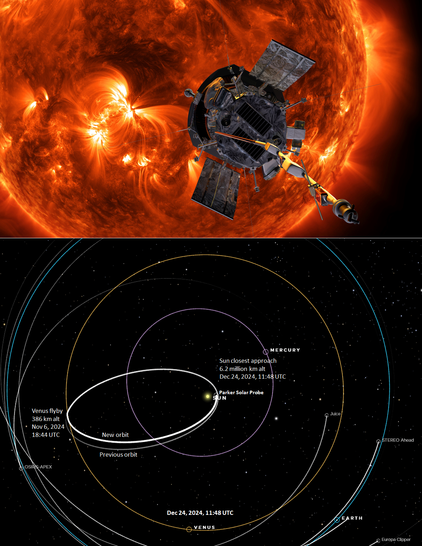
Today, around 18:44 UTC, NASA’s Parker Solar Probe completed its final Venus gravity assist maneuver, passing within 376 km of Venus’ surface.

The flyby adjusted Parker’s trajectory to bring the spacecraft to within 6.2 million km of the solar surface on Dec. 24, 2024 and on the next 4 perihelions. It will be the closest human made object to the Sun and the fastest (690,000 km/h).

FYI, Mercury is 58 million km away from the Sun on average.

https://science.nasa.gov/science-research/heliophysics/final-venus-flyby-for-nasas-parker-solar-probe-queues-closest-sun-pass/
https://eyes.nasa.gov/apps/solar-system/#/sc_parker_solar_probe?time=2024-12-24T11:48:00.000+00:00
1/n
Final Venus Flyby for NASA’s Parker Solar Probe Queues Closest Sun Pass - NASA Science

On Wednesday, Nov. 6, 2024, NASA’s Parker Solar Probe will complete its final Venus gravity assist maneuver, passing within 233 miles (376 km) of Venus’ surface.

Please take a look at this thread for some more info on the Parker Solar Probe, which was launched in 2018 and its objective is to study the outer corona of the Sun.
https://fosstodon.org/@AkaSci/111654959976676356

#ParkerSolarProbe
2/n

AkaSci 🛰️ (@[email protected])

Attached: 1 image NASA’s Parker Solar Probe will make its 18th close approach of the Sun tomorrow Dec 28, 2023 at 8:00 p.m. ET. At perihelion, it will be a record distance of just 7.26 million km from the solar surface, racing by at a record speed of 635,266 km/h (similar to perihelion 17, which occurred 3 months ago). For comparison, the perihelion of planet Mercury is at 45.3 mil km; average Earth-Sun distance = 150 mil km. https://parkersolarprobe.jhuapl.edu/ https://en.wikipedia.org/wiki/Solar_Orbiter #Parker #ParkerSolarProbe 1/n

Fosstodon