 Matt Blaze
AT&T Long Lines "Oak Hill" Tower, San Jose, CA, 2021.
A monopoly of pixels at https://www.flickr.com/photos/mattblaze/51261791084
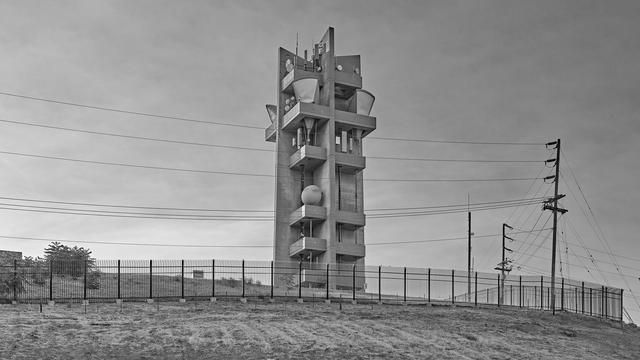

AT&T Long Lines "Oak Hill" Tower, San Jose, CA, 2021.
A monopoly of pixels at https://www.flickr.com/photos/mattblaze/51261791084
Captured with the Rodenstock 50mm/4.0 HR Digaron-W lens (@ f/4.5) on a Cambo WRS-1600 camera (with about 15mm of vertical shift to preserve the geometry), the Phase One IQ4-150 back (@ ISO 50) in dual exposure mode (which preserves a couple stops of additional dynamic range into the shadows).
The tower's shape is irregular; it tapers slightly.
The wide angle and panoramic orientation give a bit of context, alone on a hill (which is being rapidly encroached by adjacent residential development).
For much of the 20th century, the backbone of the AT&T "Long Lines" long distance telephone network consisted primarily of terrestrial microwave links (rather than copper or fiber cables). Towers with distinctive KS-15676 "horn" antennas could be seen on hilltops and atop switching center buildings across the US; they were simply part of the American landscape.
Most of the relay towers were simple steel structures. This brutalist concrete platform in San Jose was, I believe, of a unique design.
The San Jose Oak Hill Tower is unique in a number of ways. The concrete brutalist design appears not to have been replicated anywhere else; it seems to have been site-specific. It sits atop an underground switching center (that was partly used for a military contract), which explains the relatively hardened design.
Today the underground switch is still there, owned by AT&T, but the tower space is leased to land mobile and cellular providers. The old horn antennas at top are disconnected.
With a few exceptions (mostly towers atop downtown switching offices in populated areas), no one was trying to make any of this utilitarian communications infrastructure *beautiful*. It was form strictly following function, built to be reliable and rugged.
But there was, I think, quite a bit of beauty to find in it. I wonder if we'll look at our current neighborhood cellular towers, now often regarded as a visual blight, the same way decades after they're (inevitably) also gone.
 Aaron
Aaron