playing around with Inkscape and my HP pen plotter. it's not really going that well; Inkscape has severe issues with locating the origin, scaling factors, and can't handle things like crosshatching. these are problems that were solved 40 years ago.
and yes i'm aware of the crosshatch plugin for inkscape, but it hasn't been ported to 1.4 yet.
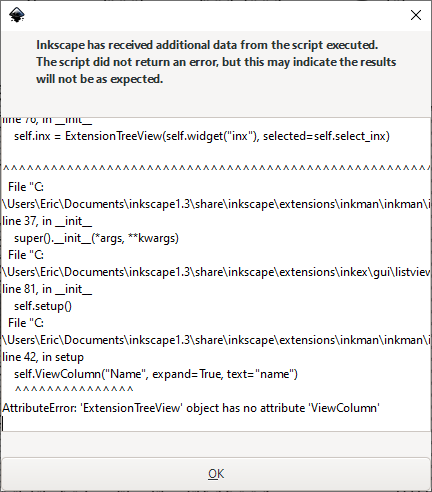
OK so i downloaded 1.3 and installed the crosshatch plugin from the plugin manager. this seems normal and expected.
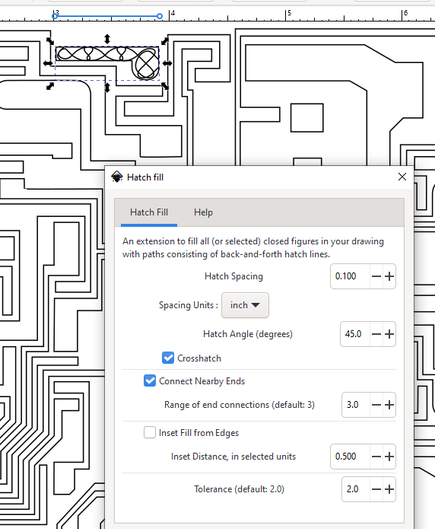
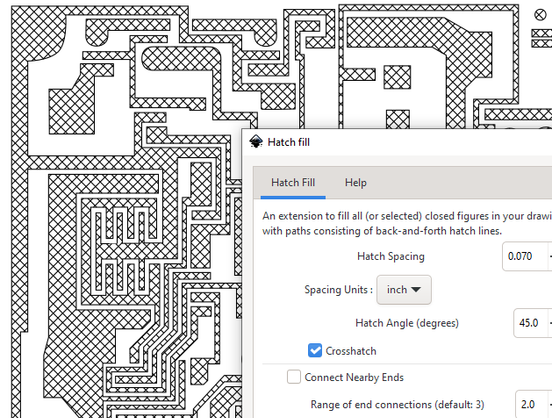
i removed that "plugin" and manually installed the axidraw extensions. why axidraw? it has a hatch plugin as well! problem: this is what it does.
you have to turn off "connect nearby ends" because it doesn't do right angle corners for some reason, only smooth swoopy corners.
holy crap this plotter is lightning fast
it's an HP 7550, probably the fastest pen plotter ever made. 🤯 This is 50cm/sec. it can go to 60cm/sec with a ballpoint rather than a fiber tip pen.
@tubetime WHOA. I've never seen one that fast before - then again my only pen plotter was the tiny TRS-80 one that took like 6" wide roll paper
@vxo @tubetime 7550s are scary fast. The fact they have a sheet feeder and can blat out who new pages is unbelievable
@vxo @tubetime was that the one with four pens in a little revolver magazine in the left? I had one of those!
@kitten_tech @tubetime yep! The little guy that'd draw a square in each of its four colors when it booted up
@vxo @tubetime yesss the memories come flooding back. It had a unique sound, especially as it swapped pens. Clever trick where it ran the head left off the page margin to rotate the pen carrier to the next slot!

@kitten_tech @tubetime it was almost like someone rapidly, rhythmically clicking a pen a few times

.... which is not far from the truth

@kitten_tech @tubetime it occurs to me that a machine with similar capabilities would not be difficult to fabricate!

@kitten_tech @tubetime you could even use that same funky pen change mechanic.

on the one I had, the carriage had an extreme right (or was it left?) position that's out of margin. to advance to the next pen in the turret, it'd just have to rock in and out of that position a couple of times. A springy finger on the printer frame would serve as a ratchet pawl against some teeth on the revolving carrier to step it to the next pen.

The only oddity was there was no "pen 0" index. Set it manually...

@kitten_tech @tubetime it gave me some deja vu the first time I had an inkjet printer that wasn't an Epson or an HP Deskjet and all of the cleaning/priming/printhead cap actions were just controlled by certain out-of-margin Y axis positions. Epson might have actually done the same, come to think of it, with the farthest extreme position out pushing in a clutch that engages the peristaltic priming pump to the paper feed drive.
@vxo @tubetime yeah, that would be a fun project!

@kitten_tech @tubetime yeah. only semi-exotic parts I can think of would be the rubber rollers, and you might be able to get away with printable TPU or some kind of off the shelf rollers... maybe even just metal shaft with grippy elastomeric tubing slipped over it.

that is assuming you're building a plotter that roll feeds paper, a flat platen type with X-Y positioner would basically be achievable with some extruded frame and linear guides or those doinky rollers 3d printers use

@kitten_tech @tubetime basically the guts of a junked 3d printer or two should get you like 90% of the way there
@vxo @tubetime a servo driven XY frame is old hat now, so many homebrew 3D printer, plotter, Dremel CNC router, card cutter, or laser engraver systems based on that! I reckon the roll fed compact plotter design would be a novel and interesting variation... Elastomeric tube over shaft so7nfs good to me. I remember an aluminium bar running along the front that drove the Z axis to push the pen onto the paper. I can't remember how the pen was transferred between head and changer though?
@vxo @tubetime the pen change rotation, IIRC, was driven by a metal pin at the bottom left of the carriage pushing the ratchet, but I can't remember how it actually loaded a pen in or out of the carriage.
@vxo @tubetime maybe the Z axis drive bar actuated that somehow, when the carriage was in the far left beyond -margin magic zone? 🤔
@vxo @tubetime ahhh no all the pens were in the carriage so it just needed to rotate, weren't they? Ignore me
@tubetime I love watching plotters at work. Thank you for posting more than a few seconds!
@tubetime Whoa....such insane engineering.
@tubetime My dad is a mechanical engineer and had these huge A0 plotters at home. Fascinating machines but slow so he jumped on A3 laser printers when they became an option (late 80’es I think)
@tubetime That is *fantastic!* Also, hard to imagine them working all that reliably
@beige_alert amazingly enough they are old-school HP levels of reliability
@tubetime impressive that they chose to yeet the paper around at high speed rather than just a pen carriage
@leftpaddotpy they also pull a vacuum to pull the paper down to the platen

@tubetime Yeah, great "little" machine, got one, too, which still needs a lot of TLC. One day....

But then again, 50 cm/s is rather pedestrian. I also have a DraftMaster RX (7596C), basically the last pen plotter HP made.

That one gets up to 110cm/s.

Putting a ball pen in there and see it fly is mesmerizing!

@tubetime I miss my 7550. Bought one used in high school, used it all the time.

Even hacked a mechanical pencil into a pen body, and "plotted" my English class homework onto lined notebook paper using a "handwriting" font.

Teacher praised my perfect handwriting. (It was very clearly written in pencil, there was "no way" that could have been printed by computer. 🤣)

@tubetime This was at a time when about 90% of all home computer printing was done on dot-matrix. I think I knew one person with an inkjet, and nobody with a laser printer at home.
@tubetime incredible! An HP or a Casio?
@tubetime Slightly terrifying! :D