 Alex Russell
Come for the frank discussion of the limiting factors to the web's longevity, stay for the incontrovertible evidence that Next.js suuuuuuuuuuuuuuuucks:
https://infrequently.org/2024/10/platforms-are-competitions/
Come for the frank discussion of the limiting factors to the web's longevity, stay for the incontrovertible evidence that Next.js suuuuuuuuuuuuuuuucks:
https://infrequently.org/2024/10/platforms-are-competitions/
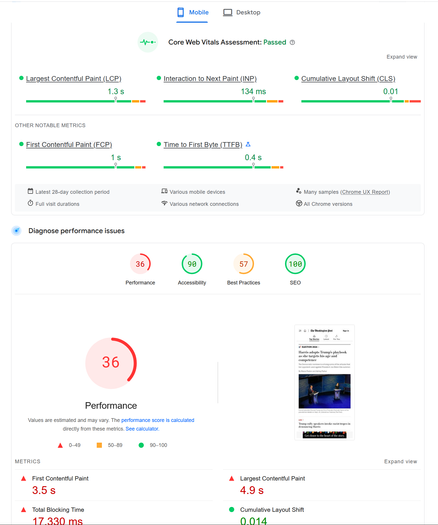
@jon_nunan Looking at this a little more closely, it's at least plausible that this effect is explained by audience selection. CrUX reports that half the site's traffic is from mobile[1] (likely larger, because iOS blindness in that data), but the sorts of folks who visit WaPo are likely wealthier, with faster phones and on faster networks. At the extreme end, a wealth bias effect would explain a divergence even this big.
@jon_nunan I recently saw a similar effect in California's (React-based) public benefits SPA; took a while to diagnose that the parade of loading screens was confusing the LCP algorithm:
https://infrequently.org/2024/08/object-lesson/#:~:text=On%20low%2Dend,the%20complete%20page.

SNAP benefits sites for more than 20% of Americans are unusably slow. All of them would be significantly faster if states abandoned client-side-rendering, and along with it, the legacy JavaScript frameworks (React, Angular, etc.) built to enable the SPA model.

 Jon
Jon