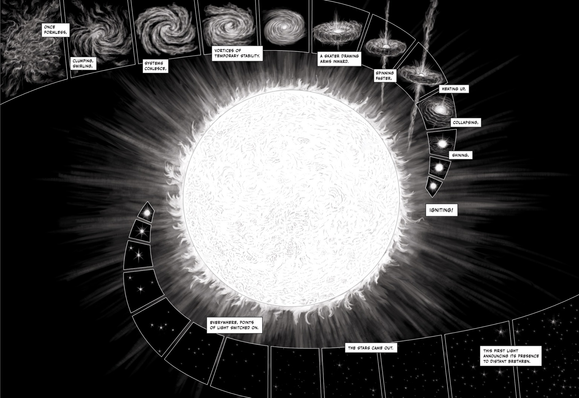
w/appreciation for the work of @jdunkley Emma Chapman & the quest for these first stars!
#Nostos #Unflattening 2
I was delighted and honored to talk about Unflattening, comics, and the importance of visual thinking at the National Gallery of Art in Washington DC earlier in June! it was an amazing experience and It’s exciting to see more and more places open up to comics. The event was recorded and the NGA has released…
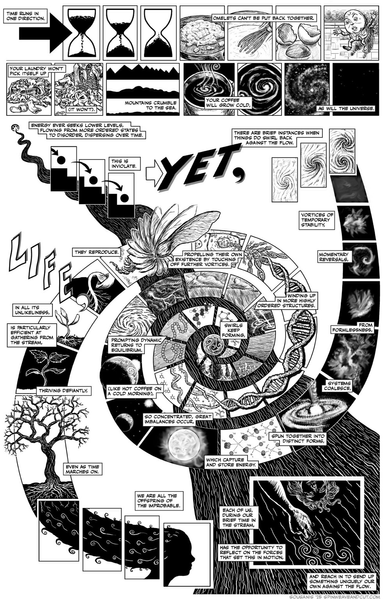
Astounding cartoon!
(On the "improbable": turns out life is good at opening new avenues for entropy to grow, and hence it may be favoured after all: "On the statistical mechanics of life: Schrödinger revisited", Jeffery et al. 2019 https://arxiv.org/abs/1908.08374 )
We study the statistical underpinnings of life. We question some common assumptions about the thermodynamics of life and illustrate how, contrary to widespread belief, even in a closed system entropy growth can accompany an increase in macroscopic order. We consider viewing metabolism in living things as microscopic variables directly driven by the second law of thermodynamics, while viewing the macroscopic variables of structure, complexity and homeostasis as mechanisms that are entropically favored because they open channels for entropy to grow via metabolism. This perspective reverses the conventional relation between structure and metabolism, by emphasizing the role of structure for metabolism rather than the other way around. Structure extends in time, preserving information along generations, particularly in the genetic code, but also in human culture. We also consider why the increase in order/complexity over time is often stepwise and sometimes collapses catastrophically. We point out the relevance of the notions of metastable states and channels between these, which are discovered by random motion of the system and lead it into ever-larger regions of the phase space, driven by thermodynamics. We note that such changes in state can lead to either increase or decrease in order; and sometimes to complete collapse, as in biological extinction. Finally, we comment on the implications of these dynamics for the future of humanity.