 Tom Lowe
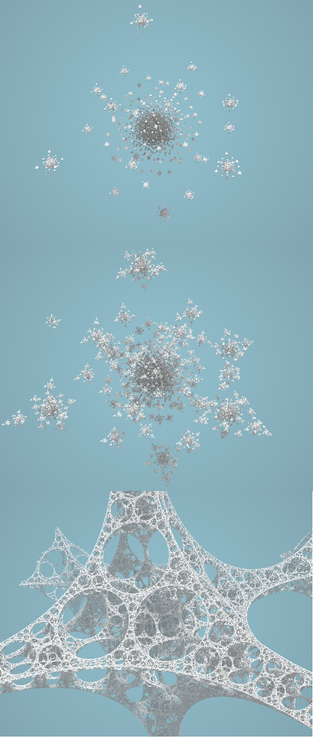
Here's a \(\textit{void-cluster}\), the least connected and most taxing to render of all the self-similar classes.
Again I'm using sphere inversions, and the iteration is very similar to the standard \(\textit{cluster}\) a few posts back, but rather than based on regular hyperbolic tesselations, it is based on the only regular Euclidean tesselation, which is the cubic tiling.
It isn't sufficient to just be a scattering of points, the requirement to be self-similar means the points form clusters, hence the name. Galaxy clusters and star clusters are good examples of this. In fact, it would be nice to have this image rendered with emissive points on a black background, for a more cosmological vibe.