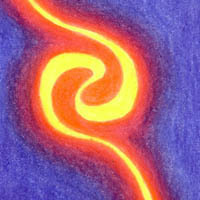
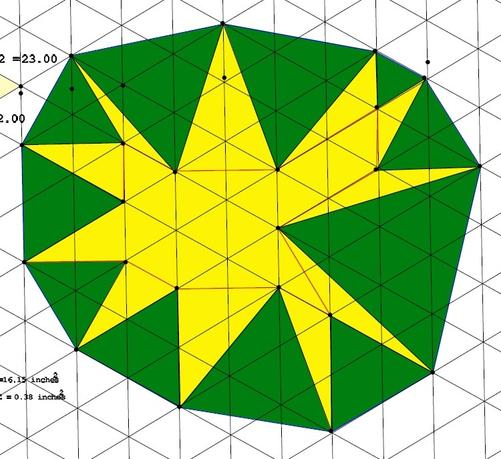
If you cut out the yellow shape here, you can fold it up along the red lines, and all 11 sharp tips will meet at one point! You'll get a polyhedron with 12 corners, tiled by equilateral triangles. 5 triangles meet at each corner. There are also places where 6 triangles meet: these places are flat. Some triangles get folded along the red lines.

This may seem like a curiosity. But it shows up in a paper by the great mathematician William Thurston, which I'm writing an article about, and there's a lot more to it.

Notice how he got this. He drew a lattice of equilateral triangles on the plane. Then he drew an 11-sided polygon whose corners are lattice points. Along each edge of this polygon, he drew a green equilateral triangle pointing inward. If you cut out these green triangles, you're left with the yellow shape, which you can fold up.

There are lots of ways you can draw such an 11-sided polygon; the picture shows just one. Each way gives a way of triangulating the sphere where the number of triangles meeting at a vertex is always either 5 or 6. In fact - and this is not obvious - you can get *all* such triangulations using this trick.

Is anyone out there willing to draw such an 11-sided polygon and then draw the polyhedron you get when you cut out the green triangles and fold up the left-over yellow shape? A super-genius could write a program where the user could choose 11 points that define a valid polygon, and then the program would show what happens when you fold up the yellow shape. But I'd be thrilled to see just one example.

(1/2)
@johncarlosbaez For anyone who wants to play: Incompetech has equilateral triangles in their printable graph paper selection: https://incompetech.com/graphpaper/triangle/
Free Online Graph Paper / Triangle

@Anke @johncarlosbaez If you want to be able to customize your triangle graph paper with different sizes, colors, etc., without using a web site, then @mcnees and I have you covered! We wrote a LaTeX package named gridpapers, available at https://github.com/mcnees/LaTeX-Graph-Paper or in any LaTeX distribution since ~2022.
GitHub - mcnees/LaTeX-Graph-Paper: Make your own quadrille, graph, hex, etc paper! Uses the pgf/TikZ package for LaTeX, which should be part of any modern TeX installation.

Make your own quadrille, graph, hex, etc paper! Uses the pgf/TikZ package for LaTeX, which should be part of any modern TeX installation. - mcnees/LaTeX-Graph-Paper

GitHub

@duetosymmetry - Thanks! I want to draw my own example 11-gon in LaTeX / TikZ for my column, so you may have just saved me some time.

@Anke @mcnees

@johncarlosbaez @Anke @mcnees I have been getting more and more proficient at TikZ, but it's still not like a first language.
@duetosymmetry - I'm bad at TikZ, but I use it a lot because there's a lot of code out there that I can adapt.
@johncarlosbaez I am supposed to be writing GR homework solutions today, but I'm very close to being nerd-sniped ;)
Gerard Westendorp (@[email protected])

Attached: 1 image @johncarlosbaez The "ordinary" icosahedron is not so obvious. I figured it out eventually, by making paper icosahedra and cutting them up.

Mathstodon
@johncarlosbaez @GerardWestendorp I figured out the cleanest way to do this with cm={ the correct shear matrix }, so you can label points by their lattice generators. But have to take care of baby and have dinner now, so can't work on it!
@johncarlosbaez @GerardWestendorp Ok, I have an extremely self-explanatory TikZ version of this, if you'd like me to send it to you!
@duetosymmetry
Sounds good! My email is on my website at https://westy31.nl/
Homepage Gerard Westendorp