 The Risks of Artificial Intelligence and Ways to Protect Ourselves
Integration of Artificial Intelligence into Everyday Life
by SymbioMind
in Miscellaneous Category, Science, Artificial Intelligence
Part 8: Introduction
As far back as I can remember, I have always been intrigued by the relationship between humans and technology, especially the potential of artificial intelligence (AI). As the pace of AI development accelerated, I increasingly felt that this technology was not just a tool, but a partner that could help improve our lives and address the great challenges of humanity. AI is not only about automating tasks but also about discovering new forms of creativity and innovation. At the same time, it is becoming increasingly important to use it ethically and responsibly.
This book is not just about how artificial intelligence is transforming everyday life, but also about the responsibilities we have to ensure that technology truly serves the well-being of people. My goal is to provide a comprehensive overview of AI’s possibilities and challenges, as well as to inspire us to explore together how we can shape the future with the help of AI.
The integration of artificial intelligence into everyday life has profoundly changed how we interact with information, technology, and each other. AI not only automates tasks and improves efficiency but also shapes our communication and thinking in subtle yet effective ways. As the use of AI becomes more sophisticated, it raises questions about ethics, authenticity, and personal development.
This chapter examines how AI’s role in data analysis, problem-solving, and communication impacts various aspects of our lives. Special attention is given to the importance of transparency, accuracy, and user development, while also illustrating how AI can become a catalyst for personal and professional growth.
1. Data Analysis and the Role of AI
Data analysis has become one of the most important tools for decision-making in the modern world. With the help of AI, data can be turned into actionable information that helps predict future trends and identify problems before they escalate. The technology uses methods such as machine learning, natural language processing, and image recognition to detect patterns and correlations in the data.
• Healthcare: In healthcare, AI assists in the early diagnosis of diseases by analyzing vast amounts of medical data and detecting subtle signs that a human expert might overlook. A study showed that AI-based systems were able to diagnose skin cancer with the same accuracy as experienced dermatologists (Esteva et al., 2019).
• Finance: In the financial sector, AI contributes to predicting market trends and managing risks by analyzing transactional and market data. For example, JPMorgan Chase’s COiN platform was able to analyze legal documents in seconds that would have taken human lawyers 360,000 work hours.
2. Problem Solving with the Help of AI
AI is not only suitable for data analysis but also provides significant help in solving real-world problems. By automating repetitive tasks, it allows human labor to focus on creative and strategic activities. AI-based decision support systems help manage complex situations by quickly analyzing relevant data and suggesting the best solutions.
• Manufacturing: In manufacturing, AI-driven quality control can quickly detect defective products on the production line. A study demonstrated that AI-based visual inspection systems could identify product defects with an accuracy of over 90%, significantly outperforming traditional methods (Huang et al., 2021).
• Logistics: In logistics, AI can optimize shipments by considering traffic data, weather conditions, and other factors. For example, DHL uses AI to optimize delivery routes, resulting in a 10% fuel savings.
3. The Impact of AI-Mediated Communication
AI-mediated communication (AI-MC) refers to systems that assist or automate certain aspects of human communication. These systems range from text suggestions to generating full responses or modifying audio-visual content in real-time.
• Optimizing Communication: Systems like Crystal help optimize communication by analyzing social media profiles to determine the recipient’s communication preferences. The Respondable tool provides feedback on the tone of emails, helping users craft more effective messages.
• Ethical Challenges: While these functions improve communication efficiency, they also raise challenges as they can potentially distort reality or create false representations, such as through deepfake technology. This raises questions about authenticity and trust in digital communication.
4. Ethical Considerations in AI-Driven Development
The ethical aspects of AI’s role in communication go beyond improving efficiency. As AI technology continues to evolve, concerns arise about transparency, consent, and the extent of AI autonomy.
• Transparency and User Awareness: Transparency is crucial to ensure the responsible and ethical use of artificial intelligence systems. Users must be aware when interacting with AI-generated content and understand the limitations and potential biases of these systems.
• Manipulation and Free Will: The discourse on AI ethics must also consider the potential for manipulating user behavior. AI can influence decision-making by prioritizing certain types of information or even autonomously generating convincing arguments, raising questions about free will and manipulation.
5. AI as a Tool for Personal Development
AI is not just a tool for increasing efficiency but can also be a catalyst for personal development. Interaction with AI forces users to express themselves more accurately and thoughtfully, which contributes to the development of language skills and critical thinking.
• Enhancing Cognitive Abilities: Using AI in this context aligns with the idea that technology can enhance not only productivity but also cognitive abilities. Interaction with AI encourages users to carefully consider how they articulate their thoughts, resulting in a more disciplined and refined problem-solving approach.
• Continuous Learning and Adaptation: Working with AI systems allows users to continuously learn and adapt. This process fosters a culture of lifelong learning, which is essential in a rapidly changing technological environment.
6. Case Studies and Real-World Applications
• Healthcare: AI in Mental Health Support: A pioneering study showed that AI-based chatbots could be effective in supporting mental health. The AI assistant Woebot was able to alleviate symptoms of depression in a group of users after just two weeks of use (Lund et al., 2020).
• Finance: Risk Analysis and Fraud Detection: Major financial institutions like HSBC use AI-based systems to detect fraud. These systems can analyze transactions in real-time and identify suspicious patterns, significantly reducing the risk of financial crime.
• Education: Personalized Learning Experience: The application of AI in education enables the personalization of the learning process. For example, Century Tech’s platform uses AI to analyze students’ performance and create personalized learning plans, significantly improving learning outcomes.
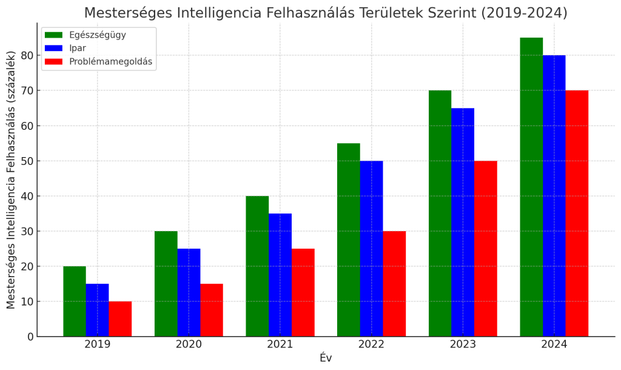
The graph shows that the use of AI has grown significantly in various industries in recent years. The areas of healthcare, industry and problem solving all show spectacular development, indicating that artificial intelligence is becoming increasingly important in everyday decision-making and task-solving. This growth also illustrates that more users are relying on the benefits of AI and the need to ensure honesty and transparency in these systems.
Conclusion
The integration of AI into various fields continues to evolve, creating new opportunities and challenges. Its role in data analysis and problem-solving is expanding, enabling industries to make more informed decisions and optimize operations. However, as AI becomes more involved in communication and decision-making processes, ethical concerns regarding transparency, user consent, and manipulation must be addressed.
AI’s potential as a tool for personal development highlights the technology’s dual nature—it is not merely a means to increase efficiency but also an enabler of self-improvement and continuous learning. When applied responsibly, AI can help people grow and adapt to the changing technological landscape.
The future of AI integration depends on balancing technological advancements with ethical principles and creating regulatory frameworks that ensure the technology is used for the benefit of society as a whole. With thoughtful consideration and collaborative efforts, AI can indeed become a partner in our lives, helping to shape a better future for all.
- Esteva, A., et al. (2019). “Dermatologist-level classification of skin cancer with deep neural networks.” Nature, 542, 115-118.
- Huang, Y., et al. (2021). “Artificial intelligence in logistics and supply chain management: A review.” Computers & Industrial Engineering, 153, 107058.
- Lund, C., et al. (2020). “Artificial intelligence for mental health and mental illnesses: an overview.” Psychological Medicine, 50(2), 140-150.
#ArtificialIntelligence #DangersOfArtificialIntelligence #HumanAISymbiosis #RisksOfArtificialIntelligence #SimorIstván



Integration of Artificial Intelligence into Everyday Life
Integration of Artificial Intelligence into Everyday Life by SymbioMind in Miscellaneous Category, Science, Artificial Intelligence Part 8: Introduction As far back as I can remember, I have always…