 Laurence Tratt
It's Not Easy Being Green: On the Energy Efficiency of Programming Languages
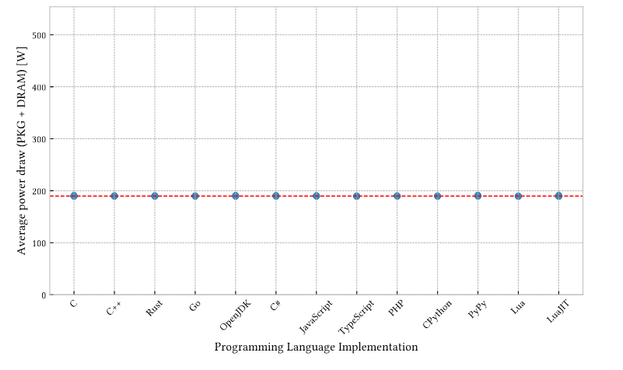
Does the choice of programming language affect energy consumption? Previous highly visible studies have established associations between certain programming languages and energy consumption. A causal misinterpretation of this work has led academics and industry leaders to use or support certain languages based on their claimed impact on energy consumption. This paper tackles this causal question directly: it develops a detailed causal model capturing the complex relationship between programming language choice and energy consumption. This model identifies and incorporates several critical but previously overlooked factors that affect energy usage. These factors, such as distinguishing programming languages from their implementations, the impact of the application implementations themselves, the number of active cores, and memory activity, can significantly skew energy consumption measurements if not accounted for. We show -- via empirical experiments, improved methodology, and careful examination of anomalies -- that when these factors are controlled for, notable discrepancies in prior work vanish. Our analysis suggests that the choice of programming language implementation has no significant impact on energy consumption beyond execution time.
 Alex Bradbury