 Kathleen Fitzpatrick
A thought experiment: if you suddenly had access to the resources required and had a burning desire to create a community-owned and -governed cloud computing/hosting service/alternative to AWS, what would you be sure to consider, include, provide, support?
 William Pietri
@kfitz My dark suspicion is that AWS makes the bulk of their profit from waste. Machines that should have been shut off, storage that should have been deleted, grossly excessive usage for the need, and so on. (Any guesses, @Quinnypig?) So I'd start with the question of what it looks to have a hosting service whose goal is not profit, but efficient use of resources and effective support of the people in served organizations such that it's easy and encouraged to use only what's needed.
@williampietri @Quinnypig Yes, totally. Thanks for this!
 Bret Mogilefsky
@williampietri @kfitz hmmm, well I may not be the best person to ask since I am focused on ensuring people have PaaS services, not IaaS. But we've gone near ten years running Cloud Foundry with only a basic set of brokered services (RDS, Redis, Elastic/Opensearch) and that covers pretty much the gamut of what straight web apps need, at least well-behaved ones. Things we never handled that people wanted: Mongo, NFS, SMTP. (SMTP is coming now.)
@williampietri @kfitz Oh and you'll need to provide object storage, of course.
A PaaS is also not great for heavy ETL/machine-learning due to limited local disk.
My feeling after looking at the Supabase stack a lot lately is that "just use postgres" is a boring but also winning architecture strategy for most of what people want to make, but as the service provider you might not get much say over what they are working with.
@williampietri @kfitz So, depending on who you want to serve, I'd probably just start with hardware and OpenStack (IaaS), then work up to OpenShift+Korifi or BOSH+Cloud Foundry (PaaS).
After that, listen to what people want and start providing those as brokered services that they don't have to operate themselves. I'm not crazy about k8s, but if you start with OpenShift you're in a good position both to provide a k8s service, and to use it yourself to operate specialized brokered services.
@williampietri @kfitz
If you're just looking to provide easy SaaS services for your community, then look at NextCloud (or whatever the active fork of that is these days). In fact I would do that regardless.
If you're just looking to provide easy SaaS services for your community, then look at NextCloud (or whatever the active fork of that is these days). In fact I would do that regardless.
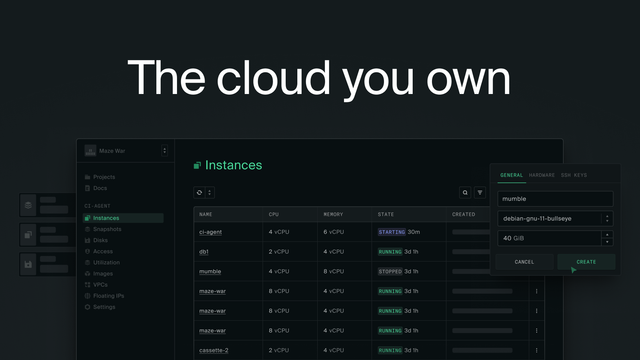
@williampietri @kfitz Oh and if you have control over the hardware, definitely check out https://oxide.computer/ !
@williampietri @kfitz Got to re-emphasize, though, that not all customers have control of their stack. So if they come to you wanting to run some enteprise-y COTS things that has a baked dependency on Mongo and Windows and Lambda, well, you just have to gently let them know they can't be your customer.
@williampietri @kfitz It helps to give them guidance/therapy, though, in the edge cases where change is more possible than it first appears. Example: I was sure we wouldn't be able to run Hypothes.is because it uses RabbitMQ but it turned out that it uses RMQ via a library abstraction that can just as easily use Redis/Valkey with a one-line config change.
So: Invest early in pre-sales engineering.