Half of all science publishers quit within 10 years. Women quit more than men. Bunch of quitters!

https://www.nature.com/articles/d41586-024-03222-7

๐Ÿค”Quit? Or were driven out?

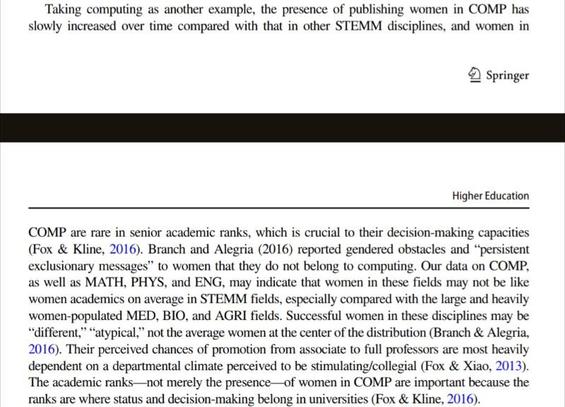
My favorite* part is that women in CompSci, Engineering, Math, and Physics, are less likely to stop publishing than women in less sexist academic fields. Possibly because we run young girls in Math/CS/Eng/Physics through a sexism gauntlet from day 1, so by the time they're grown women the survivors cope with gendered hostility better.๐Ÿ˜ฎ

(*Least)

Nearly 50% of researchers quit science within a decade, huge study reveals

Twenty years of publishing data across many countries and disciplines show women are more likely than men to leave research.

@mekkaokereke Alternatively, maybr both fields are equally sexist, but misogynists in STEM are less subtle about it, making it easier for women to steer clear of them.
@brecht @mekkaokereke but doesn't "less subtle about it" mean more sexist as a field, rather than "equally sexist"? We are interested in characterizing not just the interiority of those involved but the shape of the behaviors, in such definitions of "sexism in the field"
@brecht @mekkaokereke additionally "less subtle" sexism being present in a field implies a normative endorsement of it which can make it LESS difficult to steer clear of it in order to operate in professional contexts. In other words, overt sexism makes sexism more routine, and you are expected therefore to have to navigate it more routinely than in cultures where it is more hidden. This is part of the way misogynistic cultures and such biases are self-reinforcing. So idk, very complex stuff.

@grimalkina @brecht @mekkaokereke I can feel some kind of truth in this idea.

Being that when you're primed for it, you just roll your eyes and sigh and carry on or fight when needed - but in a supposedly non-/less-sexist field you might first take things personally or seriously before questioning and realising what's going on.

@sarajw @brecht it's important to note we're implicitly wondering about "how would the same woman act in two different fields," which is a valid important question to model, but is NOT the situation in the world because these fields do not admit women in the same way -- as noted in the screenshot @mekkaokereke shared above! So there is an achievement*gender interaction already selected for by the field entry paths themselves. This is a classic issue in studying STEM disparities

@grimalkina @brecht @mekkaokereke yes that makes sense too. Like you say it's complex.

I've come up through the stem pathway myself, and I don't feel I've suffered much sexism (aside from the occasional ass that everyone agrees is an ass) - though it's probably also true that there may be some underlying systemic stuff that I've not been aware of.

@sarajw @brecht @mekkaokereke I always remind myself it's difficult to ever directly observe "someone else got twice the promotion for half the work"!! However it's also always possible that we are in a local optimum that is better than the overall ecosystem. Another reason work like this paper is very useful! This emerging area that is looking deeper than just "STEM or not-STEM" has been super useful because there are success examples to contrast with failure examples, on gender rep

@grimalkina @brecht @mekkaokereke oh for sure. I don't mean at all to say that my experience negates anyone else's, in case it came across that way.

I'm also on the tomboy side and extremely unthreatening, I think my experiences will also differ from those of someone more classically feminine who might put men into a different mindset.

@sarajw @brecht @mekkaokereke no no I didn't read it that way at all it was totally clear to me! I was just nodding along like so true that trying to weave between our personal experiences and big systems level questions is hard, especially when it's so much "I wonder how this ambiguous thing was interpreted by others bringing in all their own expectations"!

@grimalkina @brecht @mekkaokereke have just understood (should have clicked into the second image up there earlier) that it varies within stem fields too, so interesting.

I came up through electronic engineering (extremely male attendance at university, I may have been one of 2 or 3 young women in my lectures), meandered via teaching physics to teenagers, then time lapse tech and now web development - and the worst sexism was experienced on construction sites (installing time lapse cameras) ๐Ÿ˜…

@sarajw @grimalkina @brecht @mekkaokereke One of the ways being neurodivergent can help women, is you missing social cues means you some of the sexism and just carry on. Sexism can be so disheartening to experience. So not recognizing it can actually help you persevere.

@nataliepoulin @grimalkina @brecht @mekkaokereke yep I can see that too. I don't consider myself neurodivergent but I definitely share a few traits with AuDHD folk, so it may well be a few things just passed me by.

I remember growing up with the idea of overt sexism being the only sexism, and felt happy that I didn't suffer any - until I realised how much systemic bullshit exists and that likely I was affected within that. Remember realising similar about racism (which ofc doesn't affect me).