 stabby_cicada
one more shitty techbrofad down
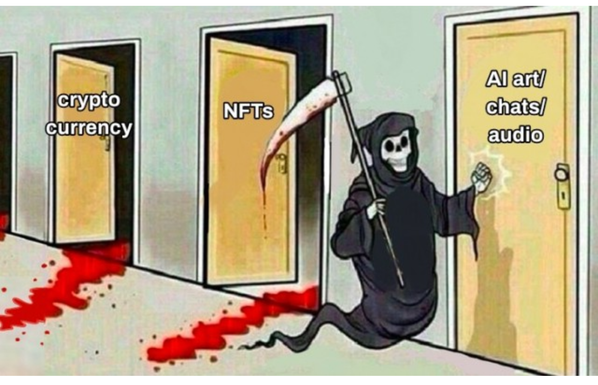
one more shitty techbrofad down
NFTs were created in a code jam and had no intents to become title transfer tools.
It was and always be limited by the amount of data the NFT can contain. They went with URLs because they are small enough to fit. An actual land deed title document? Too big to fit into an NFT. Simply not enough bytes to go around.
This was the strict limitation from the very beginning. The only thing an NFT actually verifies “ownership” of is a URL.
Unfortunately it only is useful in proving title when normal processes have failed, and in the places with title proven by a line of titles stretching arbitrarily far back, it’s only as good as the proof that got it in the block chain
It’s better in places like Australia where title is a record on a government database and block chain would protect against destruction of government records (eg from war or revolution), but there it would probably only be useful if something like the old government regained power (the Nazis had no intention of returning stuff to Jews)
But in places like Australia you wouldn’t want to add another step to the users, perhaps it could be a land titles department job
In places with title via history of title I don’t think it could defeat a result from a title search, so maybe it’d be next to useless unless it was backed by a court order or some other authoritative full stop
Nfts legitimately confuse me.
“Why can’t you put the whole image in an nft?”
“It’s too big”
“Why is it too big?”
“It’d take too long to generate.”
“Okay, but why?”
“Because nfts can’t hold that much information.”
“Okay, but why?”
“Because it’d take too long to generate.”
“Okay, but why would it take too long to generate???”
“Fuck you, stop wasting my time.”
“Oooookay. I really don’t understand but okay, fuck you too I guess.”
Does anyone know why nfts are so small? Everything I’ve read says that they’re fucking tiny, but nothing explains why they can’t be larger, why being larger would be too slow, and so on. They honestly seem like a decent answer to the digital ownership problem of “I want to resell this game like I could 20yrs ago but I can’t”, however I get sent in a circle whenever I try to figure out what makes nfts so unwieldy and impractical.
(Not that I think anyone should be able to own a digital good; I pay for digital things because I want to support people, not because I think digital ownership is a legitimate concept. Imo, because digital things can be copied as many times as you want, you can’t truly own a digital item, and nor should anyone be allowed to try and revoke said item unless said item is illegal for other reasons. However… As long as we live in a capitalist society hell-bent on applying the concept of ownership to a system that’s only limited by your hardware, I think people should have the ability to actually “own” their digital goods, which includes things like the right to not have a company take them away whenever it feels like it and the ability to sell digital goods like an IRL market.)
Does anyone know why nfts are so small?
Because storage space on “The Blockchain” is very expensive.
The blockchain is a complete list of all transaction made with a cryptocurrency. You have heard of miners. What they do is collect transactions and append them to the blockchain. Every miner must have a complete copy of the whole chain. So whenever a new NFT is created, lots of copies have to be stored and kept forever. It’s just not a good solution from an engineering standpoint. But for the popular currencies, that’s the smaller problem.
Every miner wants a fee for their services. That fee depends on the value of the cryptocurrency. There is no relation to the actual storage cost.
Besides, crypto does not offer any kind of DRM. If it did, the copyright industry would be all over it. Anyone can download anything on the blockchain.
The reason you can’t resell games is, because the publishers don’t allow it. For example, Steam has a marketplace. It would be no technical problem to make games transferrable between users. The rights-owners don’t want that.
You see, no one actually wants a digital currency. There have been several (nano was my favorite) that functioned especially well as a currency, because it used very little compute power to perform or verify transactions.
But a currency is stable. Which means you don’t magically make money by holding or trading it. So it doesn’t get attention, and therefore doesn’t get widely adopted.
Everyone likes Bitcoin because it’s speculative digital gold.
getting their huge sums out of crypto and into something they can use (while thousands watch the money like hawks) is much harder
That, my friends, is what NFT are is perfect at.
“Oh, what, tax authority? No, I didn’t steal this money. I earned it legit by selling my newly-minted monkey NFT to some sucker for 100 ETH.”
The full scheme works like this—
That was my point, in essence. Crypto fails as currency because the people in that market don’t want it to be less volatile, making it bad for typical currency uses.
While yes, the relative values of currency fluctuate over time and in relation to one another, it’s orders of magnitude less and driven by far more predictable and based on actual real world factors. Instead of Fomo, whims, market whales, and indecipherable white papers.
nano was my favorite
Hello, fellow Nanite!
I recently tried Nano-GPT and had a very good experience (see feddit.org/post/3081522/2172497), so there is at least some real-world usage – it’s cool and kind of impressive technology, though spam during certain periods was always an issue and I don’t know how resilient the network is currently.

 NateNate60
 Snot Flickerman
 Mossy Feathers (She/Her)
 Lucidlethargy
 JacobCoffinWrites
 Cryptagionismisogynist
 explodicle