@fionabradley @juancommander @cameronneylon @eschares @florianjehn

Yes, many intersecting aspects here both in terms of definition and of data availability.... In terms of developments for extending measuring diamond, a couple of points:

(here's attempting a Mastodon thread...)

/n
@fionabradley @juancommander @cameronneylon @eschares @florianjehn

1) I know @OpenAlex is looking to extend their diamond tag beyond using DOAJ only.

Two potential sources I think are useful and accessible are the set of full OA journals (labeled journal_is_oa) in OpenAlex/Unpaywall itself that are not in DOAJ, and the list of serials using OJS that PKP collected (thanks @juancommander !) Both are not all diamond journals of course, but both could be a starting point for further checking.

/

@fionabradley @juancommander @cameronneylon @eschares @florianjehn @OpenAlex

Both have the advantage of either already being indexed (journal_is_oa in OpenAlex) or having at least ISSNs available (where the journals have them) for matching (PKP). PKP's list also includes journals not using Crossref.

And of course also! Existing registries for Latin America based journals are another useful source to expand coverage of diamond journals.

/

@fionabradley @juancommander @cameronneylon @eschares @florianjehn @OpenAlex

2/ Another approach is the Diamond Discovery Hub that's a planned outcome of the Craft-OA project: https://www.craft-oa.eu/ddh/

The approach here is more geared toward collecting information from institutional publishers, and also linked to the criteria in the Diamond Open Access Standard (DOAS) developed in the DIAMAS project https://diamasproject.eu/introducing-doas-the-benchmark-for-diamond-open-access-quality/

Diamond Discovery Hub – CRAFT-OA

@fionabradley @juancommander @cameronneylon @eschares @florianjehn @OpenAlex

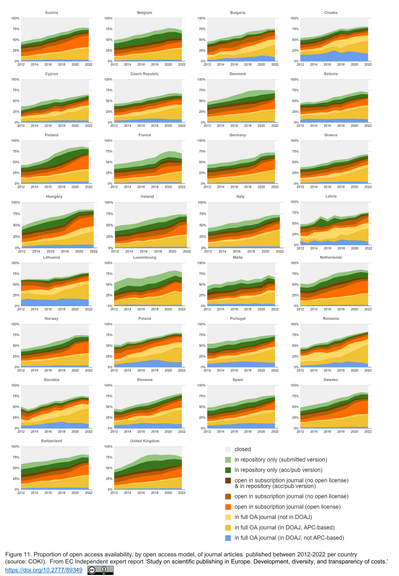
NB. For a report I I did earlier this year for the European Commission (https://doi.org/10.2777/89349), I included both DOAJ-based diamond (blue) and full OA journals not in DOAJ (light yellow) as categories - with very relevant differences between countries.

@MsPhelps @fionabradley As a quick indicator for specific journals I also use the percentage of bright archival from fatcat / #InternetArchiveScholar. https://fatcat.wiki/container/search?q=

It doesn't work everywhere but for the big publishers it's much better than trusting whatever they *say* is the status of a journal.