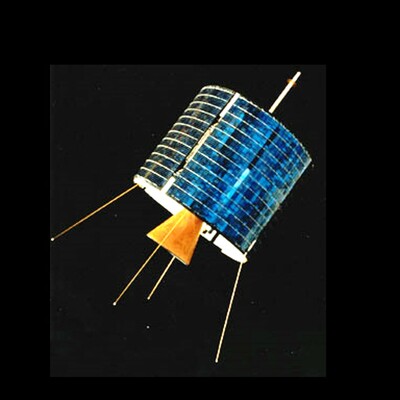
NASA Voyager update - on Sept 26, one more instrument aboard Voyager 2 was turned off to conserve power - the plasma science instrument.

Over the 46 years since launch, Voyager instruments have gradually been shut off as power levels have declined by over 50%. With 4 science instruments left, the Voyagers will continue to boldly go where no spacecraft has gone before.

Note that the plasma science instrument on Voyager 1 failed and was turned off in 2007.

https://blogs.nasa.gov/voyager/2024/10/01/nasa-turns-off-science-instrument-to-save-voyager-2-power/
#Voyager
1/n
NASA Turns Off Science Instrument to Save Voyager 2 Power – Voyager

The Voyager probes are powered by radioisotope thermoelectric generators (RTGs) which convert heat from decaying Plutonium Pu-238 into electricity using thermocouples.

In 47 years, the power level has dropped by over 50% to ~223 watts.

Pu-238 has a half-life of 87.7 years, i.e., in 87.7 years, 50% of its atoms decay to uranium-234 and then to lead-206.

The bi-metallic thermocouples, which are quite inefficient to begin with, also degrade over time, leading to a net loss of ~4W per year.

2/n

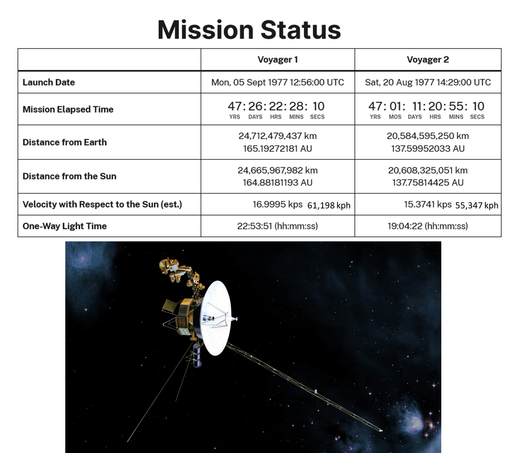
Here are some key metrics on the twin Voyager spacecraft.

Let's take a moment to marvel at the 1970s technology in these spacecraft - computing hardware/software, instruments, RTGs, thrusters, etc. - most of which are still operational after 47 years in the harsh environment of space, 22:53 and 19:04 light hours away resp., with no maintenance or repairs, just workarounds around few failures, quietly exploring where no spacecraft has explored before.
👏
https://science.nasa.gov/mission/voyager/where-are-they-now/
#Voyager
3/n

Where Are They Now? - NASA Science

Both Voyager 1 and Voyager 2 have reached "interstellar space" and each continue their unique journey deeper into the cosmos.

@AkaSci we all know it will be back as a ginormous mass of knowledge, self aware, and call itself “veeger” 🫣! #StarTrek (meets real life)!
@AkaSci just amazing. Great times 70s,80s :) when we we’re happy and didn’t know it :)

@AkaSci 'harsh environment'

you mean like driving on the roads in the american northeast?