Our article 🐌 "Phylogeny of the longest existing gastropod clade (Pleurotomariida) reconstructed with Bayesian and parsimony methods and its implications on gastropod shell characters" 🐚 authored by me, S. HΓΆhna & A. NΓΌtzel is published πŸ₯³

A long #MolluscMonday 🧡😎

https://doi.org/10.1080/14772019.2024.2384141

🐌 Gastropods have a very rich evolutionary history with many extinct groups but there are only few phylogenetic studies with fossil gastropods to understand the evolutionary relationship among different groups. Phylogeny between extinct & extant gastropods are still unresolved.
🐚 The fossil record of extant groups (e.g. Caenogastropoda, Patellogastropoda) do not extend back to the origin time of gastropods (Cambrian) with the exception of slit-shells (Pleurotomariida). Our study is the first gastropod phylogeny covering early Paleozoic to Recent taxa.
🐚 Pleurotomariida is an "ancient" group that were one of the most diverse and abundant gastropod groups in the Paleozoic shallow seas. Today they live in deep water and represented by 44 species that enjoy feeding on sponges like in this picture.
πŸ’» We reconstructed the phylogeny of Pleurotomariida using 93 shell characters and analysing 109 species ranging from the Ordovician to Recent with the Bayesian Fossilised Birth-Death Model and Parsimony analysis.
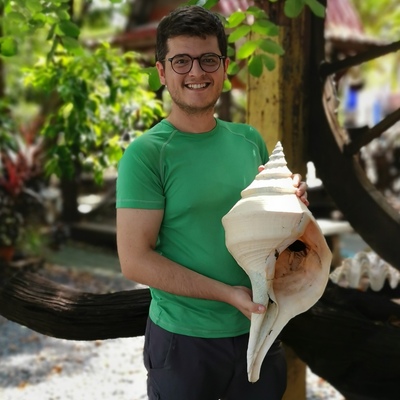
πŸ›οΈ For the analyses, specimens housed in Bavarian State Collections, Natural History Museum Vienna, Natural History Museum London (NHMUK) were used. Here, I am holding the type specimen of Pleurotomaria in NHMUK just before COVID lockdown. This genus gives its name to the group.
🌡 Here is the consensus tree of the most parsimonious trees. There are few issues, such as that the early Paleozoic taxa were reconstructed much away from the root, after Mesozoic taxa, so the tree is incongruent with the appearance date of taxa in the fossil record.
🌳 Here is the Bayesian tree. FBD analysis incorporates fossil ages & reconstructs trees that better fit to the fossil record. According to the FBD tree, only two clades, Pleurotomariini & Worthenielini, survived into the Mesozoic, and only Pleurotomariini survived until now.
πŸ“‰ An analysis of genus diversity of Pleurotomariida using an updated genus list, data from the @PaleoDB and shareholder quorum ubsampling shows that their diversity sharply declined after the end-Permian mass extinction, in contrast to expanding Gastropod diversity. But why?
πŸ€” Could it be due to decrease in character evolutionary rates or speciation rates? The Bayesian analysis indicates there were no differences in character evol. rates across time or between clades. Origination & extinction rates increased until Jurassic but dropped subsequently.
🐚 G. Vermeij suggested that axial characters might be phylogenetically less informative than spiral characters because axial characters are discontinuous. We tested this using the Consistency Index, which is the number of character state changes in ratio to minimum state changes.
πŸ“Š If Cl is high, it indicates less changes, hence more conservatism. The test failed to confirm Vermeij's assumption. The paleontologists who worked on pleurotomariids, including me, observed that characters related to shell slit are more conservative than other shell regions.
🐚 The characters related to slit and selenizone (the shell region formed by the closure of the slit) have higher Cl values than other three shell regions but the difference among regions is not significant.
🐌 In previous articles authored by me and A. Nützel, we suggested that the early ontogenetic shell is more conservative than the late ontogenetic shell. Cl values of early vs. late ontogenetic shells are significantly different, corroborating our opinion.
πŸ“ˆ The data collection also revealed that there is a correlation between larval shell size (and early whorl size) with the adult shell size. This has wide implications, that we discussed in detail in the article... You may check it for more findings and discussions...

πŸ“œ All the data and scripts used in this article can be found in the supplementary material, so you may replicate the findings and use the scripts with your own data and study group πŸ™‚

πŸ…Last but not least, I thank curators for providing access to the collections, colleagues and friends for discussing with me phylogenetic methods, the reviewers and the editors for handling this long article.