
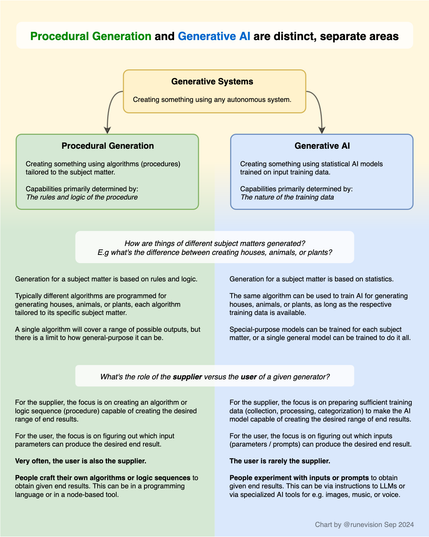
Procedural generation and generative AI are separate, distinct areas under the umbrella term of generative systems.

Regardless of opinions about the respective fields, I hope we can agree on using the right terms for the right things, to foster clear communication.

Feedback on the chart is welcome. Let me know if you find anything inaccurate or misleading, though keep in mind I had to leave out many details for brevity.

#ProcGen #GenerativeAI

@runevision The problem is that people use the term "procedural" to denote anything that is not precomputed i.e. "generated on the fly".

So generative AI would then be a subset of procedural generation ...

This is a futile battle. I remember the time when anything above pushing pixels to the screen was considered "AI" in games - even playing keyframe animations.

Or terms like "mixed reality" (nope, nothing to do with Hololens), "XR" - or "hologram" used to describe Pepper's ghost.

@janoc200 It's actually not very often I've seen people refer to generative AI as procedural generation, just once in a while, which is why I'm not sure attempting to influence the discussion is completely futile. And for example, the procedural generation subreddit is not overrun with generative AI content (on the contrary!) even though way more people are creating that kind of content compared to procedural generation.

@runevision That's probably because the current AI tools are simply not good enough (yet?) and difficult to use for lay persons for most stuff one would want to use as "procedural content".

Apart from talking to NPCs using some LLM which is the low hanging fruit, there isn't much else - e.g. level generation, geometric asset generation, etc. even though attempts have been published. So the "classic" techniques still win here.

@janoc200 Not sure about that. The subreddit has frequent posts of just artistic images generated procedurally. And creating images is certainly easier with generative AI than by coding procedures.

@runevision

I didn't mean generating images - that's apart from textures not something all that useful when working on a game.

When people think about "procedural content" it is usually 3D geometry that is being generated, whether individual objects or entire levels and worlds.

And while there has been some work on creating neural networks capable of generating these, including rigged meshes for animation, it is far from something practically usable so far.

@janoc200 I agree with you in the context of game development, but none of the terms the chart is about - generative systems, procedural generation, and generative AI - are confined to game development.

@runevision

Yes, true - but outside of that context I haven't really encountered anyone making this link between generative AI and generative systems.

OTOH, what do you even define as "procedure" and "rules"?

Would an inference runtime executing a trained network not count as a "procedure" and "algorithm" only because it runs something based on statistics? I think any computer scientist would vehemently disagree there.

Why to even make such a contrived distinction?

@janoc200 I attempted to make it clear in the chart that the defining trait is rules tailored to the subject matter. In procedural generation you'd have different rules for different things. In generative AI you have the same rules, just with different weights or parameters.

@runevision

To me that sort of distinction is rather artificial, IMO.

Moreover, procedural generation doesn't necessarily mean it must be rule-based.

It would make more sense to put it as a distinction between generative neural networks and specifically rule-based (or grammar-based) systems (which can be also non-deterministic, btw) if that's what you want to explain.

Otherwise it is overly general and risks stretching the terminology way too far.

@janoc200 I don't see what's artificial about it. I think it's a very fundamental distinction whether different subject matters are approached by constructing different rules/logic/algorithms, or just by shifting weights based on training data within without changing the logic at all. And by far the most instances of people using the term procedural generation aligns with that distinction as well.