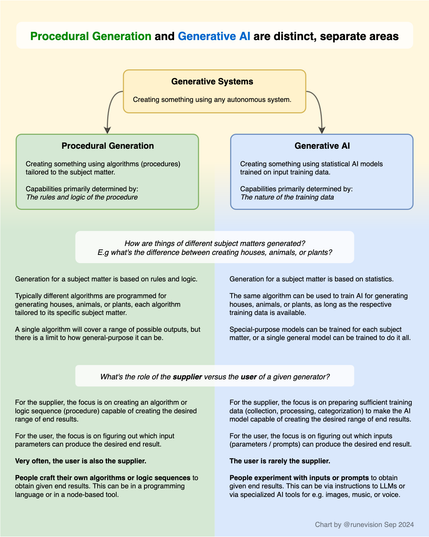
Procedural generation and generative AI are separate, distinct areas under the umbrella term of generative systems.

Regardless of opinions about the respective fields, I hope we can agree on using the right terms for the right things, to foster clear communication.

Feedback on the chart is welcome. Let me know if you find anything inaccurate or misleading, though keep in mind I had to leave out many details for brevity.

#ProcGen #GenerativeAI

@runevision This is a very similar conversation to when I talk to students about "AI" in game dev
(a term that for decades has meant something like "designing and authoring gameplay systems that imply character or intention")
and have to really stress that it's not the same idea as ML, AGI or genAI. And also these days I need to add that stuff sold as "AI" often isn't even any of those things.
@runevision I think a lot of the confusion (and grift) would go away if we could get everyone to just stop using "AI" as in "genAI" and used more accurate/descriptive terms... but that's never going to happen. πŸ˜…

@MrBehemo @runevision

That's my take, too. My first criticism of the chart is that it accepts "Generative AI" as a proper use of "AI."

@Professor_Stevens @MrBehemo AI on its own is such a broad and fuzzy term that has been used about anything that gives even the slightest impression of autonomy. As such it's not very descriptive, as it can mean almost anything.

But the combination "generative AI" has a much more specific usage. It does not refer to a lot of unrelated things. So judged on its capability for clear communication, it works fine IMO.

@runevision @MrBehemo

"AI" is fuzzy because the modern popular press is lazy. Russell & Norvig is the most widely accepted text on AI. The definition there is, β€œthe designing and building of intelligent agents that receive percepts from the environment and take actions that affect that environment.”

@runevision @MrBehemo

One can avoid the implications of a definition by recursively calling for more definitions of the words in a definition. There is, however, more to their book than I can excerpt here. Have you read it?

@Professor_Stevens @MrBehemo I haven't read it; I've mostly read books about AI in the context of game development. But in any case, academics don't really have a monopoly on defining terms and words. The meanings of words evolve based on how people use them in practice, and all anyone can do is attempting to influence it (as I'm doing too here with my chart and posts).

@runevision @MrBehemo

Lacking a monopoly isn't the same as being of no relevance. Your chart makes a (imo, crucial) distinction between procgen and what some people call "gen AI." I am with you all the way on that! But the chart isn't just about gaming.

You asked for feedback. Mine is that you have a great chance with this format to add that not everyone even accepts "gen AI" as AI.

@Professor_Stevens @MrBehemo Diving a bit more into your argument, what is it about generative AI you don't accept as AI? From my understanding, generative AI is based on deep neural networks, which Russell & Norvig specifically cover in their book? Russel has also done presentations that mentioned chatGTP etc. and, while skeptical of their utility, does not seem to question it being under the umbrella of "AI"?
@runevision @Professor_Stevens I would say that until recently the "I" in "AI" was understood to be "Intelligence" but we don't currently have any ML model that is anything like an intelligence. That could be centuries away or even impossible. It's only recently that we reassessed this concept of "intelligence" to include stochastic content generators. I don't see how it can be demonstrated to apply in any meaningful sense of the word.
@MrBehemo @Professor_Stevens Sure, but not just in ML. We don't have anything artificial that's "intelligent" at all by human standards. And if it's not by human standards then, well, it depends on what your standards are. LLMs come closest to passing the Turing Test (arguably they passed it, and now the value of the test is questioned instead), so if anything has a claim to the term "AI" at all, it might as well be that as anything else. But that's all a bit besides the point of my chart.
@runevision @Professor_Stevens
I think you and I are in agreement, Rune. πŸ˜„ I don't really have any criticism of your chart. I was just chatting about the general usage of the terms. To paraphrase what I said way above, it'd be nice if we could redefine everyone's terminology, but we know that's not how language works.
@runevision @Professor_Stevens Side notes: I'm a generalist game dev and educator (beginner levels), not a ML expert by any means. I guess the Turing Test is obsolete at this point.