
Our team at #OIST published the first complete #mitochondrial #genome for an #appendicularian #tunicate, #Oikopleura dioica. Its non-coding region is unusually large and repetitive. We plan to sequence more genomes from related species to reveal patterns of evolutionary conservation that will help elucidating function of the unannotated regions. https://doi.org/10.1093/gbe/evae182
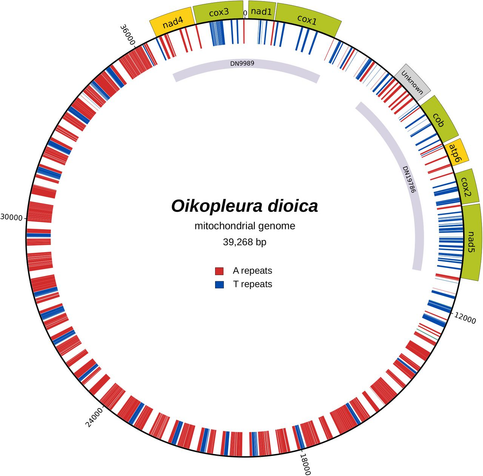
Tracing Homopolymers in Oikopleura dioica’s mitogenome

Abstract. Oikopleura dioica is a planktonic tunicate (Appendicularia class) found extensively across the marine waters of the globe. The genome of a single

OUP Academic
Our genome assembly was published back-to-back in Genome Biology and Evolution with the work of Yael Klirs and her co-authors (https://doi.org/10.1093/gbe/evae181), and our results are in very good agreement. I am very glad that it happened, because some of the features of #Oikopleura dioica's mitogenome were difficult to accept for #GenBank curators. I hope that our publications will lead them to revise their point of view and accept our gene annotation.
Evolutionary Insights from the Mitochondrial Genome of Oikopleura dioica: Sequencing Challenges, RNA Editing, Gene Transfers to the Nucleus, and tRNA Loss

Abstract. Sequencing the mitochondrial genome of the tunicate Oikopleura dioica is a challenging task due to the presence of long poly-A/T homopolymer stre

OUP Academic