
Last weekend, I traveled to Las Vegas for @defcon 32, where I had the immense privilege of giving a solo talk on Track 1, entitled "Disenshittify or die! How hackers can seize the means of computation and build a new, good internet that is hardened against our asshole bosses' insatiable horniness for enshittification":

https://info.defcon.org/event/?id=54861

1/
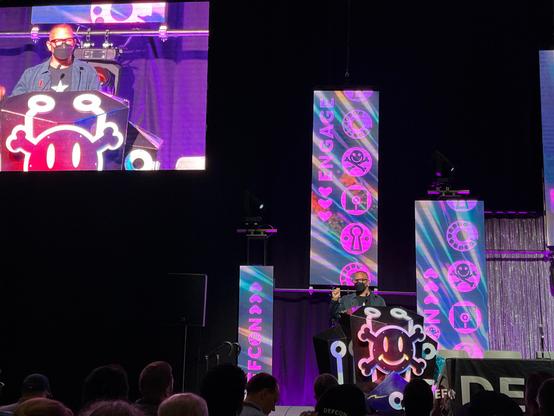
If you'd like an essay-formatted version of this thread to read or share, here's a link to it on pluralistic.net, my surveillance-free, ad-free, tracker-free blog:

https://pluralistic.net/2024/08/17/hack-the-planet/#how-about-a-nice-game-of-chess

2/

Pluralistic: “Disenshittify or Die” (17 Aug 2024) – Pluralistic: Daily links from Cory Doctorow

This was a followup to last year's talk, "An Audacious Plan to Halt the Internet's Enshittification," a talk that kicked off a lot of international interest in my analysis of platform decay ("enshittification"):

https://www.youtube.com/watch?v=rimtaSgGz_4

The Defcon organizers have earned a restful week or two, and that means that the video of my talk hasn't yet been posted to Defcon's Youtube channel, so in the meantime, I thought I'd post a lightly edited version of my speech crib.

3/

DEF CON 31 - An Audacious Plan to Halt the Internet's Ensh*ttification - Cory Doctorow

YouTube

If you're headed to Burning Man, you can hear me reprise this talk at Palenque Norte (7&E); I'm kicking off their lecture series on Tuesday, Aug 27 at 1PM.

4/

What the fuck *happened* to the old, good internet?

I mean, sure, our bosses were a little surveillance-happy, and they were usually up for sharing their data with the NSA, and whenever there was a tossup between user security and growth, it was always YOLO time.

But Google Search used to *work*. Facebook used to show you posts from people you *followed*. Uber used to be cheaper than a taxi *and* pay the driver more than a cabbie made.

5/

Amazon used to sell *products*, not Shein-grade self-destructing dropshipped garbage from all-consonant brands. Apple used to defend your privacy, rather than spying on you with your no-modifications-allowed Iphone.

There was a time when you searching for an album on Spotify would get you that album - *not* a playlist of insipid AI-generated covers with the same name and art.

6/

Microsoft used to sell you software – sure, it was buggy – but now they just let you access apps in the cloud, so they can watch how you use those apps and strip the features you use the most out of the basic tier and turn them into an upcharge.

What – and I cannot stress this enough – the *fuck* happened?!

I’m talking about enshittification.

7/

Here’s what enshittification looks like from the outside: First, you see a company that’s being good to its end users. Google puts the best search results at the top; Facebook shows you a feed of posts from people and groups you followl; Uber charges small dollars for a cab; Amazon subsidizes goods and returns and shipping and puts the best match for your product search at the top of the page.

8/

That’s stage one, being good to end users. But there’s another part of this stage, call it stage 1a). That’s figuring out how to lock in those users.

There’s *so many* ways to lock in users.

If you’re Facebook, the users do it for you. You joined Facebook because there were people there you wanted to hang out with, and other people joined Facebook to hang out with you.

9/

That’s the old “network effects” in action, and with network effects come “the collective action problem." Because you love your friends, but god*damn* are they a pain in the ass! You all agree that FB sucks, sure, but can you all agree on when it’s time to leave?

No way.

Can you agree on where to go next?

*Hell no*.

10/

You’re there because that’s where the support group for your rare disease hangs out, and your bestie is there because that’s where they talk with the people in the country they moved away from, then there’s that friend who coordinates their kid’s little league car pools on FB, and the best dungeon master you know isn’t gonna leave FB because that’s where her customers are.

11/

So you’re stuck, because even though FB use comes at a high cost – your privacy, your dignity and your sanity – that’s still less than the *switching cost* you’d have to bear if you left: namely, all those friends who have taken you hostage, and whom you are holding hostage

12/

Now, sometimes companies lock you in with money, like Amazon getting you to prepay for a year’s shipping with Prime, or to buy your Audible books on a monthly subscription, which virtually guarantees that every shopping search will start on Amazon, after all, you’ve already paid for it.

13/

Sometimes, they lock you in with DRM, like HP selling you a printer with four ink cartridges filled with fluid that retails for more than $10,000/gallon, and using DRM to stop you from refilling any of those ink carts or using a third-party cartridge. So when one cart runs dry, you have to refill it or throw away your investment in the remaining three cartridges and the printer itself.

14/

Sometimes, it’s a grab bag:

* You can’t run your Ios apps without Apple hardware;

* you can’t run your Apple music, books and movies on anything except an Ios app;

* your iPhone uses parts pairing – DRM handshakes between replacement parts and the main system – so you can’t use third-party parts to fix it; and

15/

* every OEM iPhone part has a microscopic Apple logo engraved on it, so Apple can demand that the US Customs and Border Service seize any shipment of refurb Iphone parts as trademark violations.

Think Different, amirite?

Getting you locked in completes phase one of the enshittification cycle and signals the start of phase two: making things worse for you to make things better for business customers.

16/

For example, a platform might poison its search results, like Google selling more and more of its results pages to ads that are identified with lighter and lighter tinier and tinier type.

Or Amazon selling off search results and calling it an “ad” business. They make $38b/year on this scam. The first result for your search is, on average, 29% more expensive than the best match for your search. The first row is 25% more expensive than the best match.

17/

On average, the best match for your search is likely to be found *seventeen* places down on the results page.

Other platforms sell off your feed, like Facebook, which started off showing you the things you *asked* to see, but now the quantum of content from the people you follow has dwindled to a homeopathic residue, leaving a void that Facebook fills with things that people *pay* to show you: boosted posts from publishers you haven’t subscribed to, and, of course, ads.

18/

Now at this point you might be thinking ‘sure, if you’re not paying for the product, you’re the product.'

Bullshit!

*Bull.*

*Shit*.

The people who buy those Google ads? They pay more every year for worse ad-targeting and more ad-fraud

Those publishers paying to nonconsensually cram their content into your Facebook feed? They *have* to do that because FB suppresses their ability to reach the people who actually subscribed to them

19/

The Amazon sellers with the *best* match for your query have to outbid everyone else just to show up on the first page of results. It costs so much to sell on Amazon that between 45-51% of every dollar an independent seller brings in has to be kicked up to Don Bezos and the Amazon crime family. Those sellers don’t have the kind of margins that let them pay 51% They have to raise prices in order to avoid losing money on every sale.

20/

"But wait!" I hear you say!

[Come on, say it!]

"But wait! Things on Amazon aren’t more expensive that things at Target, or Walmart, or at a mom and pop store, or direct from the manufacturer.

"How can sellers be raising prices on Amazon if the price at Amazon is the same as at is everywhere else?"

[Any guesses?!]

21/

That’s right, they charge more *everywhere*. They *have to*. Amazon binds its sellers to a policy called “most favored nation status,” which says they can’t charge more on Amazon than they charge elsewhere, including direct from their own factory store.

So every seller that wants to sell on Amazon has to raise their prices *everywhere else*.

Now, these sellers are Amazon’s best customers. They’re paying for the product, and they’re *still* getting screwed.

22/

Paying for the product doesn’t fill your vapid boss’s shriveled heart with so much joy that he decides to stop trying to think of ways to fuck you over.

Look at Apple. Remember when Apple offered every Ios user a one-click opt out for app-based surveillance? And *96%* of users clicked that box?

(The other four percent were either drunk or Facebook employees or drunk Facebook employees.)

That cost Facebook at least *10 billion dollars per year* in lost surveillance revenue?

23/

I mean, you *love* to see it.

But did you know that at the *same time* Apple started spying on Ios users in the *same way* that Facebook had been, for surveillance data to use to target users for its competing advertising product?

Your Iphone isn’t an ad-supported gimme. You paid a thousand fucking dollars for that distraction rectangle in your pocket, and you’re *still* the product. What’s more, Apple has rigged Ios so that you can’t mod the OS to block its spying.

24/

If you’re not *not* paying for the product, you’re the product, and if you *are* paying for the product, you’re *still* the product.

Just ask the farmers who are expected to swap parts into their own busted half-million dollar, mission-critical tractors, but can’t actually *use* those parts until a technician charges them $200 to drive out to the farm and type a parts pairing unlock code into their console.

25/

John Deere’s not giving away tractors. Give John Deere a half mil for a tractor and you will be the product.

Please, my brothers and sisters in Christ. Please! Stop saying ‘if you’re not paying for the product, you’re the product.’

OK, OK, so that’s phase two of enshittification.

Phase one: be good to users while locking them in.

Phase two: screw the users a little to you can good to business customers while locking *them* in.

26/

Phase three: screw *everybody* and take all the value for yourself. Leave behind the absolute bare minimum of utility so that everyone stays locked into your pile of shit.

Enshittification: a tragedy in three acts.

That’s what enshittification looks like from the outside, but what’s going on *inside* the company? What is the pathological mechanism? What sci-fi entropy ray converts the excellent and useful service into a pile of shit?

27/

That mechanism is called *twiddling*. Twiddling is when someone alters the back end of a service to change how its business operates, changing prices, costs, search ranking, recommendation criteria and other foundational aspects of the system.

Digital platforms are a twiddler’s utopia. A grocer would need an army of teenagers with pricing guns on rollerblades to reprice everything in the building when someone arrives who’s extra hungry.

28/

Whereas the McDonald’s Investments portfolio company Plexure advertises that it can use you data to predict when a user has just gotten paid so the seller can tack an extra couple bucks onto the price of their breakfast sandwich.

And of course, as the prophet @GreatDismal warned us, ‘cyberspace is everting.' With digital shelf tags, grocers can change prices whenever they feel like, like the grocers in Norway, whose e-ink shelf tags change the prices *2,000 times per day*.

29/

Every Uber driver is offered a different wage for every job. If a driver has been picky lately, the job pays more. But if the driver has been desperate enough to grab every ride the app offers, the pay goes down, and down, and down.

The law professor @veenadubal calls this ‘algorithmic wage discrimination.' It’s a prime example of twiddling.

30/

Every youtuber knows what it’s like to be twiddled. You work for weeks or months, spend thousands of dollars to make a video, then the algorithm decides that no one - not your own subscribers, not searchers who type in the exact name of your video - will see it.

Why? Who knows? The algorithm’s rules are not public.

Because content moderation is the last redoubt of security through obscurit: they can’t tell you what the como algorithm is downranking because then you’d cheat.

31/

@pluralistic

And even if you buy the name brand ink cartridges, if you don't buy them often enough, they lock you out of your printer.

My Epson printer claims that it can't recognize the EPSON cyan, magenta & yellow ink cartridges that are in it. They're the same cartridges that have always been in it. I just don't replace them very often, because we rarely print in color.

So... I have to replace them, even though they're not empty, because the printer won't work until I do.

@ZhiZhu

Yeah I just tossed my whole printer. Have laser now. What is so stupid is that when this model is on sale its cheaper than a replacement cartridge.

@pluralistic

@oldgeek @ZhiZhu @pluralistic I just tossed my laser printer and went for a tank ink-jet. Bottles of ink are around £30 for maybe 5,000 pages, so < 1p per page. And that's the manufacturer's ink. 3rd party ink is even cheaper, but I'm twitchy about blocked nozzles.

@tokensane @oldgeek @ZhiZhu @pluralistic

tank printers are good if you print frequently, they want running every day really.

Lasers are better if you print infrequently.