The Bernoulli numbers are defined like this:

x/(eˣ - 1) = B₀ + B₁x + B₂x²/2! + B₃x³/3! + ....

and if you grind them out, you get

B₀ = 1
B₁ = -1/2
B₂ = 1/6
B₃ = 0
B₄ = -1/30

and so on. The pattern is sort of strange.

They're connected to hundreds of interesting things. For example if you want to figure out a sum like

1³ + 2³ + 3³ + ... + 10³

or

1⁸ + 2⁸ + 3⁸ + ... + 1,000,000⁸

you can use a formula that involves Bernoulli numbers. The video here explains it.

But where the hell did this function x/(eˣ - 1) come from?

If D means derivative:

(Df)(x) = f'(x)

then eᴰ - 1 is a so-called 'difference operator':

((eᴰ - 1)f)(x) = f(x+1) - f(x)

which you can show using the Taylor series for f. So D/(eᴰ - 1) is about derivatives versus differences, and its inverse is about integrals versus sums. This lets you reduce sums like those above to integrals... 𝑖𝑓 you know your Bernoulli numbers.

But x/(eˣ - 1) also shows up when you compute the expected energy of a quantum harmonic oscillator in thermal equilibrium!

Let's work in units where ℏ = 1. Say we have a quantum harmonic oscillator whose allowed energies are 0, 1, 2, 3, ... etcetera. If we take its average or 'expected' energy at temperature T, and divide it by T, we get

x/(eˣ - 1)

where x = 1/T.

So the quantum harmonic oscillator secretly knows about Bernoulli numbers.

What does this fact really mean??? I don't know. I once read a book called Triangle of Thought about a conversation between Alain Connes and two other mathematicians, and he said this fact explained a lot of stuff. But he didn't go into any detail, so I'm left looking for clues.

(1/3)

https://www.youtube.com/watch?v=fw1kRz83Fj0

Power sum MASTER CLASS: How to sum quadrillions of powers ... by hand! (Euler-Maclaurin formula)

YouTube

By the way, here you can see a calculation of the expected energy of a quantum harmonic oscillator:

https://phys.libretexts.org/Bookshelves/Thermodynamics_and_Statistical_Mechanics/Essential_Graduate_Physics_-_Statistical_Mechanics_(Likharev)/02%3A_Principles_of_Physical_Statistics/2.05%3A_Harmonic_oscillator_statistics

And here's a little sanity check. I said the expected energy divided by temperature is

x/(eˣ - 1)

where x = 1/T. But in the limit T → ∞ the quantum harmonic oscillator should reduce to the classical harmonic oscillator. For that, the expected energy divided by temperature is just 1, since the oscillator has 2 degrees of freedom (position and momentum), and the equipartition theorem says we should get 1/2 times the number of degrees of freedom. And indeed, the limit of

x/(eˣ - 1)

as x → 0 is 1.

This number 1 is also, by definition, the 0th Bernoulli number! So the 0th Bernoulli number is telling us the energy per temperature of an oscillator in the high-temperature limit. The rest of the Bernoulli numbers are telling us the 'low-temperature corrections' to the energy per temperature:

x/(eˣ - 1) = B₀ + B₁x + B₂x²/2! + B₃x³/3! + ....

where x = 1/T.

(2/3)

2.5: Harmonic Oscillator Statistics

Physics LibreTexts
Bernoulli Numbers and the Harmonic Oscillator

I keep wanting to understand Bernoulli numbers more deeply, and people keep telling me stuff that’s fancy when I want to understand things simply. But let me try again. The Bernoulli numbers …

Azimuth
@johncarlosbaez Two formulae are not rendering in the "little sanity check" paragraph (missing the "latex" command I guess).
@bstacey - thanks for the sanity check!

@johncarlosbaez
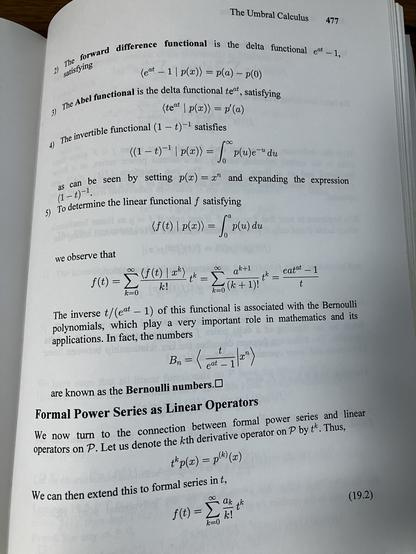
This reminds me the umbral calculus, which studies the relationship between linear operators and some formal series .

("Advanced Linear Algebra" by S. Roman)

@hatomatsu - yes, that looks very related. Thanks! My own treatment is here:

https://math.ucr.edu/home/baez/qg-winter2004/bernoulli.pdf

@johncarlosbaez it looks very similar to umbral calculus, but your paper is more easy to follow. I love it. thank you
@hatomatsu - thanks! Yes, I've always found the umbral calculus a bit mysterious - perhaps because it's 'formal' - and many other people do too, even though Gian-Carlo Rota and others have tried to demystify it.

@johncarlosbaez There's a callback to my youth ... I used the Umbral Calculus in my PhD, talking about a generalisation of the chromatic function for graphs.

I'm almost tempted to find my thesis and see what I said ...

CC: @hatomatsu