It's official: the DOJ has won its case, and Google is a convicted monopolist. Over the next six months, we're gonna move into the "remedy" phase, where we figure out what the court is going to order Google to do to address its illegal monopoly power:

https://pluralistic.net/2024/08/07/revealed-preferences/#extinguish-v-improve

-

If you'd like an essay-formatted version of this thread to read or share, here's a link to it on pluralistic.net, my surveillance-free, ad-free, tracker-free blog:

https://pluralistic.net/2024/08/12/defaults-matter/#make-up-your-mind-already

1/

Pluralistic: The Google antitrust remedy should extinguish surveillance, not democratize it (07 Aug 2024) – Pluralistic: Daily links from Cory Doctorow

That's just the beginning, of course. Even if the court orders some big, muscular remedies, we can expect Google to appeal (they've already said they would) and that could drag out the case for years. But that can be a feature, not a bug: a years-long appeal will see Google on its very best behavior, with massive, attendant culture changes inside the company.

2/

A Google that's fighting for its life in the appeals court isn't going to be the kind of company that promotes a guy whose strategy for increasing revenue is the make Google Search deliberately worse, so that you will have to do more searches (and see more ads) to get the info you're seeking:

https://pluralistic.net/2024/04/24/naming-names/#prabhakar-raghavan

It's hard to overstate how much good stuff can emerge from a company that's mired itself in antitrust hell with extended appeals.

3/

Pluralistic: The specific process by which Google enshittified its search (24 Apr 2024) – Pluralistic: Daily links from Cory Doctorow

In 1982, IBM wriggled off the antitrust hook after a 12-year fight that completely transformed the company's approach to business. After more than a decade of being micromanaged by lawyers who wanted to be sure that the company didn't screw up its appeal and anger antitrust enforcers, IBM's executives were totally transformed.

4/

When the company made its first PC, it decided to use commodity components (meaning anyone could build a similar PC by buying the same parts), and to buy its OS from an outside vendor called Micros-Soft (meaning competing PCs could use the same OS), and it turned a blind eye to the company that cloned the PC ROM, enabling companies like Dell, Compaq and Gateway to enter the market with "PC clones" that cost less and did more than the official IBM PC:

https://www.eff.org/deeplinks/2019/08/ibm-pc-compatible-how-adversarial-interoperability-saved-pcs-monopolization

5/

'IBM PC Compatible': How Adversarial Interoperability Saved PCs From Monopolization

Update, May 4, 2021: This article was corrected to change the version of DOS that ran on PC compatibles and the model of Intel chip they shipped with; it was also updated to correct which team implemented the spec as code for a new ROM.Adversarial interoperability is what happens when someone makes...

Electronic Frontier Foundation

The big question is whether the court will order a Google break up, say, by selling off Android, its ad-tech stack, and Chrome. That's a question I'll address on another day. For today, I want to think about how to de-monopolize browsers, the key portal to the internet. The world has two extremely dominant browsers, Safari and Chrome, and each of them are owned by an operating system vendor that pre-installs their own browser on their devices and pre-selects them as the default.

6/

Defaults matter. That's a huge part of Judge Mehta's finding in the Google case, where the court saw evidence from Google's own internal research suggesting that people rarely change defaults, meaning that whatever the gadget does out of the box it will likely do forever. This puts a lie to Google's longstanding defense of its monopoly power: "choice is just a click away." Sure, it's just a click away - a click, you're pretty sure no one is ever going to make.

7/

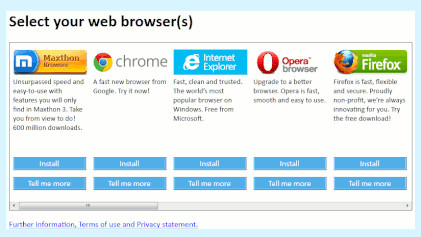
This means that any remedy to Google's browser dominance is going to involve a lot of wrangling about defaults. That's not a new wrangle, either. For many years, regulators and tech companies have tinkered with "choice screens" that were nominally designed to encourage users to try out different browsers and brake the inertia of the big two browsers that came bundled with OSes.

8/

These choice screens have a mixed record. Google's 2019 Android setup choice screen for the European Mobile Application Distribution Agreement somehow managed to result in the vast majority of users sticking with Chrome. Microsoft had a similar experience in 2010 with BrowserChoice.eu, its response to the EU's 2000s-era antitrust action:

https://en.wikipedia.org/wiki/BrowserChoice.eu

9/

BrowserChoice.eu - Wikipedia

Does this mean that choice screens don't work? Maybe. The idea of choice screens comes to us from the "choice architecture" world of "nudging," a technocratic pseudoscience that grew to prominence by offering the promise that regulators to could make big changes without having to do any real regulating:

https://verfassungsblog.de/nudging-after-the-replication-crisis/

10/

Nudging After the Replication Crisis: On Uncertain Effects of Behavioral Governance and the Way Forward

Not so long ago, nudging seemed to many to be the governance tool of the future. Behavioral interventions, like reminders or information about other people’s behavior, come at low cost, help their addressees make better choices, and do not hamper their addresses’ autonomy. Meanwhile, however, the replication crisis has shaken the behavioral sciences, famous studies have been retracted due to data fraud, and, more generally, the very effectiveness of nudging has been put into question.

Verfassungsblog

Nudge research is mired in the "replication crisis" (where foundational research findings turn out to be nonreplicable, due to bad research methodology, sloppy analysis, etc) and nudge researchers keep getting caught committing academic fraud:

https://www.ft.com/content/846cc7a5-12ee-4a44-830e-11ad00f224f9

When the first nudgers were caught committing fraud, more than a decade ago, they were assumed to be outliers in an otherwise honest and exciting field:

https://www.npr.org/2016/10/01/496093672/power-poses-co-author-i-do-not-believe-the-effects-are-real

11/

Harvard fraud claims fuel doubts over science of behaviour

Field that includes ‘nudge’ theory has gained broad traction within businesses but some findings are contested

Financial Times

Today, it's hard to find much to salvage from the field. To the extent the field is taken seriously today, it's often due to its *critics* repeating the claims of its boosters, a process Lee Vinsel calls "criti-hype":

https://sts-news.medium.com/youre-doing-it-wrong-notes-on-criticism-and-technology-hype-18b08b4307e5

12/

You’re Doing It Wrong: Notes on Criticism and Technology Hype

Maybe more people are writing about the real and potential problems of technology today than ever before. That is mostly a good thing. The list of books and articles from the last few years that have…

Medium

For example, the term "dark patterns" lumps together really sneaky tactics with blunt acts of fraud. When you click an "opt out of cookies" button and get a screen that says "Success!" but which has a tiny little "confirm" button on it that you have to click to *actually* opt out, that's not a "dark pattern," it's just a scam:

https://pluralistic.net/2022/03/27/beware-of-the-leopard/#relentless

12/

Pluralistic: 27 Mar 2022 – Pluralistic: Daily links from Cory Doctorow

By ascribing widespread negative effects to subtle psychological manipulation ("dark patterns") rather than obvious and blatant fraud, we inadvertently elevate "nudging" to a real science, rather than a cult led by scammy fake scientists.

All this raises some empirical questions about choice screens: do they work (in the sense of getting people to break away from defaults), and if so, what's the best way to make them work?

13/

This is an area with a pretty good literature, as it turns out, thanks in part due to some natural experiments, like when Russia forced Google to offer choice screens for Android in 2017, but didn't let Google design that screen. The Russian policy produced a significant switch away from Google's own apps to Russian versions, primarily made by Yandex:

https://cepr.org/publications/dp17779

14/

In 2023, Mozilla Research published a detailed study in which 12,000 people from Germany, Spain and Poland set up simulated mobile and desktop devices with different kinds of choice screens, a project spurred on by the EU's Digital Markets Act, which is going to mandate choice screens starting this year:

https://research.mozilla.org/browser-competition/choicescreen/

I'm spending this week reviewing choice screen literature, and I've just read the Mozilla paper, which I found very interesting, albeit limited.

15/

Can browser choice screens be effective? – Mozilla Research

Innovative new research from Mozilla shows that design is critical Browser choice screens are back on the menu. Most notably, the EU’s Digital Markets Act (DMA) will require them from ...

Mozilla Research

The biggest limitation is the researchers are getting users to *simulate* setting up a new device and then asking them how satisfied they are with the experience. That's certainly a question worth researching, but a far *more* important question is "How do users feel about the setup choices they made later, after living with them on the devices they use every day?" Unfortunately, that's a much more expensive and difficult question to answer, and beyond the scope of this paper.

16/

With that limitation in mind, I'm going to break down the paper's findings here to draw some conclusions about what we should look for in any kind of choice screen remedy that comes out of the DOJ antitrust victory over Google.

The first thing note is that people report liking choice screens. When users get to choose their browsers, they expect to be happy with that choice; by contrast, users are skeptical that they'll like the default browser the vendor chose for them.

17/

Users don't consider choice screens to be burdensome, and adding a choice screen doesn't appreciably increase setup time.

There are some nuances to this. Users like choice screens *during device setup* but they *don't* like choice screens that pop up the first time they use a browser. That makes total sense: "choosing a browser" is colorably part of the "setting up your gadget" task.

18/

By contrast, the first time you open a browser on a new device, it's probably to *get something else done* (e.g. look up how to install a piece of software you used on your old device) and being interrupted with a choice screen at that moment is an unwelcome interruption.

19/

This is the psychology behind those obnoxious cookie-consent pop-ups that website bombard you with when you first visit them: you've clicked to that website because you need something it has, and being stuck with a privacy opt-out screen at that moment is predictably frustrating (which is why companies do it, and also why the DMA is going to punish companies that do).

20/

The researchers experimented with different kinds of choice screens, varying the number of browsers on offer and the amount of information on each. Again, users *report* prefering more choices and more information, and indeed, more info and more info is correlated with choosing indie, non-default browsers, but this effect is small (<10%), and no matter what kind of choice screen users get, most come away from the experience without absorbing any knowledge about indie browsers.

21/

The *order* in which browsers are presented has a *much* larger effect than how many browsers or how much detail is present. People say they want lots of choices, but they usually choose one of the first four options. That said, users who get choice screens *say* it changes which browser they'd choose as a default.

22/

Some of these contradictions appear to stem from users' fuzziness on what "default browser" means. For an OS vendor, "default browser" is the browser that pops up when you click a link in an email or social media. For most users, "default browser" means "the browser pinned to my home screen."

23/

Where does this leave us? I think it cashes out to this: choice screens will probably make a appreciable, but not massive, difference in browser dominance. They're cheap to implement, have no major downsides, and are easy to monitor. Choice screens might be needed to address Chrome's dominance *even if* the court orders Google to break off Chrome and stand it up as a separate business (we don't want *any* browser monopolies, even if they're not owned by a search monopolist!).

24/

So yeah, we should probably make a lot of noise to the effect that the court should order a choice screen, as *part* of a remedy.

That choice screen should be presented during device setup, with the choices presented in random order - with this caveat: Chrome should *never* appear in the top four choices.

25/

All of that would help address the browser duopoly, even if it doesn't solve it. I would love to see more market-share for Firefox, which is the browser I've used every day for more than a decade, on my laptop and my phone. Of course, Mozilla has a role to play here. The company says it's going to refocus on browser quality, at the expense of the various side-hustles it's tried, which have ranged from uninteresting to catastrophically flawed:

https://www.fastcompany.com/91167564/mozilla-wants-you-to-love-firefox-again

26/

Mozilla wants you to love Firefox again

Mozilla is reinvesting in Firefox after letting it languish for years. But some of those investments may upset their community of die-hards.

Fast Company

For example, there was the tool to automatically remove your information from scummy data brokers, that they outsourced to a scummy data-broker:

https://www.theverge.com/2024/3/22/24109116/mozilla-ends-onerep-data-removal-partnership

And there's the "Privacy Preserving Attribution" tracking system that helps advertisers target you with surveillance advertising (in a way that's less invasive than existing techniques).

27/

Mozilla just ditched its privacy partner because its CEO is tied to data brokers

Mozilla is ending its partnership with Onerep, the data removal service it teamed up with to help users find and take down information exposed on the web.

The Verge
the closest thing to a choice screen I think I've ever used is the archinstall script asking me which DE, bootloader, audio pipeline etc. I want to use