5am talk tomorrow "No, that's not a UFO, that's Starlink" for the IAU General Assembly, about how astronomers are doing ALL of the public education for satellite companies while they destroy the sky, the atmosphere, and Low Earth Orbit for profit. Meanwhile, every fucking article that talks about SpaceX includes the line "SpaceX did not respond to a request for comment." Do better, SpaceX. You suck.

I hope I am tired enough that I avoid rage-screaming over Zoom.
...especially because my family will all be asleep while I'm giving the talk and probably wouldn't appreciate me rage-screaming in the house with them.

It's just after 5am, I've been signed in to the (empty) Zoom room for 15 min (as I was directed) but nobody is here yet to test my presentation, and I can't hear the sound in the room (but I *can* hear annoying hold music). And I heard that in the previous session all the remote speakers had no sound. So...I'm not real confident this is going to work...

Why are hybrid meetings so hard to implement?

Ok, I think that they can now hear us remote speakers in the room? Maybe? That was a very fast tech check for 5am! But I'm glad to know I'm not the only remote speaker this session, and I'm not until the very end, so hopefully everything will work perfectly by the time they get to my talk.
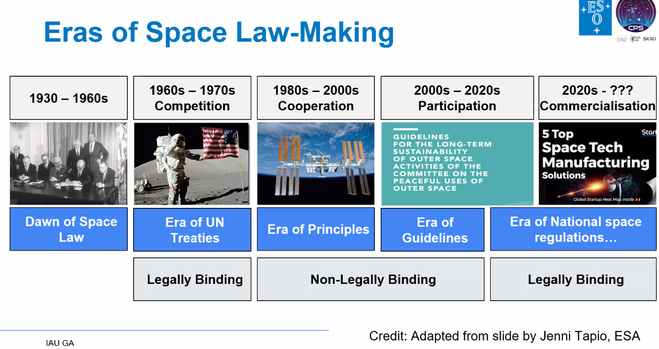
Andy Williams showing the current state of things. "We're not really in a treaty-making era anymore" but we *are* in a national-law making era, and so looks like going through individual countries is important. (Which is crappy, because there are a lot of countries...)

Yana Yakushina ran a big analysis of individual countries' rules around dark skies, quiet skies, and reduction of impacts to astronomy.

She didn't say this outright, but my takeaway is that astronomy IS space exploration and thus should be protected by the Outer Space Treaty. But some countries have pushed astronomy to the sidelines.

She says the primary area for national-level legislation that is effective is environmental law and space law, and sometimes protection of cultural heritage

Valdivia Lefort: general recommendations on how to get dark and quiet skies protections to happen at the national level. Notes that countries that DO have protections already usually focus on terrestrial light pollution only, with no provision for satellite light pollution.

Focusing on talking about the environmental impact of satellites is going to be most powerful. (Just referenced a paper I'm a co-author on, yay)

@sundogplanets As a boy, I lived in an area with dark skies (300 acres of woods behind our house). Where I live now, in the Baltimore-DC suburbs, is ridiculous. The new streetlights put in about 5 years ago with no input from us, the people who live here, were so bright, I thought a car was shining its headlights into my yard when they were first installed. It's like living in a concentration camp.
@flyhigh I'm so sorry that it's so bright there! Have you tried advocating? There's a lot of great groups that do this work, Dark Sky International is a good place to start, they have chapters all over the world: https://darksky.org/
DarkSky International

DarkSky International restores the nighttime environment and protects communities from the harmful effects of light pollution through outreach, advocacy, and conservation.

DarkSky International
@sundogplanets I've thought about this and will get on it. It was a Republican county leader who did this (he's out of office now), typical. Good idea!
@sundogplanets Okay, wrote a letter to my county councilmember, we'll see what happens! Also, there's no chapter of that dark skies group here in Maryland, but I'll see what I can do about that.
@flyhigh thank you!! Every little bit of advocacy like this makes a difference!