 Neurologist
Effcient distribution of labour my ass
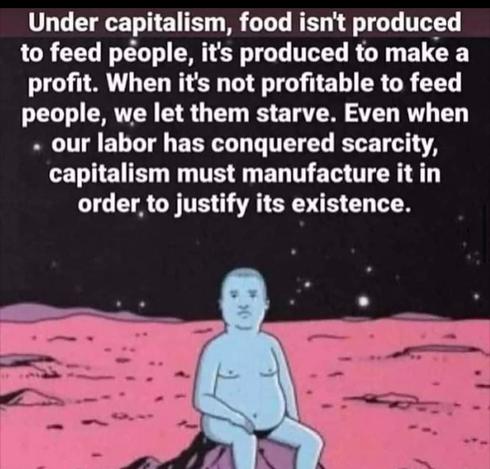
Effcient distribution of labour my ass
It, unfortunately, is an efficient distribution of labor, at least relative to other systems. Not because wasting food for profit isn’t fucking heinous, but because the mobility of investor capital and responsiveness of market prices is less inefficient than reciprocal economies or central planning.
However, we are at a point in human society where raw efficiency is no longer the bottleneck for our quality of life. Capitalism was an ugly solution to a real problem, but we can probably bid it farewell at this point, if only we can dislodge the elites who benefit from perpetuating it.
Capitalism was an ugly solution to a real problem
Not really, though. I mean, if you want to stick to the last 2000 years, we still have cities that were fed in a feudal rather than capitalist system. Not that those systems were better or more efficient mobilizing labor, but the problem you’re referring to wasn’t really there.
That’s not to mention at least several examples in the anthropological and archaeological record of large scale societies that did not rely on what we define as capitalism to feed their people.
I think it’s a pretty crazy oversimplification to say capitalism just popped up as a solution to a problem.
Not really, though. I mean, if you want to stick to looking at the last 2000 years, we still have cities that were fed in a feudal rather than capitalist system. Not that those systems were better or more efficient mobilizing labor, but the problem you’re referring to wasn’t really there.
Feudal societies are notably horrendous at efficient resource distribution, and don’t get me started on the weird fetishization of reciprocity economies.
There’s a reason that capitalist economies exploded in growth once the main features of modern capitalism took root, and it sure as shit ain’t because capitalists are just that eager to contribute to the national good.
That’s not to mention at least several examples in the anthropological and archaeological record of large scale societies that did not rely on what we define as capitalism to feed their people.
And those societies, much like any pre-modern societies, did not feed their people particularly reliably. Notably, when the Roman Empire united the Mediterranean under a unified proto-capitalist market, famine conditions drastically reduced (though very much were not completely eliminated, mind you). Not because the Roman Empire was particularly concerned about the plight of the poor - it very much was not. But because market economies and capitalist (or proto-capitalist) investment behaviors can redirect excess resources from Region A, to Region B which lacks them, with astounding speed and responsiveness, and with minimal additional labor or material investment (at least compared to alternative methods).
I think it’s a pretty crazy oversimplification to say capitalism just popped up as a solution to a problem.
The problem was inefficient methods of resource distribution. Capitalism was the solution. Modern technology, both material and organizational, allows us other choices now, but capitalism didn’t spread because it was just the chic aesthetic of the time. Capitalism spread because it is significantly more efficient than feudal or guild/mercantilist economies.
Or it’s because of nitrogen fertilizers and the scientific method.
One of the two.

 PugJesus