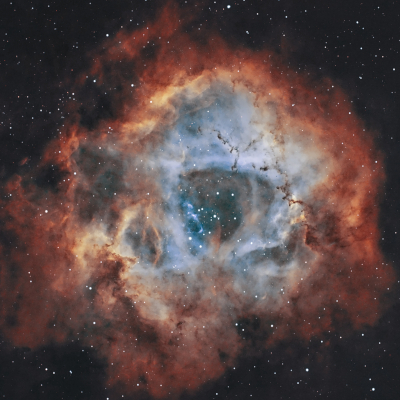
The Lagoon Nebula. A week ago I bought the Seestar S50 telescope because it looked very beginner friendly and it was my first time ever attempting deep space photography so I don’t have many clues about what it takes. For editing I was watching tutorials about Siril and how to apply Webb telescope color palette so I gave it a try.
These series are my very first attempts and I have much to learn, but so far I like looking at the dark sky and discover what is out there. #astrophotography #deepsky
@julesk Fantastic!
@jdlbt thanks so much! I am so excited for when the night comes :)
@julesk One negative side effect is that you'll now become addicted to checking the weather for clear skies...
@jdlbt I already do :)) I am also looking now at books and maps and learning when certain objects will be available on the sky. And I also started researching gear to at least have an idea what will I need. For now, this little Seestar is enough, but clearly I will want more :)

@julesk For observation planning, I'm a big fan of Telescopius (https://telescopius.com/). You can search targets by type, size, magnitude, etc. and create observation lists. For each target you have altitude vs time for a given location or yearly altitude chart. You can order the targets in a list by next opposition which is useful to find the highest targets for the current date.

It also has a telescope simulator where you can enter your equipment (scope & camera size) and simulate the field of view against the colored digitized sky survey (DSS). I used it to determine the exact framing I want for each object.

It also has a photo gallery that is useful for inspiration and discovery as well as other great features.

It is free (add supported) and if you choose so, you can support it via Patreon and get rid of the adds.

I can deduct you are a fast learner and will get a good idea of what you want next in terms of hardware. Anyhow, feel free to ask for advice anytime.

@jdlbt oh wow. Thank you! So many resources I am yet unaware of. This looks very useful. I will definitely use it. Thanks again
@jdlbt so I started reading, learning and of course I want to try out multi night exposures. Do you have any tips what softwares are out there for this? Or where should I look for ideas, tips etc?

@julesk if you do your own stacking and use the same filter, multi-night imaging is no different than single night, you only have more frames to stack.

You may want to look into this video from Cuiv the Lazy Geek. He demonstrates the use of different software to get the most out of the Seestar https://youtu.be/lMoSAHOgbD4?si=x5mdDB5aESeAKG55. BTW, his whole channel is very good to learn in general.

With its alt/az mount, the Seestar has a limit on how much time you can image a single target each night without having excessive field rotation. This doesn't prevent you from imaging the same target on multiple nights and stacking all frames together, as long as you image the target at roughly the same position in the sky. Any target should be back at the same position approximately 4 minutes earlier each day (24h/365d). So if you image a target between 00:00 and 00:30 on a given day and re-image it a week later, you should start around 23:30 and end at midnight (approx).

- YouTube

Enjoy the videos and music you love, upload original content, and share it all with friends, family, and the world on YouTube.

@jdlbt thanks! I will check it out. Yeah, I was aware of seestar limitations, though I did see others kinda “bypassing” that with installing some kind of a wedge and tilting the seestar. Not sure how well it does. Might try just for fun.

@julesk Woah, this looks so beautiful!🤩

Thank you for sharing!

Also: welcome back! 🙂