โฐ Time is a funny thing! For starters, how are we already nearly in August?

But more importantly, when examined closely, time reveals several excellent #geoweirdness examples. In this week's thread, weโ€™ll look at some of the weirdest timezone quirks from around the world.

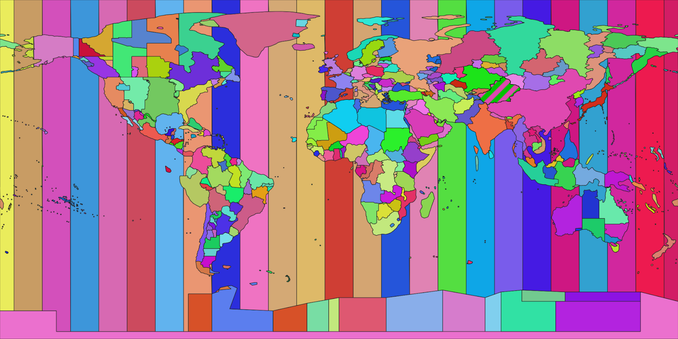
To get us started hereโ€™s a map of the world as segmented by the tz database.

1/
2/ Before we go full #geoweirdness , a bit of #geoeducation

Time zone information is tracked by the "tz" database, a fascinating, open-source project worth learning about!

https://en.wikipedia.org/wiki/Tz_database

Most countries have simple time zones, generally based on the sun's position relative to the region's positions on the Earth's surface. However, time zones also involves political and historical factors, and thus they don't always correspond to the longitudinal lines on the globe.

tz database - Wikipedia

3/ Let's get into the #geoweirdness

We start with countries where the time zone doesnโ€™t fall on the hour, usually changing with increments of 15 minutes.

Examples include Chatham Standard Time (UTC+12:45) and India Standard Time (+05:30).

Time in India ๐Ÿ‡ฎ๐Ÿ‡ณ is worth a thread in itself, though. For example, Bombay Time (+4:51) was used in 1884 (!) and is still used by some Parsi fire temples in Mumbai.
https://en.wikipedia.org/wiki/Bombay_Time

Bombay Time - Wikipedia

4/ Some countries like China ๐Ÿ‡จ๐Ÿ‡ณ use a single time zone (UTC+08:00), regardless of geography.

This timezone makes sense for Beijing, but not for western territories of the country. This leads to the odd situation that when you cross the border from China to neighbouring Afghanistan ๐Ÿ‡ฆ๐Ÿ‡ซ you change time by 3 hours and 30 minutes.

https://en.wikipedia.org/wiki/Time_in_China

#geoweirdness

Time in China - Wikipedia

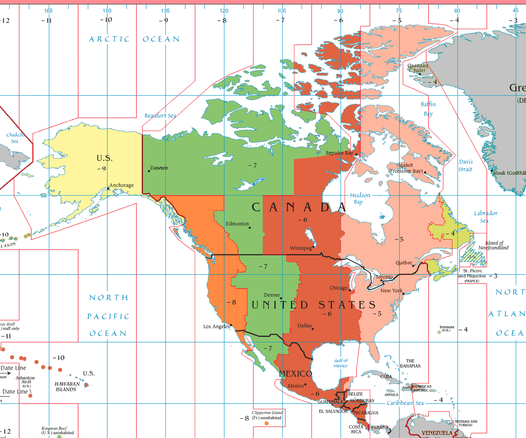
5/ Other "wide" countries like the US ๐Ÿ‡บ๐Ÿ‡ธ have multiple time zones. Local rules can lead to all sorts of #geoweirdness

Consider Arizona. Due to sunny climate, the state does not observe daylight savings time. Except of course within the Navajo Nation, which thus has a different time from the rest of the state for half the year. But of course the Hopi Reservation, an enclave within the Navajo Nation does follow DST. So you change tz six times by taking Route 264!

https://en.wikipedia.org/wiki/Time_in_Arizona

Time in Arizona - Wikipedia

6/ Equally odd is the US ๐Ÿ‡บ๐Ÿ‡ธ state of Indiana. Most counties in the state use Eastern Time, UTC-05:00.

Emphasis on the word "most"! 12 of 92 counties, however, observe Central Time, meaning their inhabitants are one hour behind their counterparts.

Even more interestingly, these counties are split in opposite corners of the state.

https://en.wikipedia.org/wiki/Time_in_Indiana

#geoweirdness

Time in Indiana - Wikipedia

7/ There are some places on Earth where three time zones meet in a single point.

The most well known spots are possibly in ๐Ÿ‡ฆ๐Ÿ‡บ Australia's outback.

Readers who enjoy a bit of postcode madness with their time zone oddities (who doesn't) will particularly enjoy Australian postcode "0872" which spans multiple timezones as it covers parts of South Australia, Western Australia, and the Northern Territory.

#geoweirdness

8/ Time zones and especially DST rules change frequently. And sometimes with only minimal notice!

Last year there was major confusion in Lebanon ๐Ÿ‡ฑ๐Ÿ‡ง due to last-minute (pun intended) disagreement as to whether to follow DST or not.

https://www.bbc.com/news/world-middle-east-65079574

In 2011 Samoa ๐Ÿ‡ผ๐Ÿ‡ธ shifted from one side of the International Date Line to the other, skipping the entire calendar day of Friday, 30 December 2011 in the process

https://en.wikipedia.org/wiki/Time_in_Samoa#2011_time_zone_change

#geoweirdness

Lebanon time zones: Partial clock change causes confusion

The time of day is a matter of dispute because of a row between political and religious authorities.

9/ Time can be a very political.

Spain ๐Ÿ‡ช๐Ÿ‡ธ currently uses Central European Time, a change made by dictator Franco in 1940 to align with Nazi Germany. The change was never reverted and has become subject to much debate.

Some feel this causes Spainโ€™s โ€œlate-night culture,โ€ and are pushing for a change to boost productivity.

https://en.wikipedia.org/wiki/Time_in_Spain#Criticism_of_the_use_of_Central_European_Time

Portugal ๐Ÿ‡ต๐Ÿ‡น actually switched to CET in the early 90s but then reverted due to public dissatisfaction

https://en.wikipedia.org/wiki/Time_in_Portugal#Switch_to_Central_European_Time

#geoweirdness

Time in Spain - Wikipedia

@opencage There are plans to abolish daylight saving time in Europe. I don't particularly disagree, but I think we (the Netherlands) should join GMT (which then becomes UTC) as the Benelux, France and Spain already "naturally" fall into that timezone.
@IIVQ @opencage
On the other hand, a few years ago Greet Wilders suggested abolishing winter time ๐Ÿคช

@MennoWolff @opencage Which is essentially the same.
I remember voxpop at the time, where the question "Which do you prefer, winter or summer time all year long" was answered by "Eeehm, I prefer summer time! Nice and warm!"

๐Ÿ˜ 

@IIVQ @opencage
Well, strictly speaking, DST is the switch to summer time.
I think the formal discussion was about no longer changing the clocks twice a year, but that brought up the question which time to keep. For me, it seems obvious to stick to the time zone that's closest to our sun time, but some geniuses thought summer time is best because of the reason you just mentioned. ๐Ÿ˜
@MennoWolff @opencage Many people want us to align with German time for ease of trade, which I see as a logical thing, but it sets us at a very early pace. Also, it was ze jermans who set our time back 40 (ok, 39ยฝ) mintes in 1940: https://nl.m.wikipedia.org/wiki/Amsterdamse_Tijd
Amsterdamse Tijd - Wikipedia

@IIVQ @MennoWolff gerne doch, nichts zu danken.
@opencage @MennoWolff I was gonna say something about someone being 80 years รกnd 40 minutes 30 seconds late in returning a bicycle, but let's not go there ;-) #EU
@IIVQ @opencage
๐Ÿ˜‚๐Ÿคฃ
Wo ist der Bahnhof??