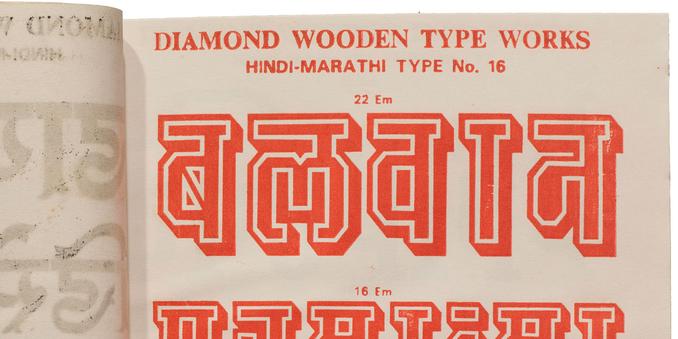
Roughly hand-bound in blank covers, two specimen books nonchalantly contain a wealth of fascinating type history, from both India and the West. When we first acquired these catalogs, we were struck by the range of styles and scripts represented, and knew there was a story to tell. So we sent our Indian correspondent, @tanyatypes, to shine a light on some Diamonds. https://letterformarchive.org/news/diamond-wooden-type-works/
#WoodType #TypeSpecimens #Typography #IndianDesign
This Just In: Diamond Wooden Type Works

An untitled catalog and some tiny wood blocks from India invite us to rewrite type history.

Letterform Archive
One surprise that first drew us to the catalogs: some of the faces shown are wood type conversions of designs originally made in film and rubdown formats of the 1960s–70s. Diamond shows loose interpretations of at least six late-20th-century typefaces. For example, Davida (https://fontsinuse.com/typefaces/6793/davida) with shadow, and Spring (https://fontsinuse.com/typefaces/31493/spring). They aren’t mere facsimiles of their sources; Diamond produced their own size-specific variants, redrawing smaller fonts to be broader and more open.
Davida in use

Designed by Louis Minott and named after his son David. Winner of a VGC competition in 1965 and released as Davida Bold. Possibly inspired by Victorian-era designs such as Ringlet and Hogarth. Minott received $1,000, but no royalties [OH no]. Alternates for ‘AEF 123456789 &$’ [VGC specimen]. Aliases include Silva [Mecanorma 1970], Garth (by Facsimile Fonts) [Berthold 1974], and Da Vinci Bold [Compugraphic 1976]. Carried by Formatt as Davida Bold [Formatt 1974] and later as Darling [Formatt 1978]. See also Yardley. English Type No. 28 is an open and shaded wood type adaptation by Diamond Wooden Type Works. Most digital versions lack the alternates but Bitstream’s uses different forms than the others. Peter Wiegel’s open-source Sylvar (2016) has the alternates included in Mecanorma’s Silva, but is of poor quality. Nick Sherman’s faithful and complete digitization Minott Davida is unreleased. See also Casserole, Ohno’s “resuscitation” from 2023.

Fonts in Use
Another surprise: how the type was made. @tanyatypes acquired a set of handcut rubber stamps from the company and interviewed former employees. Rather than using a pantograph to trace a pattern and cut type with a mechanical router, as was common in the West (https://printinghistory.org/virgin-demo/), workers would cut these stamps by hand, then use them to mark a mirrored letter on wood blocks that were then chiseled by hand to create the resulting type.
Wood Type Fabricating Demo - American Printing History Association

Geri McCormick & Matt Rieck: “Making Wood Type Today: Using the Same Methods from Yesteryear” 9 am-noon thursday, october 22 Geri McCormick & Matt Rieck hosted a…

American Printing History Association