 Patricia Aas
1/ Fine. Milton Friedmans: The Optimum Quantity of Money
For the record: It is my opinion that this man should've stood trial for crimes against humanity.
1/ Fine. Milton Friedmans: The Optimum Quantity of Money
For the record: It is my opinion that this man should've stood trial for crimes against humanity.
5/ Part 3: "Effect of Once-and-for-all change in the nominal quantity of money"
A helicopter drops 1000$ on the society (for real it says that)
Everyone thinks this is a freak one-off event
By yet another freak accident, everyone gets exactly the amount they had before, effectively doubling their money.
He now assumes they will all spend it
"The assumption that he was in a stable equilibrium position before means that he will now want to raise his consumption and reduce his cash balances until they are back at the former level" (this guy is a trip)
They can only trade with each other. So when one spends another gains (which tbh should cause that person to need to spend more which would cause someone else to get more and they'll all just go nuts in some messed up infinite loop?)
Basically he just draws the conclusion that "obviously" prices will double.
8/ Part 5: "Effect of a continuous increase in quantity of money"
New scenario: "Money rains down from heaven at a rate that produces a steady increase in the quantity of money, let us say, of 10% per year."
And of course (?????) prices increase by the same amount annually.
This part is hard to understand, but I think he's saying that you will spend more because you know your money will be worth less over time?
Dear lord, if our main character got half his money destroyed he would just consume less to fill up his bank account to the equilibrium level again. He'll be happy to do it.
I don't know, something about the fact that he knows the helicopter will come makes him use 1 dollar and 10 cent, apparently this is so obvious we'd all do it, but I don't even understand the text.
Prices increase by 10% per year and he's decreasing his holdings to 1/12th of his yearly income... For reasons?
Oh wait I missed a bit: prices rise because people think prices will rise?
bbl
10/ Cont. Part 5: "Effect of a continuous increase in quantity of money"
Apparently there is a "equilibrium path of prices" I guess that is our magic price increase (inflation). Basically a magic force will manipulate all of the actors back to their original states.
Ok... you need to reduce the money in the bank by 20% (to 1/12 of yearly income) to... mumble mumble something equilibrium. Then after that balance has returned to the force and everyone can continue with 10% increase a year.
And some stuff about overspending and underspending while you try to hit your perfect spending which is 10% per year.
Some people might've gotten richer than others and a very confusing story about an errand boy.
11/ Part 6: "Welfare effects"
Our hero is now worse off because he has less money in the bank (for reasons that allude me, but Friedman thinks are obvious) and... "He has a lower real income because productive resources have been substituted for cash-balances, raising the price of consumption services relative to the price of production services."
I don’t understand, feel free to explain it to me. Anyway, lets continue.
Ah, he is trying to play with functions so apparently the bank account thing is wealth and is a part of the "utility function" and the income thing something something "production function".
Oh dear I'm losing interest...
We'll put a pin in it. I'll pick it up tomorrow, maybe I can muster more interest in the worst Star Trek episode ever then.
12/ Cont. Part 6: "Welfare effects"
Ok, I'm back. Lets try it again!
I thnk where he lost me was with the errand boy story in the previous section. So lets look at that.
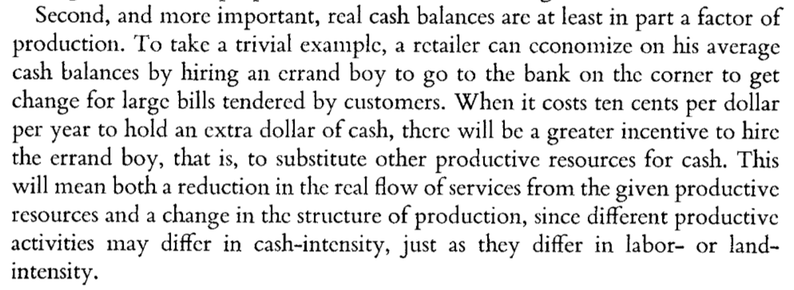
14/ Return to Part 5: "Effect of a continuous increase in quantity of money"
So maybe it's my English not being at native speaker level, but I can't parse that. Can anyone explain what it is that he is saying?

 Joxean Koret (@matalaz)