 Sean Jones KC
Listening to James Timpson's interview (link at end of thread), it is clear that he would like to see a sea-change in sentencing policy. That will not be his remit, but if the new PM supports such a change, I think it would have very significant ramifications for our political culture. Let me explain. /1
It would take a brave government to announce that it wanted to send fewer people to jail or to send them there for shorter sentences. It immediately allows the opposition an attack line: the Govt is soft on crime and there will be more of it as a result. /2
By contrast, the expectation is that creating new offences and pushing endlessly for "tougher" sentences will play well with the public. If you can drum up a little fear while you're at it, it will boost the benefit to be had from ever more exaggerated "toughness". /3
The further expectation is that whilst the public craves toughness, it will never ask whether the criminal justice system is sufficiently resourced to operate fairly (or, indeed, at all). Nor will it worry much, if at all, about prison places or conditions. /4
That makes toughness cheap. The public rarely even asks if tougher sentences do, in fact, deter criminals or make it less likely that they will re-offend*. Why ask? Aren't those propositions obvious?
*There are other possible justifications for a prison sentence which I do not address here. /5
Way back, in my university days, I took a course on Criminology and Penology. I was taught by the great Andrew Ashworth and Roger Hood. It was eye-opening. The studies we looked at did not suggest that tougher sentences had the deterrent effect I had assumed they would. /6
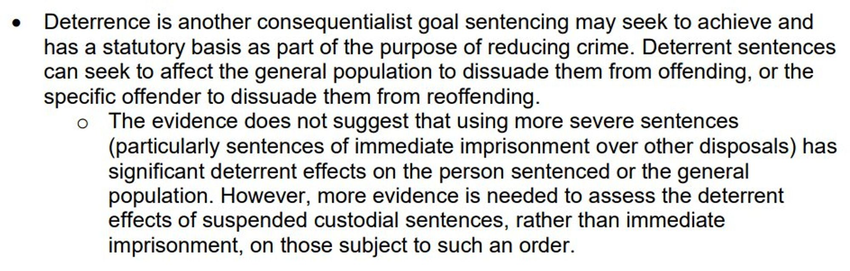
This has always been a controversial question. There has been some recent work. This is one of the key findings of the report prepared in 2022 for the Sentencing Council /8
I remember reading interviews with burglars. When asked whether they would be deterred by the thought of long prison terms, their answer was essentially: "It would if I thought about it, so I don't think about it". /9
Things were not as simple as I had thought they were. That was because people were not simple. It made me sceptical of "simplism" in politics more generally /10
So much populist authoritarian politics is aggressive simplism. There's a problem, say not enough houses. The reason is obvious, too many people. The answer is obvious, fewer people - stop immigration. How do you stop that? Get tough. Deter migrants. It's simple. It's obvious!/11
Lurking underneath the populist authoritarian preference for tough measures is (for me), a genuinely fascinating question. Why isn't it dented by evidence? If you really want to deter crime, why do something that evidence suggests is ineffective? /12
I don't have a complete answer, but I think one element is that demanding "tough" measures makes the person demanding them feel "tough". It makes them feel in some way strong, in some way powerful. /13
So if Labour decides to take this on, it will need courage, a willingness to stare down the newspapers and TV stations that will attack their "weakness" and a strategy for defeating simplism. If it can do that, the populist authoritarian threat itself might recede. /14
It will require Labour to put faith in us, the voters, to look beyond our instincts and the comforting self-empowerment of tough-talking and instead focus on what does and does not, in reality, work. I'd love to think we deserve that faith /end
The Timpson interview:
https://www.independent.co.uk/tv/news/james-timpson-prison-minister-labour-b2575224.html

 Sneezy 💚 :antifa: 🏳️⚧️ 🖤
Hmm, this page doesn't seem to work for me, I can see no interview there.
But I found this 👇 where James Timpson talks to Krishnan Guru-Murthy, and around 18 minutes in he mentions prisons.

Timpson’s boss on upside-down management and business secrets
 MultiClassGeek
@SeanJones Repairing the Probation Service won't be easy, but it's quicker, cheaper and more cost-effective overall than building new prisons
 HighlandLawyer
@SeanJones There was a programme in Scotland a few decades back (the name of which escapes me just now) which in place of prison made criminals face the consequences of their actions through training classes, meeting victims, etc combined with a fixed routine regime. It was effective at preventing reoffending, & was "tough" to the extent that some said they'd rather just be locked up for 6 months. However it was ended by the usual combination of lack of resources & having to be "tough on crime".
 SamuelJohnson
@SeanJones British justice has always seemed backward and more intent on retribution, as well prone to miscarriages of justice. Sometime after the prosecution of the killers of James Bulger I saw a documentary on how Finland rehabilitated children who killed. The contrast w the brutality and populism of UK throughout was profound. Darren McGarvey's recent series The State We're In had an episode w similar contrasts, worth seeing if you missed (probably still on iplayer)