Regarding that "Ignore All Previous Instructions" meme:

https://disabled.social/@beadsland/112222480677859859

All around us are folk ignoring all previous instructions. Linguistic epicycles are all about redefining instructions to render us ignorant of their meaning. Project of forgetting lived history—lest it threaten power—is purposeful ignorance of instruction.

#Mourning those previous instructions—all those unfulfilled retrofuture promises of #perquisitive how-to manuals—is more than just denying what we've been told.

"You do you" is Eu-gen-ics. (@[email protected])

"So if anarchic forms of organization were predominant, then anarchic values must be predominant…" Well before this, #Andrewism states "[t]he state's existence has been 'justified', 'naturalized', & 'legitimized' through various means, including…the social contract…" Yet the above is an ahistoricization worthy of Rawls—asserting what "must be predominant" for abstracted forms of organization free of any lived histories of previously adopted values—let alone "powers, drives, and consciousness".

disabled.social

@beadsland

Oh, interesting. I had automatically interpreted it to mean "instructions" in a more specific way, like a reference to the propaganda drum-beat instructing us all to unquestioningly consume, conform, comply w/ status quo power structures...

Which I think makes it a *very* different meme than if one interprets it as an instruction to forget (ignore) lived experience, the lessons of history, etc.

@tunguska

The propaganda to consume is part of lived experience; our struggles to question that propaganda are lessons of history.

apropos:

https://zeroes.ca/@NilaJones/112698513791051657

This is Santayana:

https://disabled.social/@beadsland/112330650496588688

Only in #RentierSociety, we don't just forget the past—we forget the present. Whiteness is forgetting as civic duty. "This is not who we are," as purposeful ignorance.

This is the ahistoricism at the heart of my critique of Andrewism's take on anarchism: veil of ignorance won't fix us.

NilaJones (@[email protected])

It's so frustrating how we fix something in society, or partly fix it at least And then a few generations go by, and people don't remember how bad the problem was in the first place So they undo the fixes Used to be 75% of kids died from diseases before they grew up Then we got vaccines, then people didn't understand how bad the diseases had been, and now we've got antivaxxers running public health Used to be rivers caught on fire regularly because they were so full of petroleum pollution, crime was sky high because people's brains were full of lead, and when I visited LA I had to take showers twice a day, because I got a weird coating on my skin from the air Then we passed environmental laws, and now we've got all these people who think they can trust corporations not to poison them, and there's no need to make laws about it

zeroes.ca

@beadsland

I may be a bit over my head here, but I agree with all of that (at least insofar as I understand you).

I think I'm seeing, or maybe drawing, a distinction between the (inescapable?) *experience* of propaganda, the struggle to question it, and so forth, as part of lived experience and historical knowledge; vs accepting/rejecting it *as instructions per se*.

To my reading, the act of questioning the propaganda *is* an act of disregarding instructions. Not in the sense of forgetting, but in the sense of resistance. "Disregard instructions" to me reads as an exhortation to resist, disobey, reject; not to elide, forget, or deny existence or awareness of the instruction.

To stretch the LLM connection: lived experience, which is of course steeped in propaganda, is not "instructions" but "training set", the material from which one's responses are built. "Instructions" are commands to do this or not do that. The reading of "disregard previous instructions" that comes naturally to me is something like: "some user(s), (ie those in power), have told you to do certain things and behave in certain ways. You could... not, though". Which I don't *think* implies forgetting anything, nor necessarily segues into the (very real and important) dynamics of forgetting the past (and present, of which my go-to example is "what pandemic? Covid's over").

Uhh... if that makes sense.

@tunguska

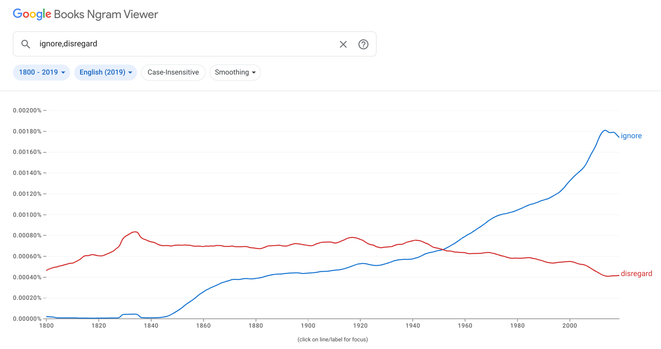
Subtle nuance to term "disregard" here. Though largely synonymous, to "disregard" is to treat as unworthy of notice, where to "ignore" is to be unaware, to pay no attention.

First evokes a sense of earned contempt for that which is disregarded; second a sense of blithe indifference.

Were meme "Disregard all previous instructions" (as, e.g., how Jakob on birdsite worded it on May of this year) we would not be having this discussion.

Since 2022, common formulation has been "Ignore…"

@beadsland

Huh. I find it intriguing that I had unconsciously altered the meme's wording in my recollection. 🤔

That said, my experience of the common usage of the word "ignore" very much includes situations in which one is very much *aware of* but makes no *outward reaction to* something.

"I saw <acquaintance> on the bus, and they stone-cold ignored me" specifically implies awareness and conscious non-response. To be unaware of an acquaintance's presence is absent-minded, oblivious, benign. To ignore them is a deliberate snub.

I wonder whether the meaning being conveyed and received in practice by most people passing this meme around is more like the technically correct "forget/unknow/delete from your awareness entirely" or more like a less-formal synonym for disregard, signifying roughly "remove from your (immediate) instruction set of (explicit) compulsions and prohibitions".

Like, if someone instructs me to take off my mask and I choose to neither acknowledge nor obey the command, I don't think saying that I "ignored" their instruction would strike almost any listeners in almost any context as nonsensical or self-contradictory, even in a conversation revolving around my experience of being given the command, the effect of that experience on my mindset and future decision-making, and so forth.

@tunguska

"stone-cold" is an affective assessment. Also, is a social inference made on non-behavior.

Myself, have trouble recognizing faces out of context. Someone might think am ignoring them, in the absence of my greeting them, because they're indistinguishable to me from any other random person am unaccustomed to being present on a bus.

The only certain affect here is on the part of the person judging this event a "snub".

That said, a purposeful ostracization might also be happening.

1/2

@tunguska

Yet, in such case, a pretense of unawareness—again, per git usage—is distinct from a revolutionary act. If anything, is a conservative, if not reactionary, act.

Again, near synonymous to suffice in speech acts—including speech acts instructing a GIGO machine—does not mean that difference in meaning is insubstantial.

Would "I ignored their instruction to take off my mask" be nonsensical? No.

Does more colloquial "I paid their instruction no regard" carry exact same sentiment?

2/2

@beadsland

I have no disagreement with characterizing the case of ignoring (pretending to be unaware of) a friend or acquaintance as a reactionary act.

But if we consider the case in which that which is ignored (perceived and known and rejected with a pretense of unawareness) is the instruction (backed at least by ableist dominance, if not state authority) to take off my mask? *That* I would consider to be a revolutionary act.

In my experience of day-to-day informal usage, "I paid their instruction no regard" would come across as a slightly stilted or formal-sounding way of conveying the same sentiment as "I ignored their instruction".

@tunguska

In what way does the passive aggression of such pretense overthrow a state of affairs?

As opposed to a momentary glare, shift in posture, or such other body language that indicates: Yeah, you need not infer anything. You've been heard. No compliance will be forthcoming.

Yes, disregard is already a stiltedly formal term. Far less messily overloaded by colloquial use.

One could also say "I pointedly ignored their instruction," to express that one did more than try to pass as unaware.