"Improving Schlick’s Approximation of the Fresnel Equations"
https://www.photometric.io/blog/improving-schlicks-approximation/
Improving Schlick's Approximation of the Fresnel Equations - Photometric.io

As a first test the Fresnel equations seemed like a good fit. These describe the reflection and transmission of light and are therefore very relevant for

Photometric.io
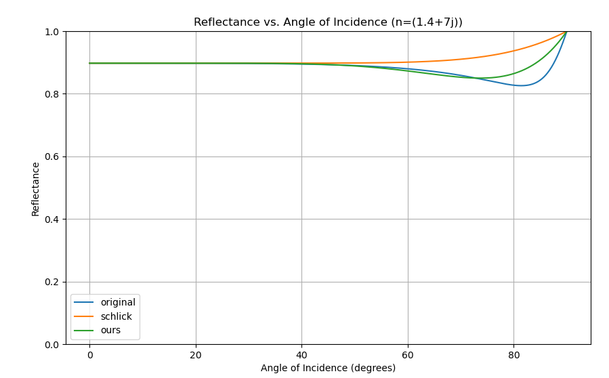
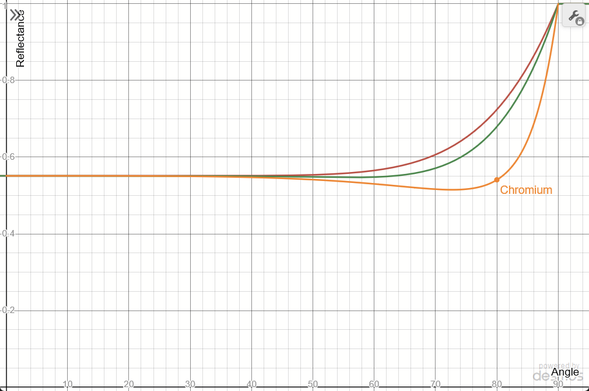
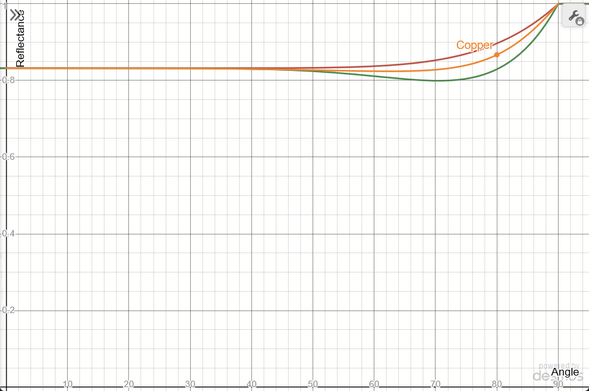
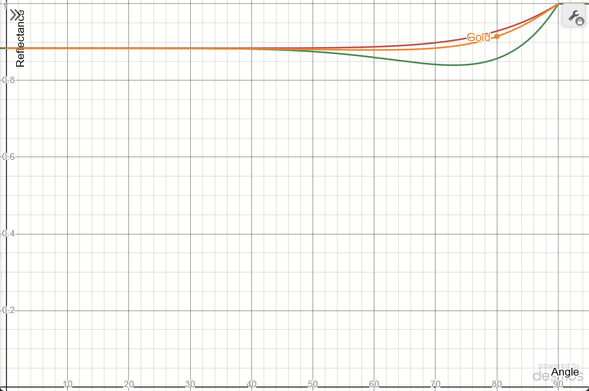
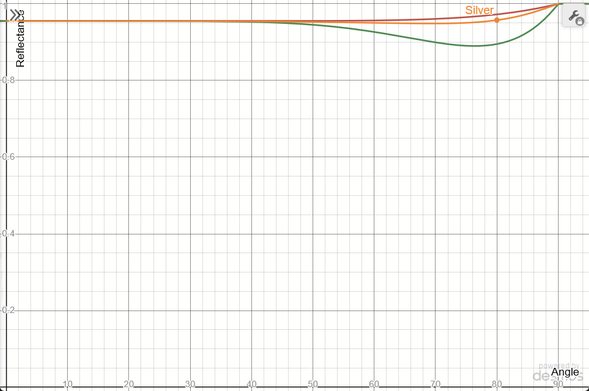
@shamanix Comparing it to Schlick on dielectrics I didn’t find the delta relevant. But on conductors, unless the dip around the 80 degrees is prominent it doesn’t do a great job at them, and for commonly authored metals it doesn’t do as well as Schlick. It doesn’t do much better on chromium which is a material Schlick is known to not reproduce well, it does better on aluminum (probably why it was shown), but on other conductors it isn’t much better and can be worse like on gold or silver.
@shamanix anyway, that’s what I found after some quick plotting of data after being awake too early to watch the F1 race 😅
@pzurita Thanx! I’ll pass that to a friend who wrote that :)
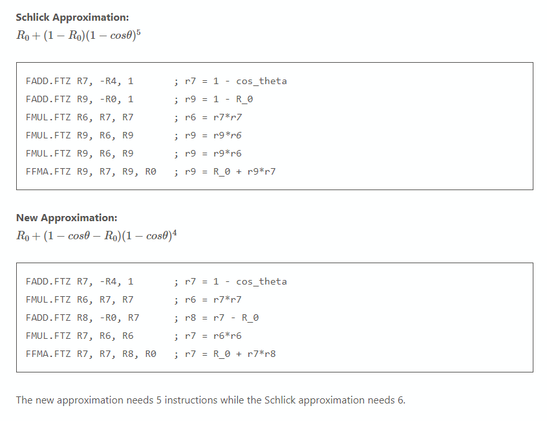
@pzurita @shamanix Hi, I'm the author. The fact that the approximation only depends on f0 and not a complex valued IOR (which also shapes the curve in different ways for equal f0s) makes it impossible to get a better match on chromium and will also mean it will be worse on other metals. At least for the example metal selection I randomly chose it has a lower error on average. For dielectrics it's indeed essentially the same approximation.
@nhauber @shamanix do you have the list of the random metals you selected? It would be nice to know examples of this approach working better than Schlick beyond aluminium. Having that info would help people like myself have a better understanding of the tradeoffs to make when choosing Schlick vs your new approach.
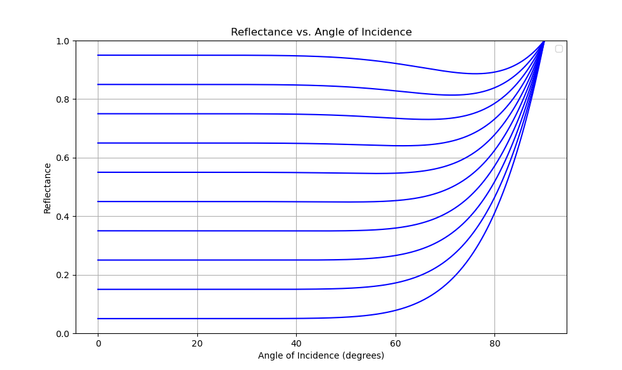
@pzurita @shamanix What could maybe interest you though is another still fairly simple approximation that also allows to control the shape via another parameter: f0+(1-f0-shape*cos_theta)*(1-cos_theta)^5
I've added some info in a "Controlling the Shape" section in the original blog post that explains what it does and its derivation.
@pzurita @shamanix Ok interestingly I just found a very similar approximation in literature (https://otik.zcu.cz/bitstream/11025/11214/1/Lazanyi.pdf). When setting alpha to 5 these are equal.
@nhauber @shamanix just in case you haven’t seen it @renderwonk goes over some approaches here https://youtu.be/kEcDbl7eS0w
Some Thoughts on the Fresnel Term

YouTube