 fossilesque
I just cited myself.
I just cited myself.
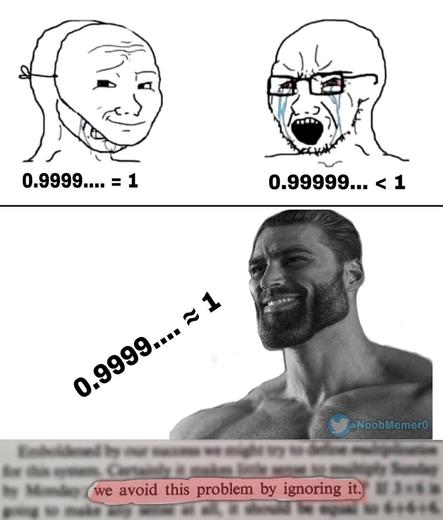
x=.9999… 10x=9.9999… Subtract x from both sides 9x=9 x=1
There it is, folks.
Somehow I have the feeling that this is not going to convince people who think that 0.9999… /= 1, but only make them madder.
Personally I like to point to the difference, or rather non-difference, between 0.333… and ⅓, then ask them what multiplying each by 3 is.
There are a lot of concepts in mathematics which do not have good real world analogues.
i, the _imaginary number_for figuring out roots, as one example.
I am fairly certain you cannot actually do the mathematics to predict or approximate the size of an atom or subatomic particle without using complex algebra involving i.
It’s been a while since I watched the entire series Leonard Susskind has up on youtube explaining the basics of the actual math for quantum mechanics, but yeah I am fairly sure it involves complex numbers.
i has nice real world analogues in the form of rotations by pi/2 about the origin.
Since i=exp(ipi/2), if you take any complex number z and write it in polar form z=rexp(it), then multiplication by i yields a rotation of z by pi/2 about the origin because zi=rexp(it)exp(ipi/2)=rexp(i(t+pi/2)) by using rules of exponents for complex numbers.
More generally since any pair of complex numbers z, w can be written in polar form z=rexp(it), w=uexp(iv) we have wz=(ru)exp(i(t+v)). This shows multiplication of a complex number z by any other complex number w can be though of in terms of rotating z by the angle that w makes with the x axis (i.e. the angle v) and then scaling the resulting number by the magnitude of w (i.e. the number u)
Alternatively you can get similar conclusions by demoivre’s theorem if you do not like complex exponentials.

 Valthorn