https://www.youtube.com/watch?v=Nqxjfp4Gi0k loving this. i kind of want to try making some of the 18°C stuff myself;

A #DIY make-at-home non-toxic Phase Change Material that can act as a thermal battery, like a cool pack. it stays at 18°C while it's going from frozen to solid or backwards. That means you only need to lower it to somewhere below 18°C to "charge" it for cooling.

This is a specific ratio of Sodium Sulfate + Table Salt (NaCl) plus something that turns it into a gel (optional but very recommended)


#PCM #chemistry #HeatWave

DIY Supermaterial Could Save You From Heatstroke: Salt based PCMs

YouTube

order placed ... what have i done ...

thanks to smaller amounts of the ingredients costing drastically much more, I will now have ... an amount ...

guess i'll offer some packs to my parents and maybe neighbours for roughly the price of the ingredients, then it won't be as silly

@timotimo Hi there! I am so glad to have found somebody from Germany attempting to reproduce this. It's all I can think about since I saw the video.

I'll be honest, I expected to find a DIY community around this, but I can't find anything. Either there is this one big caveat that he didn't talk about in the video or... It's too new? Seems weird.

Anyway, would you mind sharing what you ordered and your results? Once you have any, of course.

@Tillerino sure thing, I went with
"GOLDEN PEANUT Xanthan Gum Powder 1 kg" (since i need four teaspoons for every cup of the sulfate, this will last me for roughly the rest of my life), "Sodium Chloride NaCl – chem. – 1 kg" and "GLAUBER Salts 2.5kg Sodium Sulphate E514 Na2SO4 Water-Free Pharma Quality Nature" from the "dicleanshop" and "Pack of 12 Reusable Storage Bags, BPA-Free Reusable Freezer Bags" from "ideatech"

dicleanshop charges 5 euros for shipping for this order

needless to say the kilogram amounts are wildly out of whack, i'll have about 600 grams of the NaCl left, a boatload of the xanthan, and I'd have ingredients to fill many many more freezer bags than i bought.

this is already roughly 80 euros. i'll have to do some actual napkin math to figure out what the finished goop will cost per liter or gram, and how much filling per bag is good, then i'd know what a fair price for one bag would be.

i'll hopefully have the first pot made on the weekend

@Tillerino I may end up with serious egg on my face if it turns out there's a big caveat that makes this not nearly as good as NHIL suggests, but it'd be nothing like putting my life savings in JPEGs

@timotimo Whatever you learn from this will already be worth 80 bucks, I'm sure. There will be no egg.

Anyway, thanks for sharing, I'm excited to hear more.

@timotimo I did a small experiment yesterday with just a bit of sodium sulphate that I grabbed from the pharmacy.

Everything is very straight-forward, but Xanthan is not easy to work with. It will clump up very quickly and not dissolve any further. Somebody in the Patreon gave the following tip: Dissolve the Xanthan in a tiny bit of isopropyl alcohol before mixing it in. Supposedly that solves the whole issue.

@timotimo The result? There is definitely something there. I am ordering a larger quantity of sodium sulfate now :)

Something else I wanted to mention: This recipe is two parts sodium sulfate decahydrate and one part sodium chloride decahydrate on a molecular level. I love how works out so well in terms of cups.

Since he said in the video that you want to saturate the water with salt, I am guessing that it's two parts sodium sulfate decahydrate and one part fully saturated salt water.

@timotimo Sodium sulfate decahydrate is a well known PCM and this is what all the literature talks about - always _decahydrate_. You can find a ton of results when you search for exactly that term e.g. on google scholar. SSD has a melting point of 32C. Fully saturated salt water has a melting point of -19C. So I guess this is all that we're doing. Mixing those two to adjust the melting point and then stabilizing the mixture.

@Tillerino yeah, i think this is the concept of "Eutektikum", but i am lacking almost all the knowledge required to really understand the wikipedia article. Furthermore, the article Kältemischung, which covers many salt + water mixtures, mostly concerns itself with cooling down some water when you mix in the salt, and reaching the lowest temperatures possible ...

I actually wanted to get some isoprop the other day and found out i went to the wrong place entirely haha. I'm hoping intense whisking (with an electric kitchen mixer appliance) will do it for now, though i do want to get isoprop.

Still waiting for delivery of the powdery ingredients.

I have the silicone ziplock bags already and i've been using one with just regular tap water in it for cooling to evaluate how well the seal holds up. i haven't dared to put it between my back and the chair to see if it pops open ...

@timotimo I think the alcohol will be well worth it.

I think my bad first attempt didn't stabilize enough due to my Xanthan troubles. I could already feel a much weaker effect on the second cool->warm cycle.

I think getting a lot of ingredients is a good idea. I have no idea what I'm doing and there will probably be a few more learnings of this kind :D

@Tillerino do you know if there's anything i need to do to turn "water free" sodium sulfate into the decahydrate variant? i seem to recall reading that the reverse process is just "gentle heating" which releases the water from inside the crystal structure and it looks like the salt is melting, even though it's really just becoming a solution?

with my very limited knowledge and not looking very deeply into it, it seems like just saturating boiling water with sodium sulfate will give me the decahydrate form?

@timotimo I think the recipe does exactly that: turn the two powders into decahydrates by adding water. The recipe is in volume (cups or ml), so it's not very obvious. Fully saturated salt water is close to the decahydrate. I'm not sure if the same goes for the sodium sulfate, but I'll try to figure it out if I can find my napkin where I did my previous calculations :D

@timotimo Oh boy, chemistry math is not like regular math and I'm no chemist.

Yeah, but in the Video, he makes it very clear that you would fully saturate the water with sodium sulfate, so I guess it's exactly what you're saying.

💡 Of course: once the water is fully saturated with sodium sulfate, then it is also fully saturated by sodium chloride. So as long as the water is fully saturated and you roughly hit the ratio between sodium sulfate and sodium chloride, you're good!

Truly idiot proof

@Tillerino i always do my very best to circumvent "idiot proof" things. not necessarily always on purpose, though ...

@timotimo The Xanthan is the tough part, I think. I got all the stuff now. I might take a stab at it in a minute, but I don't have much time today.

Btw, I put all the numbers in a sheet here: https://docs.google.com/spreadsheets/d/10wo6-S3hEhiJECBhX55gvMOP0oQ2W8LggOjw-1t25n0/edit?usp=sharing

Weight is easier to deal with for me than volume. There's a scaler on top to adjust the batch size. You can just make a copy for yourself, if it's useful.

PCM

Sheet1 Scaled by,0.45 ml,ml,Density (g/ml),g,Molar Mass (g/mol),mol Water,1200,540.00,1.000,540.00,18.02,29.97 Sodium sulfite,240,108.00,2.664,287.71,142.04,2.03 Sodium chloride,60,27.00,2.170,58.59,58.44,1.00 Xanthan,20,9.00,0.800,7.20

Google Docs
@Tillerino do you happen to know if it significantly grows in volume from the xanthan or from the whole process? my cooking pot isn't huge :D

@Tillerino i checked before starting and my measuring cup gives me 200 ml instead of whatever the imperial standard cup is. So i used the cup and fractions of the cup as basis for measuring and used a little more than three teaspoons of xanthan gum instead of 4.

i'm definitely experiencing the clumping up you mentioned, and i think xanthan itself, or with some part of the mixture also built up on the bottom of the pot, which i had to scrape off. the isoprop is definitely worth a try, but i'll have to order that i think. If I do another attempt before that, i'll probably use an electric whisking machine instead of manually with a whisk first and a fork later. that might already make a big difference, too.

@timotimo I grabbed 100ml 70% isopropyl alcohol from the pharmacy for 4,50€. No need to order/wait!

So how did it turn out?

@Tillerino left it in the fridge over night, the goop has become pretty much solid. i have it between my back and the sack of my chair now and it's pleasant, but it's not hot enough in here to really benefit from it.

annoyingly, i don't have anything good to measure temperature with, so for now i'll have to go "feels over reals" with this project ...

@Tillerino additionally annoyingly our basement is warm rather than cold, and i don't think it's below 18degC so i can't try charging it "for free" with just the cold from the basement as others would be able to

@timotimo I finally got around to cooking a true first batch yesterday. My volume to weight conversion was off (I think because powders are lighter than the solid material). I ended up having to switch pots because I needed so much more water :D

Through the idiot-proofness (just saturate the water), it all ended up somewhat ok, though. But I think I ended up with too little Xanthan.

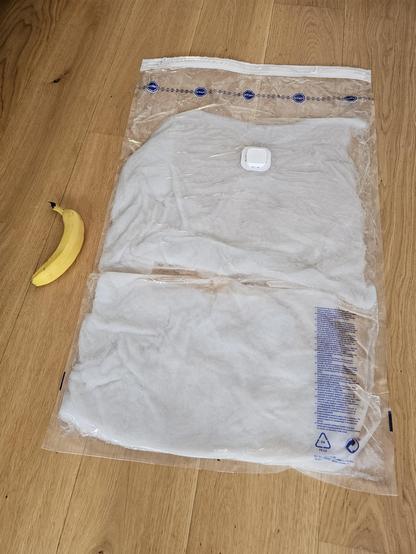
@timotimo I managed to make this monstrosity. It weighs 3kg and is an absolute beast. It plain refuses to go above 21-point-something degrees. I've had it out of the fridge for hours.

The material inside the bag is two sheets of kitchen hood filter stuff. Saw that by chance in the store. It's cheaper than a towel, but using a single sheet of material is definitely recommended.

This result is definitely encouraging and I'll make some more stuff soon.

@Tillerino on line you get under that price per liter, and I will hopefully be getting into some electronics projects in the future where isoprop is useful all the time so I might burn through 100ml way too fast...