 Lanky_Pomegranate530
And they never will
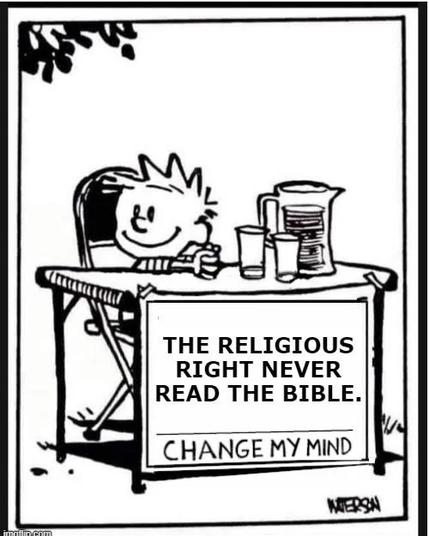
And they never will
The Jesus of the New Testament was a dark skinned communist who whipped the greedy and informed them they would go to hell if they didn’t stop being selfish fucks.
If the Jesus of the new Testament both existed and returned, the “Christian” right would be first in line to kill him again.
Assuming all the stories are true and accurate, Jesus from the Bible was a pretty chill dude and good human. His dad, on the other hand, makes Hitler look like Mr Rogers. So there’s that.
I used to believe it all, but the more I learned, the more I questioned, the more I questioned, the more it all fell apart.
Notable things that led to my deconstruction/atheism:
The sheer number of times the Bible has been edited. From key words omitted or added to entire books added or removed. It’s like a cobbled together series of Grimms Fairy Tales and Op Ed news articles by hundreds of people for over a thousand years. If it was real then why has it been edited and changed so much though history? Couldn’t a god that wrote that make it divine and unalterable.
The sheer number of contradictions.
The fact that there are countless thousands of other religions all claiming to be the only one. Most have their own books. Their own prophets. Their own stories. There’s a ton of overlap and commonality, almost as if they all pull from similar cultural stories. If any religion were true, wouldn’t that god have some way to make their religion the only one? And if you want to argue that it is a test of some sort then it’s a crazy test because it’s impossible to ever choose one out of thousands of clones and spinoffs.
If it is all true, why did the god need people to write a book to tell the story, but did it hundreds of years after the Jesus stuff and thousands of years after the creation stuff? Couldn’t the lore book have been created and existed on a little pedestal for all to see or something? What about the millions of people that died before it was written? What about all the people that have lived and died having never heard about it even once? It’s unfathomable.
If religion is good and right and moral then why are priests, pastors, and other religious leaders the ones committing so many SAs and other awful behaviors? Similarly, why is an entire political party so intertwined and permeated with religion while committing the most awful of actions?
Lastly, go read the old testament, specifically all the stories where the response to almost everything is murder and genocide. Like, one person commits some sin and the god just murders everyone and burns the whole city down. Seriously? That’s “good”? That’s worthy of belief and worship? The flood story. The Jericho story. The Sodom and Gammorah story. Etc etc. That god’s solution to everything is psychopathic mass destruction and death. You’d think a good god would come down and be like “Hey guys, let’s talk”.
Yeah, I get where you’re coming from. My dad was a real asshole as well. He’d literally rather leave me dying in a ditch than suffer a single word of criticism from me. Weird how that works, huh? Almost like there is some truth to the Bible after all…
Unfortunately, I can tell you from harsh experience that becoming atheist and deconstructing the entire faith isn’t going to lead to any sort of salvation at all, the only thing it’ll accomplish is your own undoing. It’s a very slow and agonizing death by a thousand papercuts.
I can tell you from harsh experience that becoming atheist and deconstructing the entire faith isn’t going to lead to any sort of salvation at all, the only thing it’ll accomplish is your own undoing. It’s a very slow and agonizing death by a thousand papercuts.
I deconverted two decades ago and nothing wrong came out of it. If anything, the immoral hypocrites who provoked problems from within the faith kept creating those problems and covering for each other, so things would have gone better if more people deconverted.
I’m sorry you weren’t in a good mental place to healthily finish the process though.
Thanks, I appreciate that. But I hope you do understand that this is not the average experience for the vast majority of people who become atheist, right?
Would you care to share what you may have done differently?
Just to be clear, I am by no means advocating for anyone to return to their parents’ church if they found it to be full of assholes and hypocrites. Rather, what I am saying is that unless you manage to live a more moral life than those you left behind, you aren’t likely to end up anywhere good in life, and to the extent you use atheism as an excuse for being a shitty person, you’ll be just as much of a hypocrite as those you condemn.
So just stick to your own values?
If you won’t find ethics in religion, you’ll find some by exploring philosophy. If you won’t find truth in religion, you’ll find some by learning science. If you won’t find a purpose without religion, reach out to people who are worthy of sharing a life with, enjoy art, try to make the world a better place. You will find a purpose far truer to you than any preacher could offer.
So just stick to your own values?
Not a good idea if your own values suck – and a lot of people end up using atheism as a an excuse to have shitty values because there is no God who will judge them for it.
The values Jesus espouses are fundamentally solid and worth imitating. The fact that many of his fan clubs do a terrible job at living them is not a testament to their futility, but rather, to the sheer difficulty of actually practicing them.
My point is basically that if you throw out your morals along with God, there is no hope for ever making it anywhere good in life. It’s true that you don’t HAVE to go to church to have morals, but unless you find them somewhere else, you’ll be no better than those fake Christians.
a lot of people end up using atheism as a an excuse to have shitty values
Citation needed. This is a total straw man argument.
“Morals” are a completely man made concept. With or without religion, it is immaterial. They did not and do not have to come from somewhere else. They come from us.
And what is and isn’t “moral” changes over time as society evolves. As I am positive you know, quite a few things in Judeo-Christian scripture were considered “moral” in their time but are now viewed as unquestionably heinous. Have you ever stopped to think why that is?
Citation needed. This is a total straw man argument.
Believe it or not, but it turns out studies on this actually exist.
Two U.S. M-Turk studies (Studies 1A and 1B, N = 429) and two large cross-national studies (Studies 2–3, N = 4,193), consistently show that disbelievers (vs. believers) are less inclined to endorse moral values that serve group cohesion (the binding moral foundations).
Specifically, disbelievers are less inclined than believers to endorse the binding moral foundations, and more inclined to engage in consequentialist moral reasoning. […] It seems plausible that the more constrained and consequentialist view of morality that is associated with disbelief may have contributed to the widespread reputation of atheists as immoral in nature.
Very interesting also that you’re showing the exact same behavior (i.e. consequentialist moral reasoning) in the remainder of your comment. This poses the question, if society were to evolve to consider rape, murder, and theft as excusable or even desirable behavior, would you go along with it?
As I am positive you know, quite a few things in Judeo-Christian scripture were considered “moral” in their time but are now viewed as unquestionably heinous.
What exactly are you referring to here? Slavery? Persecution of homosexuality and witchcraft? I’m sure I don’t need to tell you that the abolitionist movement was largely driven by Christians, while the other two causes were championed by atheists or non-Christians. I’ll leave my moral judgment of the latter aside so as not to unnecessarily inflame the discussion with reactionary rhetoric, but I will pose the question of whether in light of the rapidly declining birth rates in the west, homosexuality is a net good for society as a whole.
There is a widespread cross-cultural stereotype suggesting that atheists are untrustworthy and lack a moral compass. Is there any truth to this notion? Building on theory about the cultural, (de)motivational, and cognitive antecedents of disbelief, the present research investigated whether there are reliable similarities as well as differences between believers and disbelievers in the moral values and principles they endorse. Four studies examined how religious disbelief (vs. belief) relates to endorsement of various moral values and principles in a predominately religious (vs. irreligious) country (the U.S. vs. Sweden). Two U.S. M-Turk studies (Studies 1A and 1B, N = 429) and two large cross-national studies (Studies 2–3, N = 4,193), consistently show that disbelievers (vs. believers) are less inclined to endorse moral values that serve group cohesion (the binding moral foundations). By contrast, only minor differences between believers and disbelievers were found in endorsement of other moral values (individualizing moral foundations, epistemic rationality). It is also demonstrated that presumed cultural and demotivational antecedents of disbelief (limited exposure to credibility-enhancing displays, low existential threat) are associated with disbelief. Furthermore, these factors are associated with weaker endorsement of the binding moral foundations in both countries (Study 2). Most of these findings were replicated in Study 3, and results also show that disbelievers (vs. believers) have a more consequentialist view of morality in both countries. A consequentialist view of morality was also associated with another presumed antecedent of disbelief—analytic cognitive style.

 MacN'Cheezus
 Colonel Panic
 dual_sport_dork 🐧🗡️