 Fiona
FionaOf recent I have been looking into clinical guidance for menopausal women, and a few things bother me. Most notably is the approach of just prescribing to reduce symptoms, and the confusion around various cancer risks...
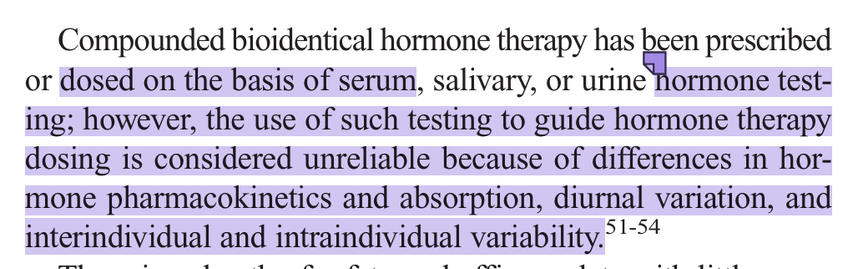
NAMS's 2022 menopausal HRT statement (doi:10.1097/GME.0000000000002028) has an entire section attempting to dissuade care providers from prescribing compounded HRT. In it, it suggests that dosing based on serum results may be unreliable. This misses nuance - it's only less accurate if timing of dose and the context of ROA are not taken into consideration. In trans healthcare, we do this by measuring serum levels either at midpoint or trough in cycle.
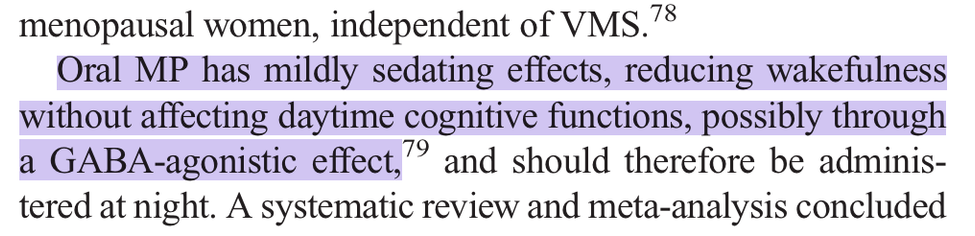
Guidance also suggests the use of oral progesterone in patients affected by sleeping disturbances, noting the "possibility" of GABA-agonstic effect. Oral administration doesn't produce meaningful P4 levels - Levine & Watson, 2000 (doi:10.1016/S0015-0282(99)00553-1) observed for 100mg po qd a max/avg of 2ng/mL and 0.14ng/mL, far lower than mean pre-menopausal levels and likely ineffective at providing hormonal benefit to the body. More bluntly - it's just sedating patients.
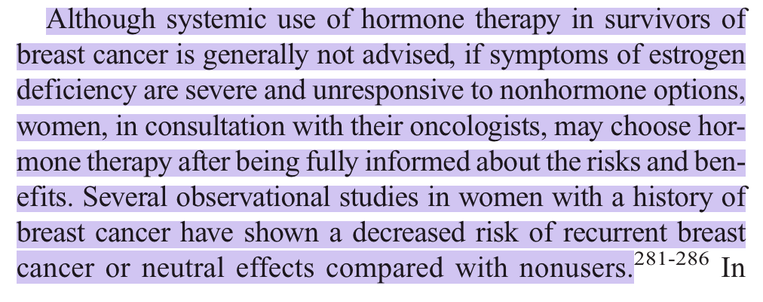
Impact of cancer risks are admittedly complicated due to many variables. The section of HRT use in breast cancer survivors is confusing, on one part hand waves "generally not advised" then proceeds to describe how several meta-analyses found a reduction of reoccurrence. I'm worried this phrasing may confuse providers, or encourage negative behaviours.
In more positive aspects of this guidance, it makes clear that decision making should be shared with patients, that taking HRT is best started early and ongoing, and discontinuation due to age is not required.