 Dr. Victoria Grinberg
#PaperTime from yesterday's #ArXiv
Steiner et al., incl. me + @astrobianchi
"An #IXPE-Led X-ray Spectro-Polarimetric Campaign on the Soft State of Cygnus X-1: X-ray Polarimetric Evidence for Strong Gravitational Lensing"
➡️ https://ui.adsabs.harvard.edu/abs/2024arXiv240612014S/abstract , ApJ accepted
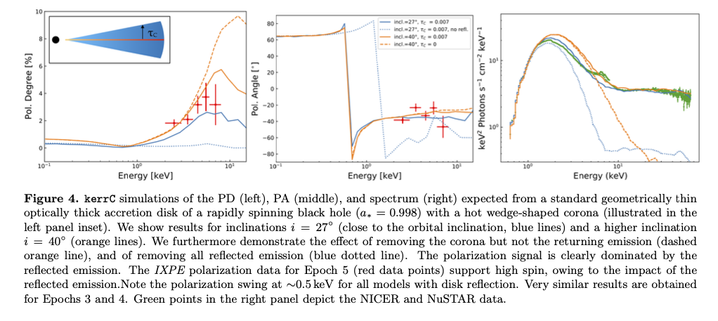
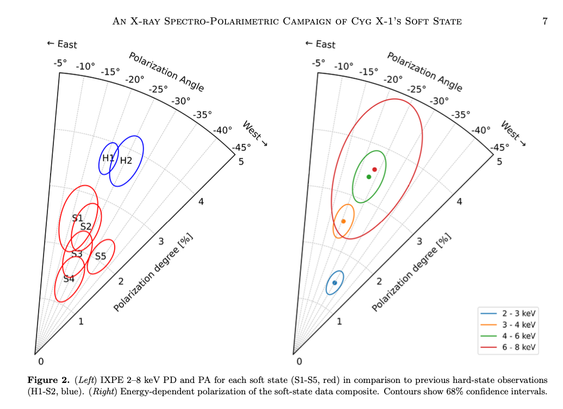
🤯 Soft X-ray polarization in the black hole X-ray binary Cygnus X-1 can be explained by returning radiation, i.e. radiation from the disk returning back due to GR effects & reflected off the disk!
1/3
An IXPE-Led X-ray Spectro-Polarimetric Campaign on the Soft State of Cygnus X-1: X-ray Polarimetric Evidence for Strong Gravitational Lensing
We present the first X-ray spectropolarimetric results for Cygnus X-1 in its soft state from a campaign of five IXPE observations conducted during 2023 May-June. Companion multiwavelength data during the campaign are likewise shown. The 2-8 keV X-rays exhibit a net polarization degree PD=1.99%+/-0.13% (68% confidence). The polarization signal is found to increase with energy across IXPE's 2-8 keV bandpass. The polarized X-rays exhibit an energy-independent polarization angle of PA=-25.7+/-1.8 deg. East of North (68% confidence). This is consistent with being aligned to Cyg X-1's AU-scale compact radio jet and its pc-scale radio lobes. In comparison to earlier hard-state observations, the soft state exhibits a factor of 2 lower polarization degree, but a similar trend with energy and a similar (also energy-independent) position angle. When scaling by the natural unit of the disk temperature, we find the appearance of a consistent trendline in the polarization degree between soft and hard states. Our favored polarimetric model indicates Cyg X-1's spin is likely high (a* above ~0.96). The substantial X-ray polarization in Cyg X-1's soft state is most readily explained as resulting from a large portion of X-rays emitted from the disk returning and reflecting off the disk surface, generating a high polarization degree and a polarization direction parallel to the black hole spin axis and radio jet. In IXPE's bandpass, the polarization signal is dominated by the returning reflection emission. This constitutes polarimetric evidence for strong gravitational lensing of X-rays close to the black hole.