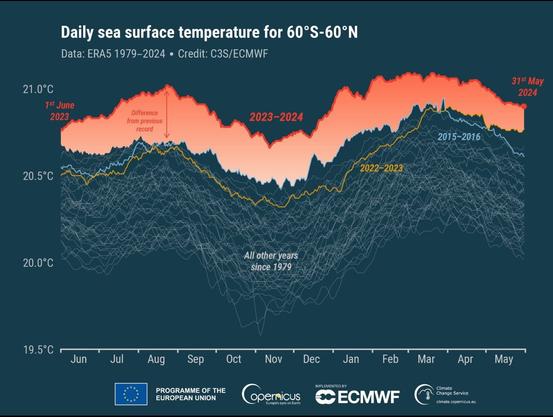
It’s not only Earth’s atmosphere that is warming very rapidly. Perhaps even more worrisome is the tremendous amount of change occurring in our seas.

More than 90% of the excess heat trapped in the Earth system due to human-caused global warming has been absorbed by the oceans, which currently store 50 times more carbon than the atmosphere and 20 times more than land plants and soil combined.

It’s not certain, however, how long this ratio can be sustained. As the ocean continues to heat up like the rest of the planet, its waters are projected to become *less* efficient at taking in carbon dioxide and may release it back into the atmosphere more rapidly.

Also, the more CO₂ the ocean absorbs, the more acidic its chemistry becomes. After years of working overtime to take in some of the excess carbon we’ve pumped into the atmosphere, ocean acidification has already increased 30% compared to pre-industrial levels, and could increase an additional 120% in the decades ahead. That, in turn, could lead to severe disruptions in the worldwide food chain, followed by famine and starvation such as we’ve never seen.

I wish I was exaggerating. But I’m not. We are in grave danger.

#Science #Environment #Climate #ClimateChange #ClimateCrisis #ClimateEmergency
@breadandcircuses

> I wish I was exaggerating. But I’m not.

Plainly stated. If anything, this is too calm a telling.

> We are in grave danger.

We sometimes hear "grave" as a kind of synonym for "strong". Here I think it is intended literally.

We don't have to wait for the temperatures to go up more for the danger to be existential. Food chains can start failing at any time.

> ... could lead to severe disruptions in the worldwide food chain ...

I recommend using "will" here. Could seems too weak. And I think you and I both would be thrilled to have someone actually prove "will" is not the correct modal. I doubt it would be possible, and I think it the more likely-correct word. By what possible mechanism could it NOT lead to these things?

> ... followed by famine and starvation such as we've never seen.

It's hard to say this with appropriate seriousness. It's hard to visualize, so people probably don't. I look at images of Gaza, or the aftermath of hurricanes, where people are rummaging rubble that could not possibly be the source of food growth, where there is only the shards of food from before a disaster, mixed with rubble, and try to use such scenes in my mind to visualize what a world where there is no seafood or no crops that didn't fail would look like. Even that is probably not adequate.

I'm surprised you didn't write this in all-caps, as if there was ever an occasion to scream at the top of one's lungs, this is it. And yet we as a society tend to shrug off yelling as crazy talk. The boy who cried wolf has really done us in on this one, I guess.

I hope your softly stated warning will be heard with all due urgency. Thanks for writing it, as always.

@breadandcircuses

Today June 10th 2024 it rained like end of September and the temperature was 11 deg C here in the Netherlands. Planting vegetables in the garden is for now not very successful due to continuous fierce rain showers as I never have seen and way too cold... I am truly worried...

@breadandcircuses Don't forget also that warm ocean water = hurricane food.
@breadandcircuses
I am so worried for my grandchildren. We are busy destroying their future