 Hotspur🏳️🌈🇺🇦
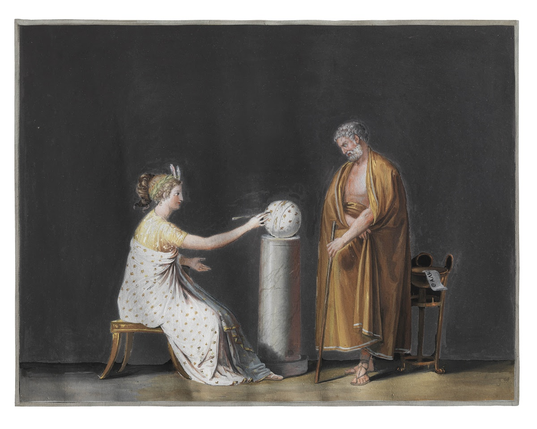
"Urania, the Muse of Astronomy, Reveals to Thales the Secrets of the Skies," Antonio Canova, 1798-99.
Canova (1757-1822) was better known as a Neoclassical sculptor. And I'll admit...as a painter, he's a great sculptor. But despite whatever technical deficiencies this may have, I find it a sweet and charming scene. It may have been a study for a proposed sculpture that never got off the ground.
The son of a stonemason, Canova was a busy sculptor pretty much as soon as he was old enough to pick up a chisel. By 1800 he was Europe's most celebrated sculptor, patronized by Napoleon (who was sculpted, nude, as Mars), and created a statue of George Washington for the state government of North Carolina.
And Thales? Thales of Miletus (626/623 - 528/525 BCE) was one of Greece's Seven Sages, a philosopher who pioneered explaining the world through natural philosophy rather than mythology, and the use of mathematics, science, and deductive reasoning. This painting refers to his observations of the movements of the planets, which enabled him to be the first recorded person to predict an eclipse through scientific observation.
From the Museum Gipsoteca Antonio Canova, Possagno, Italy.
#Art #ItalianArt #AntonioCanova #Urania #Astronomy #ThalesOfMiletus #NotPerfectButCharming #NeoClassicism #Muse
 SunnJax 🌷🏳️🌈
 bill (pliny the older)
 Mark Lepper